Facts
Appellant No. 2, an employee of the Respondent-company, applied for voluntary retirement on medical grounds on 22.07.2015.
Source reference: para. 6He submitted a certificate from a Civil Surgeon certifying permanent incapacitation.
Source reference: para. 6At the time of application, he was 54 years old.
Source reference: para. 6Despite two reminders sent before he turned 55 on 10.12.2015, the Respondent remained silent.
Source reference: para. 7-8Only on 03.02.2016 (after the age threshold) did the Respondent demand a Medical Board certificate, which the Appellant provided within seven days.
Source reference: para. 9The Respondent accepted the retirement on 31.05.2016 but rejected Appellant No. 1’s (the son's) claim for compassionate appointment on 15.07.2019, citing that the employee had retired after the age of 55.
Source reference: para. 11The High Court of Bombay upheld this rejection.
Source reference: para. 12Issues
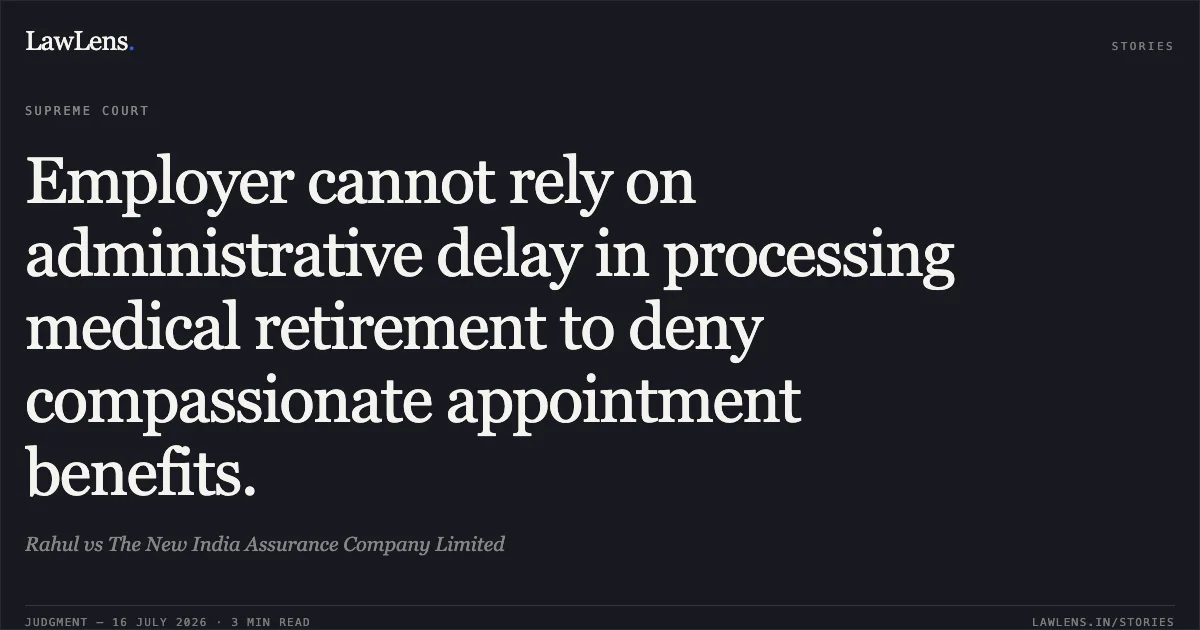
1. Whether an employer can deny a claim for compassionate appointment by relying on an age threshold crossed during the pendency of a timely application due to the employer's own administrative delay.
Source reference: para. 42. Whether the requirement of certification by a "duly appointed Medical Board" under Clause 1.1 of the Scheme must be communicated to the applicant within a reasonable time before the eligibility window closes.
Source reference: para. 21Law Applied
The Court applied Clause 1.1 of the Scheme for Compassionate Appointment in Public Sector General Insurance Companies, which requires medical incapacitation before age 55 to be certified by a Medical Board.
Source reference: para. 14It relied on Umesh Kumar Nagpal v. State of Haryana regarding the humanitarian object of compassionate appointment to tide over financial crises.
Source reference: para. 16Bhawani Prasad Sonkar v. Union of India, which emphasizes that while schemes must be strictly construed, they must be administered fairly.
Source reference: para. 17The Court applied the principle from Malaya Nanda Sethy v. State of Orissa that applicants should not suffer due to "absolute callousness" or delay by authorities.
Source reference: para. 19The equitable maxim from Kusheshwar Prasad Singh v. State of Bihar that a party cannot take advantage of its own wrong or default.
Source reference: para. 20Reasoning
The Court reasoned that while Clause 1.1 specifies "is retired" before age 55, it cannot be interpreted to allow an employer to control eligibility through "delayed processing".
Source reference: para. 26The Appellant acted with diligence by applying and providing a Government medical certificate four months before the deadline.
Source reference: para. 23The Respondent’s failure to communicate the specific deficiency (the need for a Medical Board vs. a Civil Surgeon certificate) until after the age threshold was crossed constituted a default in duty.
Source reference: para. 21, 25The Court held that a technical construction of the Scheme would place beneficial provisions at the mercy of administrative delay, thereby defeating the fairness inherent in such schemes.
Source reference: para. 26Since the Appellant complied with the Medical Board requirement immediately upon request, the delay was attributable solely to the Respondent.
Source reference: para. 25Holding
The Supreme Court set aside the High Court judgment and the Respondent's rejection order.
It held that the Respondent could not rely on the age-bar because the timely application was frustrated by its own inaction.
Source reference: para. 28-29The Court directed the Respondent to grant compassionate appointment to Appellant No. 1 within eight weeks.
Source reference: para. 32(iii)It further ordered age relaxation if Appellant No. 1 had crossed the upper age limit during the litigation and directed the payment of any unpaid dues to Appellant No. 2.
Source reference: para. 32(ii), 33Appellant No. 1 is entitled to monetary benefits only from the date of actual appointment.
Source reference: para. 32(iv)Acts & Sections Cited
1 provisions across 1 statute referred to in this judgment. Linked provisions open on LawLens.
Deposit Scheme for Retiring Employees of Public Sector Companies, 19911
Original Court PDF
RahulvsThe New India Assurance Company Limited
Click to open original judgment
Original judgment, available to read, download and summarize on LawLens.in


![Subsequent exoneration does not retrospectively invalidate a finalized promotion select list.. UNNIKRISHNAN M vs M/o Environment And Forests. CAT - ['Ernakulam']. LawLens](/stories/thumbnails/subsequent-exoneration-does-not-retrospectively-invalidate-a-finalized-promotion-select-li-ce80a0e84f2f4887857271e8b4341c42.webp)