Facts
The petitioner applied for the post of Constable (Driver) through the M.P. Professional Examination Board and was selected after clearing written and physical tests
Source reference: para 2Before joining, the petitioner submitted an attestation form disclosing a prior criminal case (ST No. 277/2011) but answered 'No' to whether the acquittal was based on benefit of doubt/compromise
Source reference: para 10Additionally, he submitted an affidavit on 23.04.2018 failing to disclose the case
Source reference: para 3, 24A Screening Committee found that while the case was mentioned in the form, the acquittal was not "honourable" or "clean" as the petitioner had been acquitted on the benefit of doubt because witnesses failed to identify him
Source reference: para 6, 22Based on the character verification report, the petitioner was removed from service on 15.11.2018 for suppression of material facts
Source reference: para 7, 10Issues
1. Whether the non-disclosure of the nature of acquittal in the attestation form and the failure to disclose the criminal case in the accompanying affidavit constituted a suppression of material facts warranting termination
Source reference: para 24, 262. Whether an acquittal based on the "benefit of doubt" in a case involving charges like rioting and obstructing public servants (u/s 147, 332, 353 IPC) entitles a candidate to appointment in a disciplined force
Source reference: para 16, 23, 27Law Applied
The court primarily applied the guidelines established in Avtar Singh v. Union of India (2016), which hold that information given to an employer must be true and any suppression regarding criminal antecedents allows the employer to assess suitability
Source reference: para 12, 25It further relied on Commissioner of Police, New Delhi v. Mehar Singh (2013) and UT Chandigarh v. Pradeep Kumar (2018), established that "honourable acquittal" is required for police service and that a Screening Committee’s assessment of suitability is final unless mala fide
Source reference: para 6, 23, 25The Court also referenced State of Rajasthan v. Chetan Jeff (2022), emphasizing that the trust and integrity of a constable are compromised by the suppression of material facts at the threshold
Source reference: para 25Reasoning
The Court reasoned that although the petitioner mentioned the case in one part of the form, he deliberately misrepresented the nature of his acquittal as "clean" by marking 'No' in the relevant field despite knowing it was based on the benefit of doubt
Source reference: para 24This intent to suppress was reinforced by the subsequent affidavit where he claimed no criminal cases had ever been registered against him
Source reference: para 24The Court observed that the underlying offences (stone pelting after an election) involved moral turpitude and were against the public at large, rendering him unsuitable for a disciplined force like the police
Source reference: para 18, 25Applying the Avtar Singh principles, the Court held that the department conducted an objective assessment via the Screening Committee and correctly concluded that a person who lacks transparency cannot be trusted with the duties of a police personnel
Source reference: para 23, 27Holding
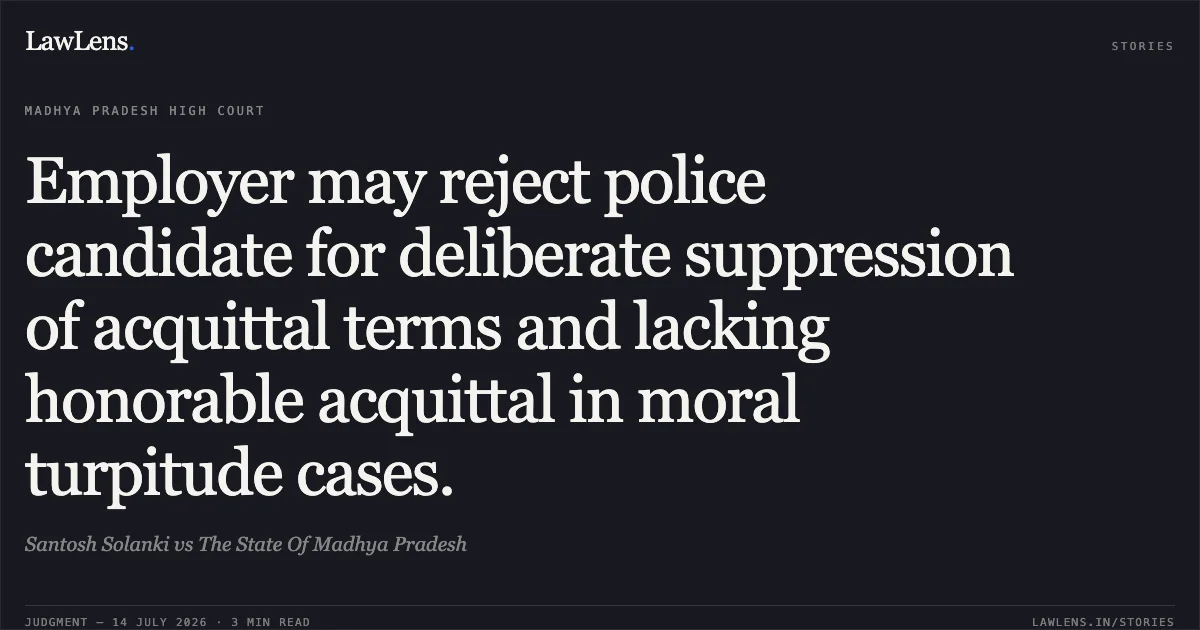
The Court answered the issues in the affirmative, holding that the petitioner was guilty of deliberate suppression and misrepresentation of material facts
It held that an acquittal based on the benefit of doubt is not equivalent to an "honourable acquittal" and does not automatically entitle a person to public employment, especially in a disciplined force
Source reference: para 23, 25Consequently, the High Court found no illegality in the termination order dated 15.11.2018 or the appellate order dated 06.11.2019 and dismissed the writ petition
Source reference: para 28Acts & Sections Cited
15 provisions across 1 statute referred to in this judgment. Each provision opens on LawLens.
Original Court PDF
Santosh SolankivsThe State Of Madhya Pradesh
Click to open original judgment
Original judgment, available to read, download and summarize on LawLens.in


![Subsequent exoneration does not retrospectively invalidate a finalized promotion select list.. UNNIKRISHNAN M vs M/o Environment And Forests. CAT - ['Ernakulam']. LawLens](/stories/thumbnails/subsequent-exoneration-does-not-retrospectively-invalidate-a-finalized-promotion-select-li-ce80a0e84f2f4887857271e8b4341c42.webp)