Facts
The claimant sustained fractures to the tibia and fibula of his left leg in a road accident on 9 May 2020.
Source reference: pp. 2–5, 9–10, 13–15He sought compensation under Section 166 of the Motor Vehicles Act, 1988, stating that he had been employed as a Senior Accounts Executive and had resigned because of his injuries.
Source reference: pp. 2–5, 9–10, 13–15The Tribunal awarded him Rs.10,18,934, including compensation for future loss of income based on 10% functional disability, but deducted Rs.1,60,000 in medical expenses reimbursed by his employer.
Source reference: pp. 2–5, 9–10, 13–15The claimant appealed under Section 173(1), seeking enhancement, including recognition of the doctor’s disability assessment and reimbursement of the medical expenses
Source reference: pp. 2–5, 9–10, 13–15Issues
1. Whether the claimant was entitled to enhancement of compensation, including on account of functional disability and amounts awarded under other heads
Source reference: p. 7, para. 122. Whether the Rs.1,60,000 in medical expenses reimbursed by the claimant’s employer should be included in the compensation
Source reference: pp. 10–15, paras. 20–25Law Applied
Sections 166 and 173(1) of the Motor Vehicles Act, 1988, respectively provide for a claim for compensation arising from a motor vehicle accident and an appeal against a Tribunal’s award
Source reference: pp. 2–3Compensation under the Act is guided by the principle of just and fair compensation.
Source reference: no citationThe Court considered New India Assurance Co. Ltd. v. Dolly Satish Gandhi and Another, which held that reimbursement under a Mediclaim policy purchased by a claimant is independent of compensation under the Act and is not to be treated as a “double benefit”
Source reference: pp. 10–13, paras. 20–21It also noted the claimant’s reliance on V. V. Pradeep v. Avinash Sadakale and Another
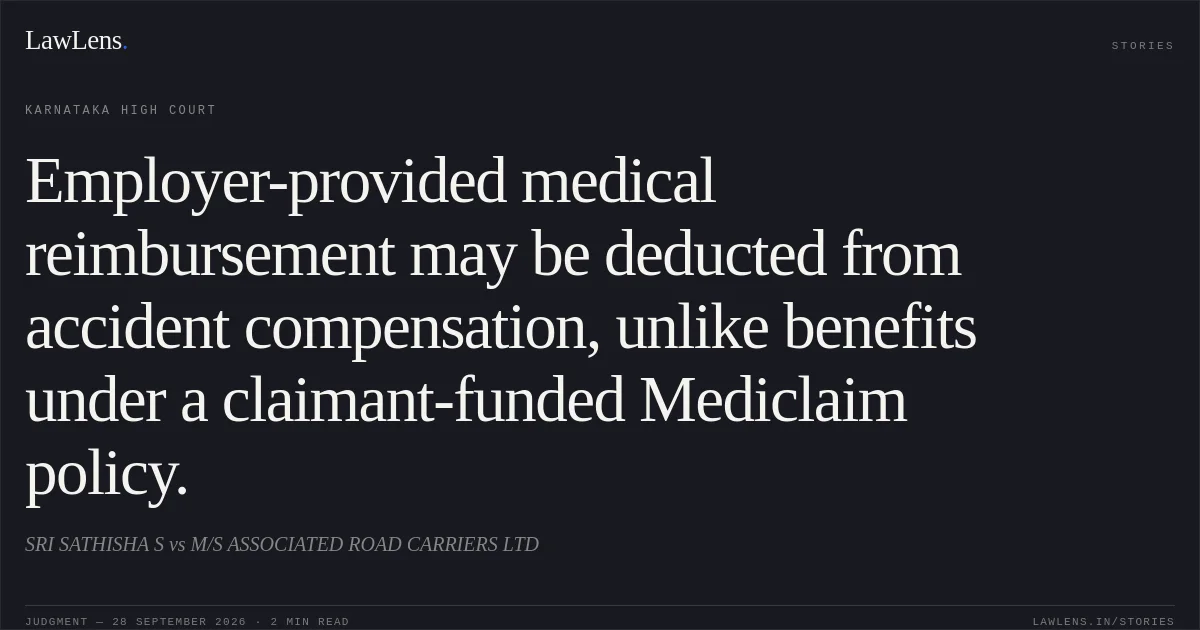
Source reference: p. 6, para. 9The Court distinguished the Mediclaim principle where the medical reimbursement was provided by the claimant’s employer rather than under a policy purchased by the claimant
Source reference: pp. 14–15, paras. 24–25Reasoning
The Court found that the claimant had not established that his work required long-distance travel or that his injuries prevented him from performing his accounts work while seated.
Source reference: pp. 8–10, paras. 15–19The employer’s witness also confirmed that the claimant had not been removed for continuous absence, and the evidence showed that he worked after the accident in May 2020.
Source reference: pp. 8–10, paras. 15–19The Court therefore declined to enhance the compensation based on the doctor’s disability assessment or the asserted resignation
Source reference: pp. 8–10, paras. 15–19It also rejected the argument that the employer-reimbursed Rs.1,60,000 should be added to the medical expenses, distinguishing the cited Mediclaim decision because the reimbursement here was provided by the employer, not under a policy purchased by the claimant
Source reference: pp. 13–15, paras. 21–25Although it observed that the Tribunal had awarded less under pain and suffering, loss of amenities, and loss of income during the laid-up period, it found no occasion to reassess those heads in view of the compensation already awarded for future loss of income
Source reference: p. 15, para. 26Holding
The Court answered the enhancement question in the negative and dismissed the appeal.
The Tribunal’s award of Rs.10,18,934 with interest at 6% per annum remained undisturbed
Source reference: pp. 7, 15–16, paras. 13, 26–27Acts & Sections Cited
2 provisions across 1 statute referred to in this judgment. Each provision opens on LawLens.
Motor Vehicles Act, 19882
Original Court PDF
SRI SATHISHA SvsM/S ASSOCIATED ROAD CARRIERS LTD
Click to open original judgment
Original judgment, available to read, download and summarize on LawLens.in
![Omission from service records alone cannot defeat a widow’s claim for compassionate-appointment consideration.. SMT ARISHI DEVI vs ORDNANCE FACTORY. CAT - ['Allahabad']. LawLens](/stories/thumbnails/omission-from-service-records-alone-cannot-defeat-a-widows-claim-for-compassionate-appoint-885232d4acd04973bf42ec35220c8374.webp)
![Compassionate appointment claims must receive a third consideration when previously considered only twice.. LALIT SHARMA vs D/o Post. CAT - ['Allahabad']. LawLens](/stories/thumbnails/compassionate-appointment-claims-must-receive-a-third-consideration-when-previously-consid-7df116bb81b1454bab2ecaddec606237.webp)
![Recovery of excess pay from Group C employees is impermissible absent fraud or misrepresentation.. Nand Kishor vs Ordnance Factory. CAT - ['Allahabad']. LawLens](/stories/thumbnails/recovery-of-excess-pay-from-group-c-employees-is-impermissible-absent-fraud-or-misrepresen-88f70f12f14a4437aa66e43a832afa9a.webp)