Facts
The applicant is the widow of Late Sh. Gujjar Mal, who joined Northern Railway in 1957 and was terminated in 1980 for participating in a strike
Source reference: p. 2Following the Hon’ble Supreme Court’s judgment in Union of India v. R. Redappa, the deceased employee was reinstated
Source reference: p. 2-3While his initial challenge for consequential benefits (O.A. No. 47/1996) was dismissed, a subsequent collective application (O.A. No. 4011/2010) was allowed by the Tribunal and upheld by the Supreme Court, directing the release of service benefits to similarly situated employees
Source reference: p. 3The respondents failed to release the benefits to the applicant’s husband during his lifetime, citing the non-availability of service records
Source reference: p. 3After his death in 2021, the applicant obtained the service records through an RTI request, yet the respondents continued to withhold the benefits, citing the finality of the 1996 dismissal and alleged suppression of facts
Source reference: p. 3-5Issues
1. Whether the applicant, as a widow, is entitled to the consequential service and pensionary benefits of her deceased husband despite the respondents' plea of missing service records.
Source reference: p. 6, para. 5.12. Whether the claim is barred by the principles of res judicata, suppression of material facts, or the finality of earlier adverse proceedings.
Source reference: p. 6, para. 5.1 & p. 7, para. 5.6Law Applied
The court applied Rule 14(2) of the Railway Servant (D&A) Rules, 1968, and the precedent set in Union of India v. R. Redappa regarding the reinstatement of employees
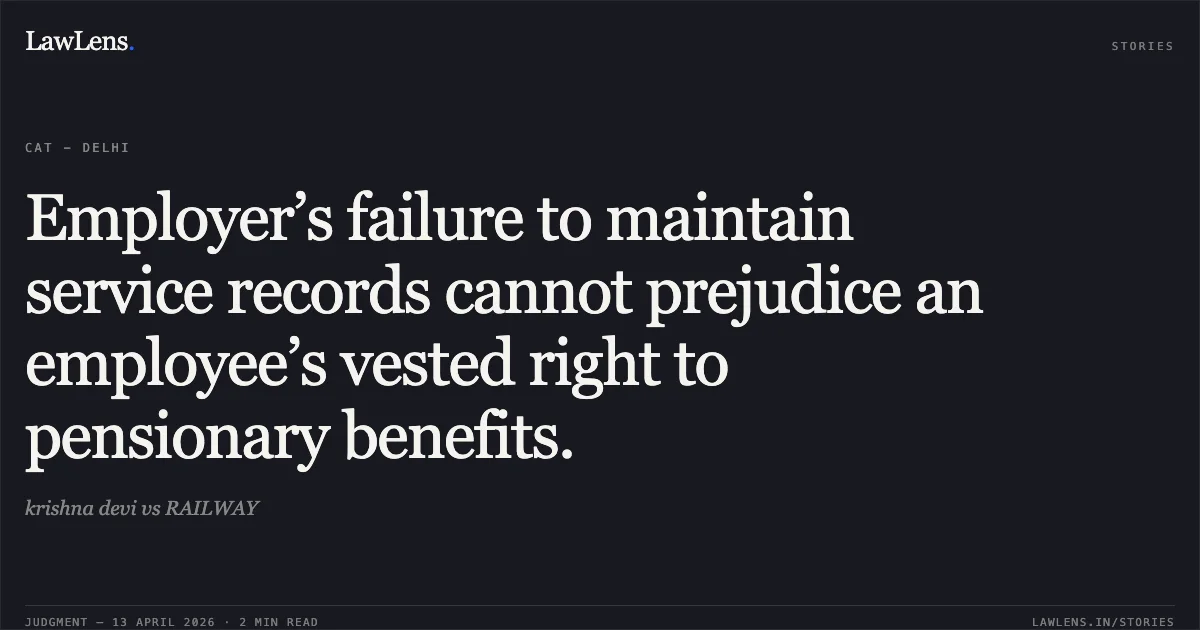
Source reference: p. 2It relied on the principle that the maintenance of service records is an exclusive administrative obligation of the employer, and lapses therein cannot prejudice the employee
Source reference: p. 6, para. 5.3Furthermore, the court applied Article 14 of the Constitution of India, holding that selective implementation of judicial orders among similarly situated employees is discriminatory
Source reference: p. 8, para. 5.7It also affirmed the established legal doctrine that pensionary benefits are a vested right accruing from past service rather than a matter of grace
Source reference: p. 8, para. 5.8Reasoning
The Tribunal found the respondents' defense of "missing records" to be untenable and "falsified" by the fact that the applicant successfully obtained those very records via RTI in 2021
Source reference: p. 6, para. 5.3-5.4The court reasoned that administrative apathy or failure to reconstruct records cannot be used to defeat a legitimate claim
Source reference: p. 7, para. 5.4Addressing the legal bars, the Tribunal rejected the plea of res judicata, determining that the non-payment of pension and consequential benefits constitutes a "continuing wrong" and that the subsequent grant of benefits to similarly situated peers created a fresh cause of action
Source reference: p. 7-8, para. 5.6The court emphasized that denying the applicant benefits that were extended to others, pursuant to the same judicial directions, was "patently arbitrary" and violated the right to equality
Source reference: p. 8, para. 5.7Holding
The Tribunal allowed the O.A., holding that the applicant is entitled to all consequential service and pensionary benefits
The respondents were directed to compute and release all arrears (pay, pension, gratuity) within twelve weeks, along with interest at GPF rates from the date the amounts became due
Source reference: p. 8-9, para. 6.2-6.4The court further ordered the respondents to ensure regular future pension payments to the applicant without delay
Source reference: p. 9, para. 6.5Acts & Sections Cited
2 provisions across 1 statute referred to in this judgment. Each provision opens on LawLens.
Indian Penal Code, 18602
Original Court PDF
krishna devivsRAILWAY
Click to open original judgment
Original judgment, available to read, download and summarize on LawLens.in