Facts
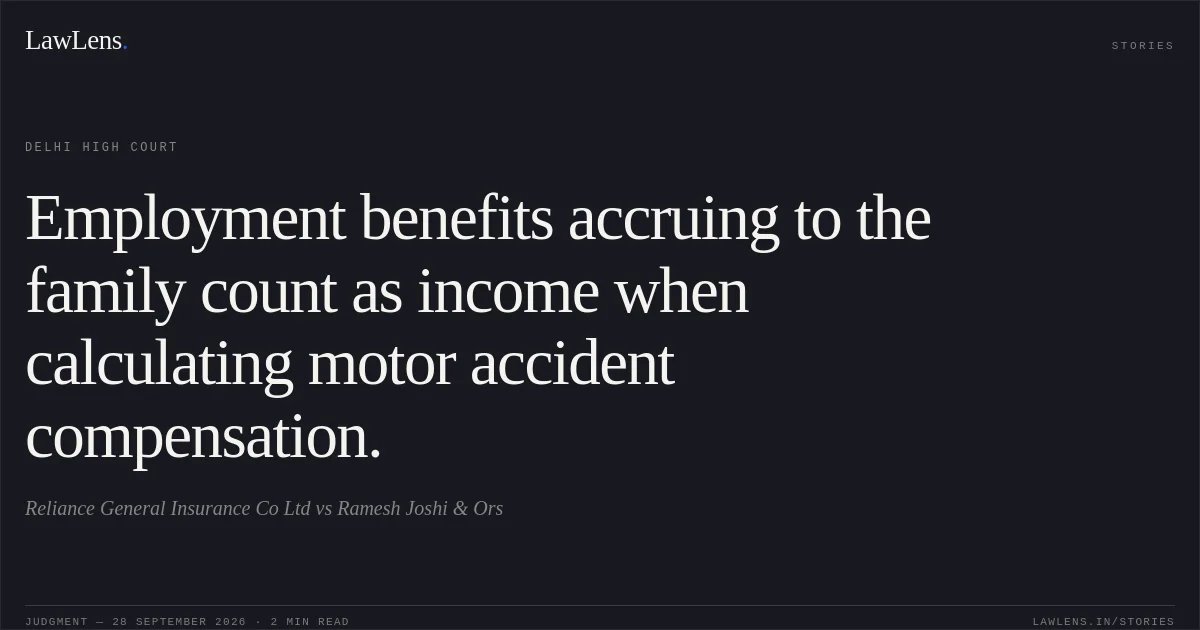
In MAC.APP. 39/2016, the insurer challenged a MACT award of ₹86,36,689 with 10% interest for the death of D.N.G. Kovalou in a 15 September 2012 road accident.
Source reference: p.1-p.6It disputed the future-prospects rate, deduction for personal expenses, income components, conventional heads of compensation, and the rejection of contributory negligence.
Source reference: p.1-p.6The claimants relied on the deceased’s permanent employment, his hearing- and speech-impaired dependent brother, and an eyewitness account attributing the accident to the offending vehicle
Source reference: p.1-p.6In MAC.APP. 40/2016, the insurer challenged an award of ₹4,42,904 with 10% interest for injuries suffered by Ramesh Joshi in the same accident, pressing contributory negligence
Source reference: p.9Issues
1. Whether the deceased’s future prospects, personal-expense deduction, and income for calculating dependency were correctly assessed
Source reference: p.2-p.62. Whether the compensation under conventional heads required adjustment under the applicable Supreme Court precedents
Source reference: p.2, p.7-p.83. Whether contributory negligence was established in either appeal
Source reference: p.2-p.5, p.94. Whether the injury compensation in MAC.APP. 40/2016 should otherwise be altered
Source reference: p.9Law Applied
The Court applied the compensation principles in Sarla Verma & Ors. v. Delhi Transport Corp. & Anr., (2009) 6 SCC 121, and National Insurance Co. Ltd. v. Pranay Sethi, (2017) 16 SCC 680, including the applicable approach to dependency deductions, future prospects, and conventional heads.
Source reference: p.5-p.7It relied on United India Insurance Co. Ltd. v. Satinder Kaur, (2021) 11 SCC 780, for the rule that compensation for loss of love and affection is not awardable.
Source reference: p.5-p.7On income, it relied on National Insurance Co. Ltd. v. Indira Srivastava, (2008) 2 SCC 763, and the cited later authorities for including monetary and non-monetary benefits that accrue to the employee’s family, while excluding allowances demonstrably personal to the employee or variable performance-based payments
Source reference: p.5-p.7No statutory provision was expressly identified in the judgment
Source reference: no citationReasoning
The Court fixed future prospects at 40%, finding no substantial evidence of regular increments to support the claimants’ proposed 50% rate.
Source reference: p.4It upheld the one-third personal-expense deduction because the claim that the deceased’s hearing- and speech-impaired brother depended on him had not been substantially rebutted
Source reference: p.4The Court included HRA in income but excluded conveyance and medical allowances because they were personal to the employee, and excluded variable ex-gratia payments because they were performance-based rather than fixed salary
Source reference: p.5-p.7It rejected contributory negligence because the driver’s account was unreliable and was contradicted by the consistent eyewitness testimony that the occupants were standing beside a stationary car when the offending vehicle struck them
Source reference: p.4-p.5It recalculated the death compensation, including conventional heads, and found no basis to disturb the injury award on the contributory-negligence ground
Source reference: p.7-p.9Holding
In MAC.APP. 39/2016, the Court reduced the award by ₹25,00,376 and fixed revised compensation at ₹61,36,313, with 10% annual interest from the date of filing.
Any excess deposited, with accrued interest, was to be refunded to the insurer; any shortfall was to be deposited and released to the claimants
Source reference: p.8-p.9In MAC.APP. 40/2016, the contributory-negligence challenge was rejected, and the Court directed release of the balance compensation with accrued interest as a lump sum
Source reference: p.9Both appeals were disposed of, and pending applications were rendered infructuous
Source reference: p.10Original Court PDF
Reliance General Insurance Co LtdvsRamesh Joshi & Ors
Click to open original judgment
Original judgment, available to read, download and summarize on LawLens.in