Facts
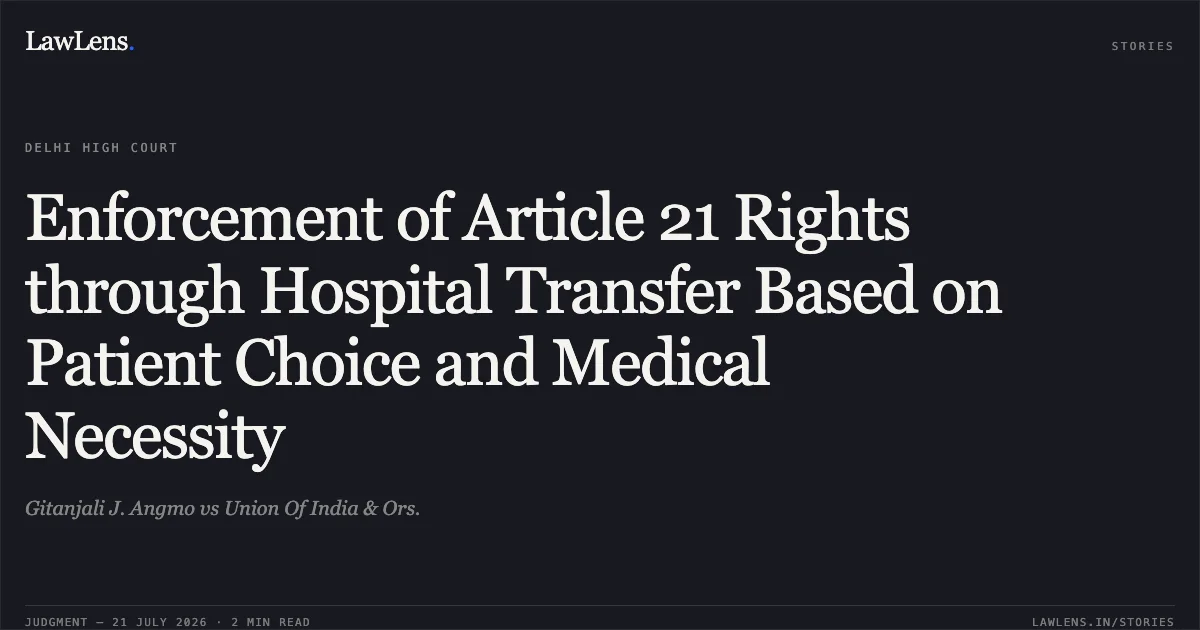
The Appellant filed a Writ Petition [W.P.(C) 9770/2026] seeking the release of her husband, Shri Sonam Wangchuk, from alleged illegal confinement at Safdarjung Hospital
Source reference: p. 2She sought his transfer to a medical facility of his choice, citing violations of Articles 19 and 21 of the Constitution
Source reference: p. 2-3On 19.07.2026, a Single Judge issued notice but declined interim relief, directing medical monitoring instead
Source reference: p. 3Medical reports from Safdarjung Hospital, AIIMS, and private labs indicated concerns regarding low Total Leucocyte Count (TLC) and potassium levels, necessitating continuous monitoring
Source reference: p. 4-5Issues
1. Whether the continued medical confinement of the Appellant’s husband at a state-designated hospital violated his fundamental rights under Articles 19 and 21 of the Constitution
Source reference: p. 2 / para. 22. Whether the court should direct the transfer of the patient to a private hospital of his choice to ensure his constitutional right to health and autonomy
Source reference: p. 6 / para. 12-13Law Applied
The court primarily applied Article 21 (Right to Life and Personal Liberty) and Article 19 (Freedom of Speech and Expression/Movement) of the Constitution of India
Source reference: p. 6These provisions encompass the right to health and the right of a patient to receive medical treatment at a facility of their choice, particularly when state-imposed confinement is challenged as illegal
Source reference: p. 2, 6The court also relied on medical consensus regarding the necessity of "constant and continuous monitoring" by experts to safeguard the right to life
Source reference: p. 5Reasoning
The Court facilitated a consensus between medical experts from AIIMS and the Appellant's private doctor to determine the severity of the patient's condition
Source reference: p. 4-5Recognizing the clinical concerns (low TLC and potassium), the Court determined that the patient required specialized monitoring
Source reference: p. 5To balance the state’s duty to provide care with the individual's fundamental rights, the Court reasoned that allowing the husband to be shifted to his preferred facility (Medanta Hospital, Gurugram) would satisfy the constitutional requirements of Articles 19 and 21
Source reference: p. 6The Court noted that the Solicitor General offered no objection to this transfer, thereby removing the adversarial hurdle to the patient's autonomy
Source reference: p. 6Holding
The Court held that protecting the husband's fundamental rights necessitated his transfer to a hospital of his choice
It directed that he be immediately shifted to Medanta Hospital, Gurugram, where a specialized team of doctors must monitor him
Source reference: para. 15The Court further ordered that the Appellant be granted unrestricted access to her husband according to hospital protocols
Source reference: para. 16Consequently, the Appeal and the underlying Writ Petition were disposed of, and the hearing date of 24.07.2026 was cancelled
Source reference: para. 17-18Original Court PDF
Gitanjali J. AngmovsUnion Of India & Ors.
Click to open original judgment
Original judgment, available to read, download and summarize on LawLens.in