Facts
The petitioner, Manharan Suryavanshi, claims ownership of lands bearing Khasra Nos. 1204 and 1306 in Village Afrid, which were acquired for the widening of National Highway No. 200 under the National Highways Act, 1956.
Source reference: para. 2An award was passed on 30.07.2016, and compensation was determined under Section 3G of the Act; however, the amount was not disbursed to the petitioner.
Source reference: para. 2Initially, the acquisition notification erroneously reflected the name of one Prem Bai instead of the petitioner.
Source reference: para. 3Although the petitioner subsequently obtained an order from the Tahsildar and corrected the revenue records through mutation, the respondent authorities failed to release the compensation.
Source reference: para. 2-3The petitioner filed the present writ petition seeking a direction for the immediate disbursement of the awarded amount with interest.
Source reference: para. 1Issues
1. Whether the petitioner is entitled to a writ of mandamus for the disbursement of compensation where a discrepancy regarding the rightful claimant existed in the initial notification.
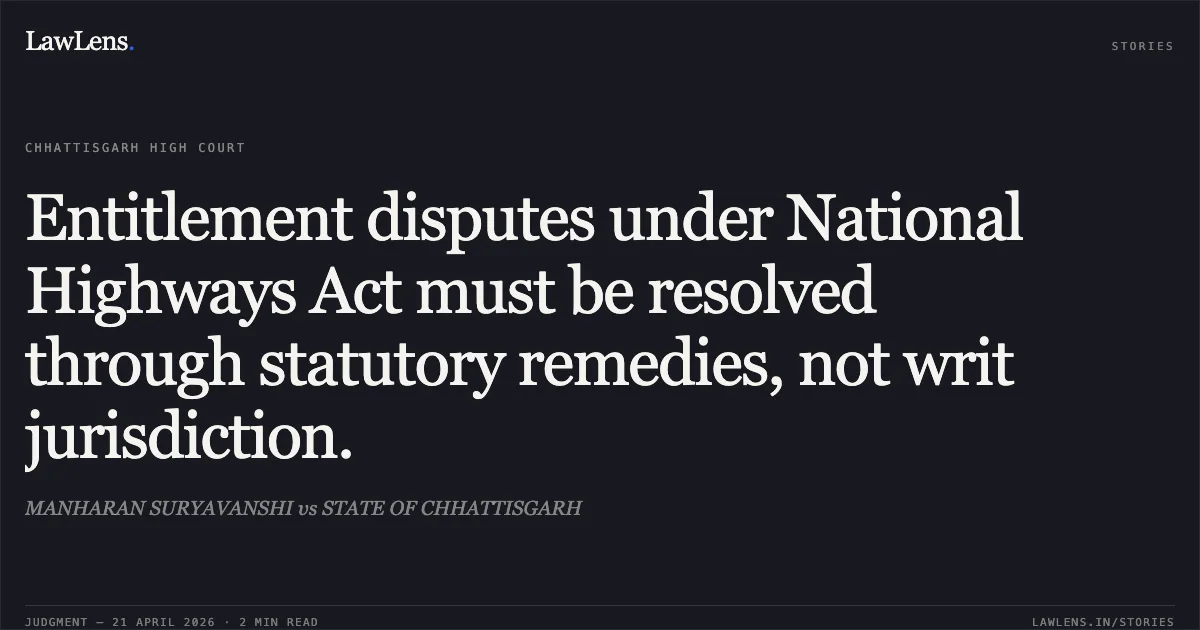
Source reference: para. 9 & 122. Whether a dispute regarding entitlement to compensation under the National Highways Act, 1956, must be adjudicated via the statutory mechanism provided under Section 3H of the Act rather than through writ jurisdiction.
Source reference: para. 11-13Law Applied
The court primarily applied Sections 3G and 3H of the National Highways Act, 1956, which govern the determination and deposit of compensation, specifically Section 3H(4) regarding the resolution of disputes over apportionment or entitlement.
Source reference: para. 1, 5-6It relied heavily on the precedent established in Vinod Kumar and Others v. District Magistrate, Mau and Others (2013) 19 SCC 126, which holds that disputes relating to the entitlement or apportionment of compensation are statutory in nature and must be resolved by the designated authority/forum rather than through the extraordinary jurisdiction of the High Court.
Source reference: para. 7, 10-11Reasoning
The court observed that while the petitioner’s name was eventually mutated in the revenue records, the fact that the initial notification carried a different name (Prem Bai) created a prima facie dispute regarding the rightful claimant.
Source reference: para. 12The court reasoned that under the statutory scheme of the Act of 1956, the Competent Authority is tasked with determining the person entitled to receive compensation.
Source reference: para. 12Following the ratio in Vinod Kumar, the court determined that writ jurisdiction should not be invoked to bypass the statutory remedy provided under Section 3H(4) for resolving entitlement disputes.
Source reference: para. 11 & 13The court emphasized that even if the petitioner’s claim is supported by updated revenue entries, the issue of entitlement must be conclusively examined by the Competent Authority to ensure adherence to the statutory mechanism.
Source reference: para. 13Holding
The High Court disposed of the petition without expressing an opinion on the merits of the petitioner's claim.
The court held that the appropriate remedy lies with the Competent Authority under the National Highways Act, 1956.
Source reference: para. 14The Competent Authority was directed to issue notices to all concerned parties, afford them a hearing, and decide the claim for disbursement of compensation strictly in accordance with the law within three months of receiving the order.
Source reference: para. 14No order as to costs was made.
Source reference: para. 17Acts & Sections Cited
11 provisions across 2 statutes referred to in this judgment. Linked provisions open on LawLens.
National Highways Act, 19562
Land Acquisition Act, 1894
Original Court PDF
MANHARAN SURYAVANSHIvsSTATE OF CHHATTISGARH
Click to open original judgment
Original judgment, available to read, download and summarize on LawLens.in