01Facts
The Petitioners are retired and serving employees of the National Council for Promotion of Urdu Language (NCPUL) and Maulana Azad National Urdu University (MANUU). All Petitioners joined NCPUL before January 1, 2004, and opted for the GPF-cum-pension scheme under Para 22 of the NCPUL Service Regulations
pp. 2-3Despite NCPUL making GPF deductions for years, the Ministry of Finance issued communications (notably on February 25, 2005) asserting that direct recruits of NCPUL should be covered under the Contributory Provident Fund (CPF) rather than the Central Government pension pattern
pp. 4-5NCPUL withheld pension and gratuity for retired Petitioner M.A. Khan
p. 5MANUU Petitioners—who moved from NCPUL via proper channel—were directed to migrate to the New Pension System (NPS) because NCPUL failed to transfer their pro-rata pensionary liabilities
pp. 7-8NCPUL admitted in its records that a CPF framework never actually existed in the organization and no employee had opted for it
p. 5, 902Issues
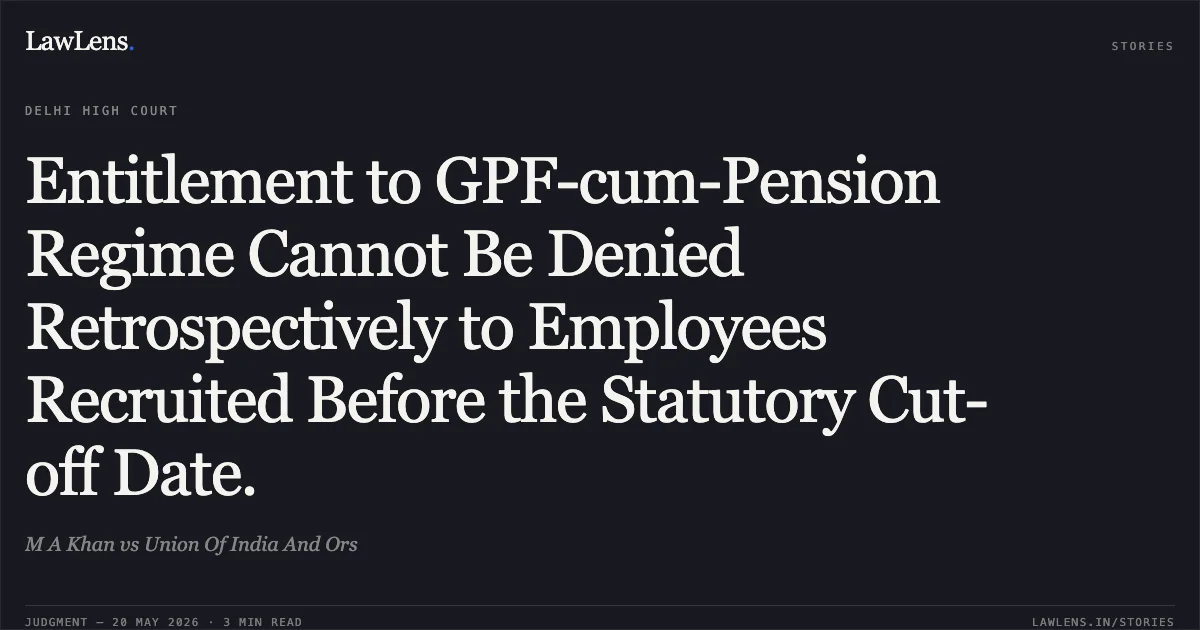
i.1. Whether NCPUL direct recruits appointed before 1st January 2004, who opted for GPF-cum-pension, can be denied pensionary benefits based on subsequent executive communications
p. 10 / para. 25(i)ii.2. Whether serving employees have a maintainable cause of action to challenge pension status prior to retirement
p. 10 / para. 25(ii)iii.3. Whether MANUU can compel employees to migrate to NPS due to the previous employer’s failure to transfer pro-rata pension liability
p. 10 / para. 25(iii)03Law Applied
The Court relied on the principle that pension is a valuable right and a form of social security, not a bounty, as established in D.S. Nakara v. Union of India
pp. 10-11It further applied State of Jharkhand v. Jitendra Kumar Srivastava, which classifies pension and gratuity as property under Article 300A of the Constitution
p. 11The doctrine against the retrospective alteration of service conditions to the detriment of accrued or vested rights was upheld through Chairman, Railway Board v. C.R. Rangadhamaiah and Punjab State Cooperative Agricultural Development Bank Ltd. v. Registrar, Cooperative Societies
p. 11Regarding delay, the court applied Union of India v. Tarsem Singh, holding that pension denial is a continuing wrong
p. 14Provisions in the judgment · 1 · Linked ones open on LawLens
Maulana Azad National Urdu University Act, 1996 Section 8
04Reasoning
The Court reasoned that the Petitioners’ pensionary status had crystallized upon их entry into service and exercise of options under Para 22 of the approved Service Regulations
p. 2, 11NCPUL’s consistent conduct—opening GPF accounts, issuing annual statements, and making deductions—created a vested right that could not be undone by the 2005 Ministry communication
p. 12The Court found the Respondents' position "untenable" because they sought to move Petitioners to a CPF scheme that NCPUL admitted never existed within the organization
p. 12It further noted that administrative failures or lack of inter-departmental concurrence between the Ministry of Finance and NCPUL cannot penalize employees who acted on the pensionary position held out to them
p. 13Regarding the MANUU Petitioners, the Court analyzed that the duty to transfer pro-rata liability lies with the institutions, and an employee moving through a "proper channel" cannot be deprived of pensionary continuity due to institutional financial inertia
pp. 15-1605Holding
The Court allowed the writ petitions, holding that the communications denying the GPF-cum-pension regime were inapplicable to employees who joined before January 1, 2004, and opted for GPF
pp. 17-18The Court directed: (i) NCPUL to process and release M.A. Khan’s pension and gratuity with 6% interest on arrears [p.18]; (ii) NCPUL to maintain serving Petitioners under the GPF-cum-pension regime per CCS (Pension) Rules, 1972 [p.18-19]; and (iii) MANUU to set aside notices compelling migration to NPS, with a specific direction to NCPUL to remit pro-rata pension liabilities to MANUU within twelve weeks [p.19-20]. The Court emphasized that institutional financial adjustments cannot be used to retrospectively alter an employee's pensionary status
p. 18, 19, 20Original Court PDF
M A KhanvsUnion Of India And Ors
Click to open original judgment
Original judgment, available to read, download and summarize on LawLens.in