Facts
Power Grid Corporation of India Ltd. (PGCIL) was entrusted with the augmentation of transformers at the Hamirpur Substation, which included two 220 kV line bays (Asset 2).
Source reference: p. 6These bays were intended to connect to HPPTCL’s downstream network (Hamirpur–Dehan line). PGCIL declared the commercial operation date (COD) as 31.03.2019, but the bays remained unutilized as HPPTCL’s downstream line was not ready.
Source reference: p. 6CERC, in the Impugned Order dated 21.11.2019, directed HPPTCL to pay transmission charges from 31.03.2019 until the commissioning of its downstream system.
Source reference: p. 7HPPTCL appealed, contending it never provided the mandatory two-year advance intimation for construction and that PGCIL failed to execute a formal Implementation Agreement (IA) required under the Grid Code.
Source reference: p. 8-10Issues
1. Whether the requirement of the 220 kV bays at Hamirpur was crystallized and approved such that the condition of a two-year advance intimation was inapplicable.
Source reference: p. 16/para 222. Whether the absence of a formal Implementation Agreement under the 2016 Amendment to the IEGC absolves the Appellant of liability for transmission charges.
Source reference: p. 26/para 403. Whether the principle of "defaulting entity pays" applies in the absence of a bilateral contract.
Source reference: p. 34/para 52Law Applied
The court applied Regulation 4(3) of the CERC (Terms and Conditions of Tariff) Regulations, 2014, regarding the declaration of COD when an asset is ready but cannot be charged due to non-availability of the downstream system.
Source reference: p. 6It interpreted Regulation 6.3A(4) of the Indian Electricity Grid Code (IEGC) (Fourth Amendment) 2016 concerning the "endeavour" to match commissioning through Implementation Agreements.
Source reference: p. 26-27The Tribunal further relied on the regulatory principle of "compensatory liability," established in Bhopal Dhule Transmission Company Limited v. CERC, which dictates that the entity responsible for the mismatch in commissioning must bear the transmission charges to ensure the ready-licensee is not deprived of its tariff.
Source reference: p. 34Reasoning
The Tribunal found that the requirement for the bays was specifically requested by HPPTCL and crystallized during the 30th Standing Committee Meeting (19.12.2011) and 25th NRPC meeting.
Source reference: p. 19-21Consequently, the general "two-year notice" proviso in the meeting minutes did not apply to these specific, already-approved assets.
Source reference: p. 21Regarding the IEGC 2016 Amendment, the Tribunal held that since the investment approval (2014) and implementation began before the Amendment's notification, the requirement for a mandatory Implementation Agreement could not be applied retrospectively.
Source reference: p. 29-30The court distinguished this case from PSTCL v. CERC (Appeal 109/2021) because, unlike PSTCL, HPPTCL had actively sought the bays and provided status updates on its downstream line, thereby creating a binding regulatory obligation.
Source reference: p. 33-34By failing to match PGCIL’s timeline, HPPTCL became the "defaulting entity" liable for the mismatch.
Source reference: p. 32Holding
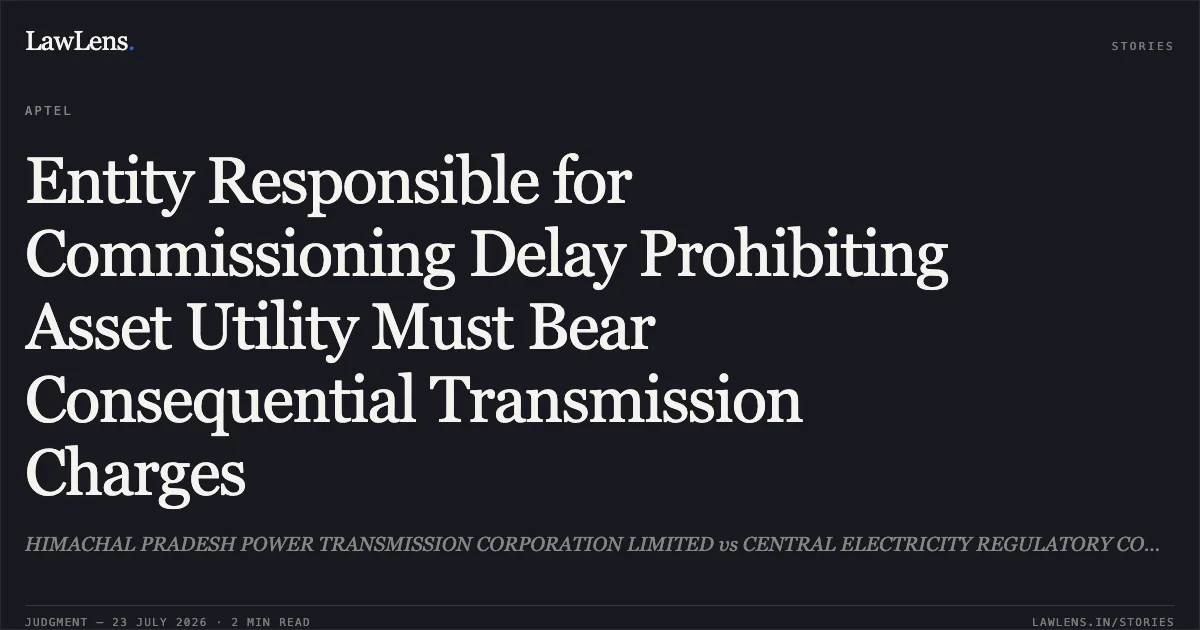
The Tribunal answered all issues in the negative against the Appellant. It held that HPPTCL is liable to pay the transmission charges for the 220 kV bays from the deemed COD (31.03.2019) until its downstream network was commissioned.
The Tribunal upheld the CERC’s Impugned Order, ruling that the liability flows from the statutory planning process and the "defaulting entity pays" principle, regardless of the lack of a formal bilateral contract. Appeal No. 300 of 2022 was dismissed.
Source reference: p. 34-35Acts & Sections Cited
8 provisions across 2 statutes referred to in this judgment. Each provision opens on LawLens.
Electricity Act, 20037
Indian Contract Act, 18721
Original Court PDF
HIMACHAL PRADESH POWER TRANSMISSION CORPORATION LIMITEDvsCENTRAL ELECTRICITY REGULATORY COMMISSION & Ors
Click to open original judgment
Original judgment, available to read, download and summarize on LawLens.in