Facts
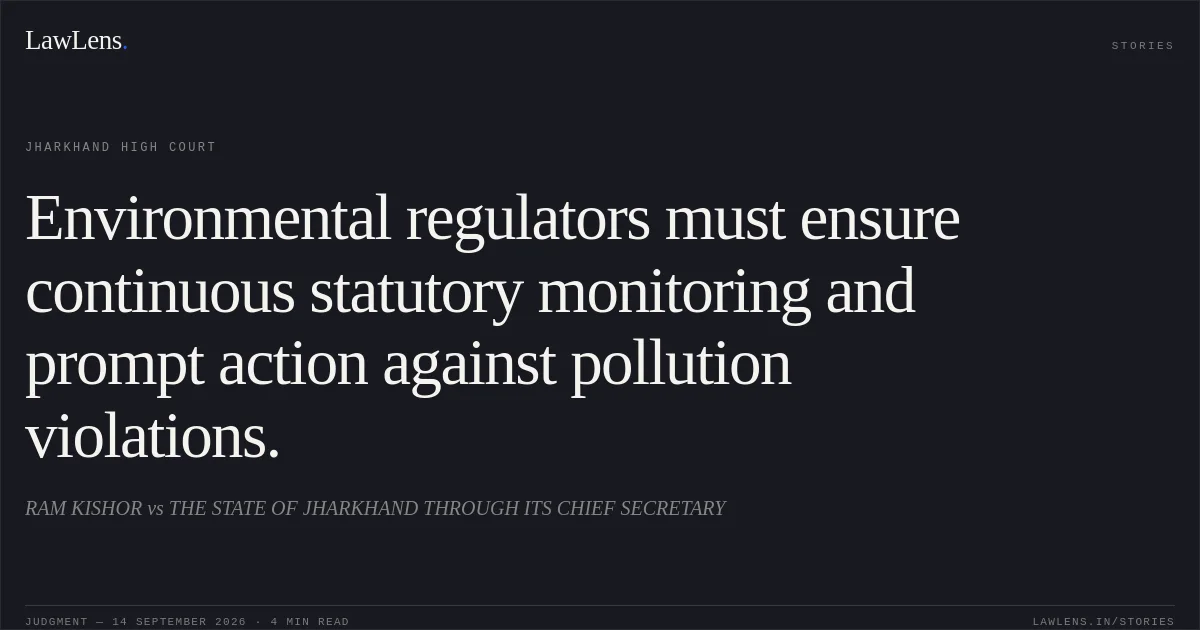
The petitioner filed a Public Interest Litigation seeking directions against alleged air and water pollution caused by industrial units operating in Ramgarh, particularly Bihar Foundry and Casting Limited and Dayal Steel Limited.
Source reference: paras. 2–4The petition alleged that toxic smoke, dust and gases emitted from the industries affected surrounding residential areas and sensitive establishments, including VIVA International School and a jail.
Source reference: paras. 3, 11The State initially disputed the allegations and questioned the establishment of the school, but subsequently withdrew those averments and constituted a committee to assess the environmental impact.
Source reference: paras. 14–15During the proceedings, the Jharkhand State Pollution Control Board (“JSPCB”) placed on record its monitoring and enforcement framework, including ambient-air monitoring, water testing and waste-management protocols.
Source reference: paras. 17–20A water analysis report found marginally elevated fluoride, total dissolved solids and nitrate levels, although most parameters were within acceptable standards; the JSPCB consequently directed the Public Health Engineering Department to take remedial action.
Source reference: paras. 21–22The industries possessed valid statutory permissions, including Consents to Operate, and available inspection and air-quality reports indicated compliance with prescribed standards.
Source reference: paras. 23, 34–35The Court nevertheless noted deficiencies in regulatory monitoring and required continuing supervision.
Source reference: paras. 37, 42–43Issues
Whether the alleged emissions and industrial activities of respondent nos. 6 and 7 constituted continuing violations of environmental laws warranting immediate closure or other coercive judicial directions?
Source reference: paras. 24, 33–37, 42Whether the statutory and regulatory authorities had adequately discharged their duties under the Air Act, the Water Act, the Environment (Protection) Act and the applicable consent conditions?
Source reference: paras. 12, 16, 27, 38, 42–43Whether the marginal exceedance of fluoride, total dissolved solids and nitrate in water samples near VIVA International School was attributable to industrial discharge and required remedial or compensatory action?
Source reference: paras. 21–22, 36–37Whether directions should be issued to ensure effective, regular and continuing monitoring of the respondent industries without creating a parallel regulatory regime?
Source reference: paras. 40–44Law Applied
The Court applied Article 21 of the Constitution, which includes the right to pollution-free air and water, read with Articles 47, 48, 48A and 51A(g), concerning public health, environmental protection and the duty of citizens to protect the environment.
Source reference: para. 27It relied on the Air (Prevention and Control of Pollution) Act, 1981, the Water (Prevention and Control of Pollution) Act, 1974, the Environment (Protection) Act, 1986, and the industries’ consent conditions as the governing statutory framework.
Source reference: paras. 12, 27, 38Subhash Kumar v. State of Bihar, AIR 1991 SC 420, was applied for the principle that pollution-free air and water form part of Article 21.
Source reference: para. 28Municipal Council, Ratlam v. Vardhichand, AIR 1980 SC 1622, established that public authorities have a primary and non-delegable duty to protect public health and cannot avoid statutory obligations on grounds of administrative inconvenience or lack of resources.
Source reference: para. 29People United for Better Living in Calcutta v. State of West Bengal, AIR 1993 Cal 215, supported harmonising industrial development with ecological protection.
Source reference: para. 30N.D. Jayal v. Union of India, (2004) 9 SCC 362, required continuing operational compliance rather than treating environmental clearance as a one-time exemption.
Source reference: para. 31Vellore Citizens’ Welfare Forum v. Union of India, (1996) 5 SCC 647, affirmed the precautionary and polluter-pays principles as part of Indian environmental law.
Source reference: para. 32Reasoning
The Court treated the alleged pollution as a matter of public interest because environmental harm could extend beyond Ramgarh and affect downstream communities and the wider ecological system.
Source reference: paras. 5–10However, the material produced by the JSPCB showed that both industries had valid Consents to Operate, that air-emission parameters were being met, and that continuous ambient-air monitoring data for 22–31 July 2025 remained within prescribed limits.
Source reference: paras. 34–35The Court therefore found no present basis for holding that the industries were committing a continuing statutory violation or for ordering their closure.
Source reference: paras. 36–37, 42In relation to water quality, the marginal exceedance of fluoride, TDS and nitrate did not establish whether the cause was industrial discharge, geogenic conditions or municipal sources; accordingly, the Court directed fresh accredited testing, including upstream and downstream sampling and testing of identified discharge points.
Source reference: para. 36; direction IVApplying the principles of continuing regulatory compliance and precaution, the Court concluded that the principal deficiency lay not in a proven continuing violation by the industries but in the need for more effective monitoring and enforcement by the authorities.
Source reference: paras. 37–43Holding
The petition was disposed of without a finding of continuing statutory non-compliance by respondent nos. 6 and 7 and without directing closure of the industries.
The Court directed the Regional Officer, JSPCB, to conduct two inspections of each industry every calendar year, including at least one unannounced inspection, and to report the results to the Member Secretary.
Source reference: directions I–IIContinuous emission-monitoring data was to remain connected to the Board’s server, with sustained exceedances triggering show-cause proceedings.
Source reference: direction IIIThe JSPCB was directed to conduct fresh accredited water testing within three months and, depending on the cause of contamination, initiate environmental-compensation proceedings or refer the matter to the Drinking Water and Sanitation Department.
Source reference: directions IV–VIt was further directed to verify the currency of the industries’ environmental clearances and consents and take action in cases of expiry or delayed renewal.
Source reference: directions VI–VIIThe Deputy Commissioner was directed to assist inspections and forward pollution complaints within three working days.
Source reference: direction VIIIThe Member Secretary, JSPCB, was required to file a compliance affidavit within four months, with copies supplied to the petitioner.
Source reference: directions IX–XLiberty was reserved to the petitioner to seek enforcement of the directions or bring fresh pollution incidents before the Court in the same proceedings.
Source reference: para. 45No costs were awarded.
Source reference: para. 48Original Court PDF
RAM KISHORvsTHE STATE OF JHARKHAND THROUGH ITS CHIEF SECRETARY
Click to open original judgment
Original judgment, available to read, download and summarize on LawLens.in