Facts
The petitioner, an Assistant Grade-III employee in the Office of the District Education Officer, Gwalior, was admitted to a Ph.D. program in Sociology at Maharani Laxmi Bai Government College of Excellence
Source reference: p. 1-2After failing her first attempt at the Ph.D. Course Work Examination, she failed to appear in the 2023 examination, citing a lack of information
Source reference: p. 2She approached the High Court seeking a mandamus to allow her to participate in the forthcoming 2024 examination as her second and final attempt under the University Ordinance
Source reference: p. 3-4The University contested the petition, stating that the petitioner had failed to submit the mandatory examination form and fees within the stipulated time, and thus no admit card could be generated
Source reference: p. 5Issues
1. Whether the petitioner has an absolute right under Ordinance No. 11 to appear for the Ph.D. Course Work Examination without complying with mandatory procedural requirements such as submission of forms and fees
Source reference: p. 92. Whether a writ of mandamus can be issued to relax academic regulations on the grounds of personal hardship or sympathy
Source reference: p. 9Law Applied
The court primarily applied the principles governing the issuance of a writ of mandamus under Article 226 of the Constitution of India, which requires the existence of a clear legal right in favor of the petitioner and a corresponding legal duty upon the respondents
Source reference: p. 8Ordinance No. 11 of the University, which regulates Ph.D. course work and examinations
Source reference: p. 3The doctrine that academic standards and statutory requirements must be applied uniformly and cannot be overridden by equitable or sympathetic considerations in the absence of enabling provisions
Source reference: p. 6, 9Reasoning
The Court reasoned that interference in academic matters is limited to cases of arbitrariness or violation of statutory provisions
Source reference: p. 8It found that the petitioner failed to provide contemporaneous evidence to prove she was prevented from filing her examination form due to technical errors or lack of information
Source reference: p. 8-9The Court rejected the argument that Ordinance No. 11 grants an "absolute right" to two attempts, clarifying that such opportunities are strictly subject to procedural compliance (forms and fees)
Source reference: p. 9The Court noted that the petitioner could not claim parity with the order in Smt. Manju Soni Vs. State of M.P. (W.P. No.16782/2026) because that order had been set aside by a Division Bench in Writ Appeal No.1996/2026
Source reference: p. 5, 10The Court held that the petitioner’s status as a woman from an OBC category did not exempt her from uniform academic regulations
Source reference: p. 9Holding
The Court answered the issues in the negative, holding that no enforceable legal right was established to justify a writ of mandamus
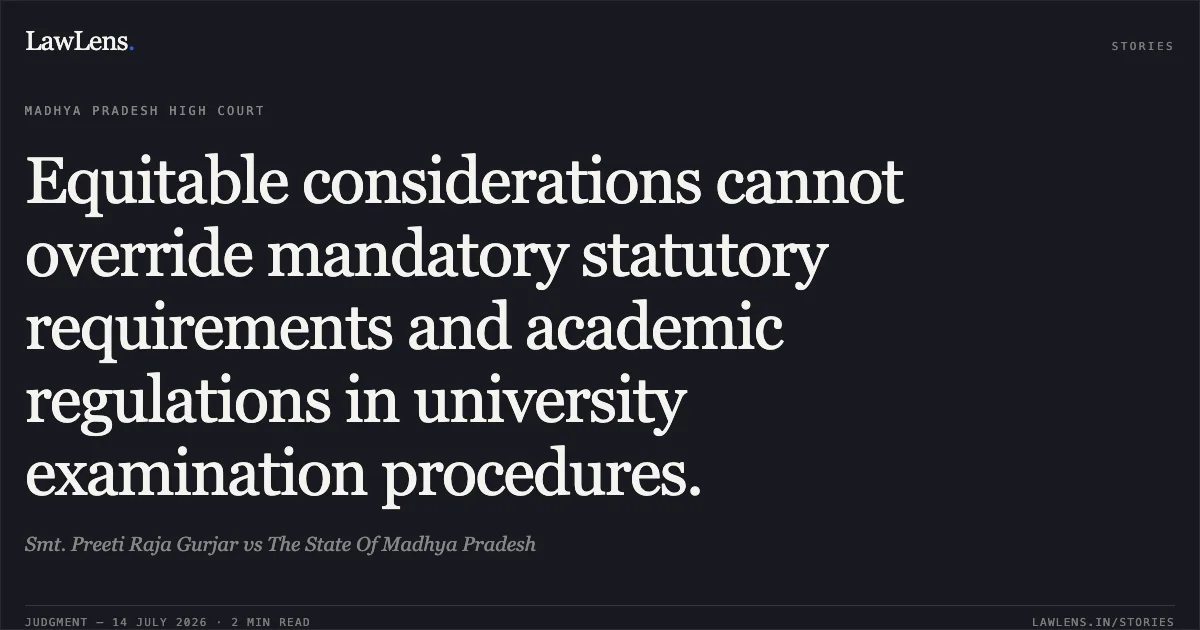
The Court held that sympathy and personal hardships cannot override mandatory academic requirements or statutory procedures
Source reference: p. 9The writ petition was dismissed as being devoid of merit
Source reference: p. 10Original Court PDF
Smt. Preeti Raja GurjarvsThe State Of Madhya Pradesh
Click to open original judgment
Original judgment, available to read, download and summarize on LawLens.in


![Subsequent exoneration does not retrospectively invalidate a finalized promotion select list.. UNNIKRISHNAN M vs M/o Environment And Forests. CAT - ['Ernakulam']. LawLens](/stories/thumbnails/subsequent-exoneration-does-not-retrospectively-invalidate-a-finalized-promotion-select-li-ce80a0e84f2f4887857271e8b4341c42.webp)