Facts
The appeals arose from a common order dated 06.09.2022 in six writ petitions concerning the approval of appointments of six teachers—P.G. Assistants and B.T. Assistants—in Nadar Saraswathi Higher Secondary School, Usilampatti.
Source reference: para. 15The teachers had been appointed between February and September 2011 by a person claiming authority over the institution.
Source reference: no citationTheir appointments were initially treated as appointments made by a religious minority institution, and interim orders passed in 2015 directed temporary approval and release of salary.
Source reference: para. 15The institution had earlier instituted O.S.No.1682 of 1981, seeking a declaration under Article 26 of the Constitution that Usilampatti Nadars constituted a religious denomination and that the school was a minority institution.
Source reference: paras. 4–10Although the suit was decreed, the finding regarding denominational status was based substantially on the State’s failure to adduce evidence, rather than on affirmative proof by the plaintiffs.
Source reference: paras. 4–10Pursuant to earlier proceedings, the State conducted an enquiry through a Joint Director of School Education.
Source reference: para. 15The enquiry concluded that the school did not possess minority status and that the teachers’ appointments could not therefore be approved.
Source reference: para. 15The learned Single Judge agreed that the institution was not a religious or denominational minority institution, but nevertheless directed approval of the appointments on equitable grounds, principally because the teachers were qualified, had served under interim orders, and had received salary.
Source reference: paras. 16–20Both the State and the school challenged the direction granting approval.
Source reference: paras. 3, 18–20Neither side challenged the finding that the institution was not a minority institution.
Source reference: paras. 3, 18–20Issues
1. Whether the learned Single Judge was justified in directing approval of the teachers’ appointments solely on equitable or sympathetic grounds after holding that the institution was not a religious minority or denominational institution.
Source reference: paras. 20–222. Whether appointments made by an individual whose authority to manage the institution was subsequently undermined could confer a legal right to approval and continued salary.
Source reference: paras. 21, 25–293. Whether interim orders, continued service, or prior payment of salary could validate appointments that were otherwise unauthorised and legally defective.
Source reference: paras. 23–32Law Applied
The Court applied the principle that a plaintiff must prove its own case and cannot rely on the weakness or default of the opposing party, relying on Sri Chand v. Inder, 1993 Supp (2) SCC 560, Punjab Urban Planning and Development Authority v. Shiv Saraswati Iron and Steel Re-Rolling Mills, (1998) 4 SCC 539, and C.N. Ramappa Gowda v. C.C. Chandregowda, (2012) 5 SCC 265.
Source reference: paras. 6–10It applied the rule that statutory qualifications and legal conditions of appointment cannot be relaxed on sympathy or equity, particularly where doing so may prejudice other eligible candidates, relying on State of Rajasthan v. Hitendra Kumar Bhatt, (1997) 6 SCC 574.
Source reference: paras. 23–24The Court further held, on the basis of St. John’s Teachers Training Institute (for Women), Madurai v. State of Tamil Nadu, (1993) 3 SCC 595, that no legal or equitable benefit can ordinarily arise from interim orders contrary to statutory requirements.
Source reference: para. 27It relied on State of Kerala v. Puthenkavu N.S.S. Karayogam, (2001) 10 SCC 191, for the proposition that consequential orders fall when the principal order is set aside, and on National Bal Bhawan v. Union of India, (2003) 9 SCC 671, for the merger of interim orders into the final judgment.
Source reference: paras. 28–30Finally, under State of Madhya Pradesh v. Ramesh Chandra Bajpai, (2009) 13 SCC 635, Article 14 cannot be invoked to perpetuate an illegality.
Source reference: para. 31The Court distinguished the de facto doctrine in Gokaraju Rangaraju v. State of Andhra Pradesh, (1981) 3 SCC 132, observing that it protects the validity of acts performed in the public interest by a de facto officer, not the personal employment benefits of persons appointed without authority.
Source reference: paras. 34–36Reasoning
The Court held that the school’s minority or denominational status had not been established by legally sufficient evidence and, in any event, that finding had not been challenged by the teachers or the institution.
Source reference: paras. 4–5, 18–20Consequently, the individual who appointed the teachers could not rely on the autonomy available to a recognised minority institution to make appointments without complying with the applicable regulatory framework.
Source reference: paras. 21, 25–26His authority over the institution was later undermined, and the appointments were therefore made without valid institutional authority.
Source reference: paras. 21, 25–26The teachers’ qualifications, their continued service, payment of salary, and the interim directions issued during the pendency of the litigation could not cure the foundational illegality.
Source reference: paras. 23–26, 32, 37The Court rejected the application of equity because equity cannot validate an appointment that was void from inception, nor can sympathy override statutory requirements or compel the State to approve an unlawful appointment.
Source reference: paras. 23–26, 32, 37The Court also distinguished the de facto doctrine, finding that it was intended to prevent disruption to public and private transactions, not to confer retrospective legitimacy or employment benefits upon appointments made by an unauthorised person.
Source reference: paras. 34–36Holding
The Division Bench answered the issues against the teachers.
It held that the learned Single Judge erred in directing approval of the appointments on equitable grounds after finding that the school was not a minority institution.
Source reference: paras. 32, 37The appointments, having been made without valid authority, could not be regularised by reason of interim orders, continued service, prior salary payments, qualifications, or sympathy.
Source reference: paras. 32, 37Accordingly, all twelve writ appeals were allowed.
Source reference: para. 38The writ petitions were dismissed insofar as they granted equitable relief directing approval of the teachers’ appointments and continuation of salary.
Source reference: para. 38No costs were awarded, and the connected miscellaneous petitions were closed.
Source reference: para. 38Original Court PDF
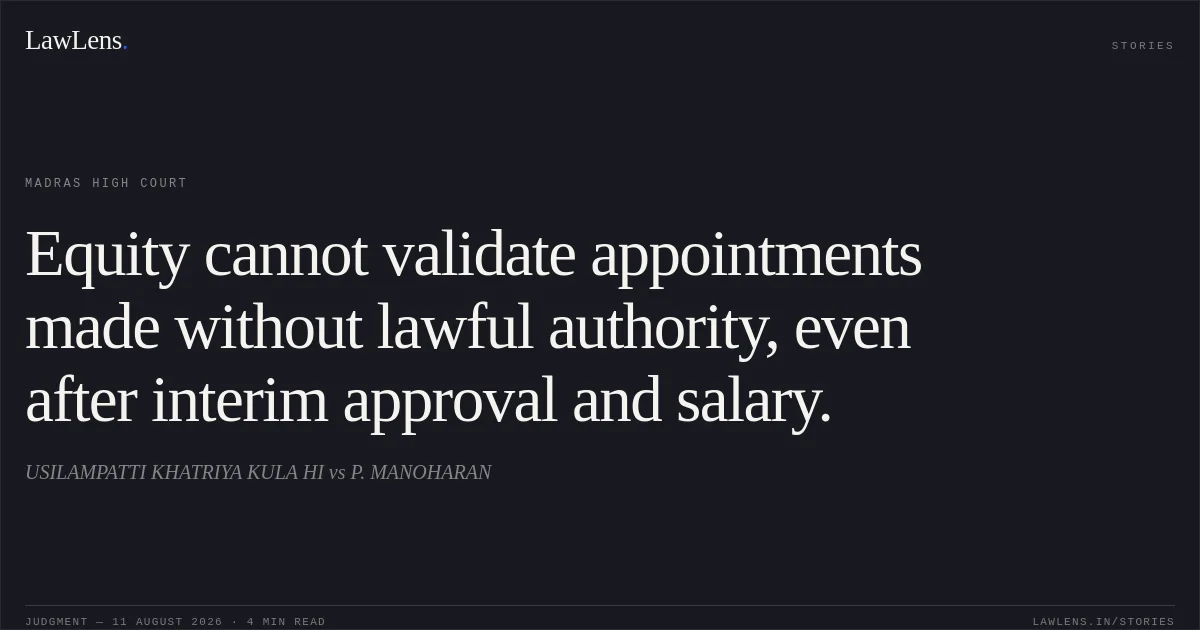
USILAMPATTI KHATRIYA KULA HIvsP. MANOHARAN
Click to open original judgment
Original judgment, available to read, download and summarize on LawLens.in