Facts
Two bidders, E Trav Tech Limited and M/s Verasys Limited, participated in tenders issued by the Ministry of External Affairs for outsourcing Consular/Passport/Visa (CPV) services in Kuwait, UAE, Singapore, and Australia.
Source reference: para. 1, 4The Request for Proposal (RFP) mandated a two-stage process: technical and financial.
Source reference: para. 7Both petitioners were disqualified at the technical stage for failing to meet the minimum 70% score.
Source reference: para. 1, 8Following a Supreme Court directive in a prior round of litigation (E Trav Tech Ltd.-II), the Respondents disclosed parameter-wise mark breakups in May 2026.
Source reference: para. 10-11The petitioners challenged this evaluation as arbitrary, noting that despite providing identical documentation across Missions, they received widely varying marks (e.g., E Trav received 4/7 in UAE but 0/7 in Kuwait for the same credentials).
Source reference: para. 32-33E Trav claimed its financial bids were significantly lower than the successful L-1 bidders.
Source reference: para. 17Issues
1. Whether the petitions were barred by res judicata or constructive res judicata due to previous litigation.
Source reference: para. 44, 452. Whether the technical evaluation process was arbitrary, opaque, and violative of Articles 14 and 19(1)(g) of the Constitution.
Source reference: para. 44, 533. Whether the failure to provide specific reasons for the deduction of marks and disqualification vitiated the process.
Source reference: para. 44, 88Law Applied
The court applied the principles of judicial review in contractual matters established in Tata Cellular v. Union of India, focusing on illegality, irrationality, and procedural impropriety.
Source reference: para. 55It relied on Jagdish Mandal v. State of Orissa regarding the "arbitrariness" test in tenders.
Source reference: para. 56It relied on Reliance Energy Ltd. v. Maharashtra State Road Development Corp. regarding the "level playing field" and legal certainty under Article 14.
Source reference: para. 59The court further applied Rule 173(iv) and Rule 189 of the General Financial Rules (GFR), 2017, which mandate transparency and the recording of reasons for rejecting bids.
Source reference: para. 89-90The court applied Clauses 5.4.2 and 7.3.4.2(d) of the Manual of Procurement of Non-Consultancy Services (2025) regarding debriefing unsuccessful bidders.
Source reference: para. 85Reasoning
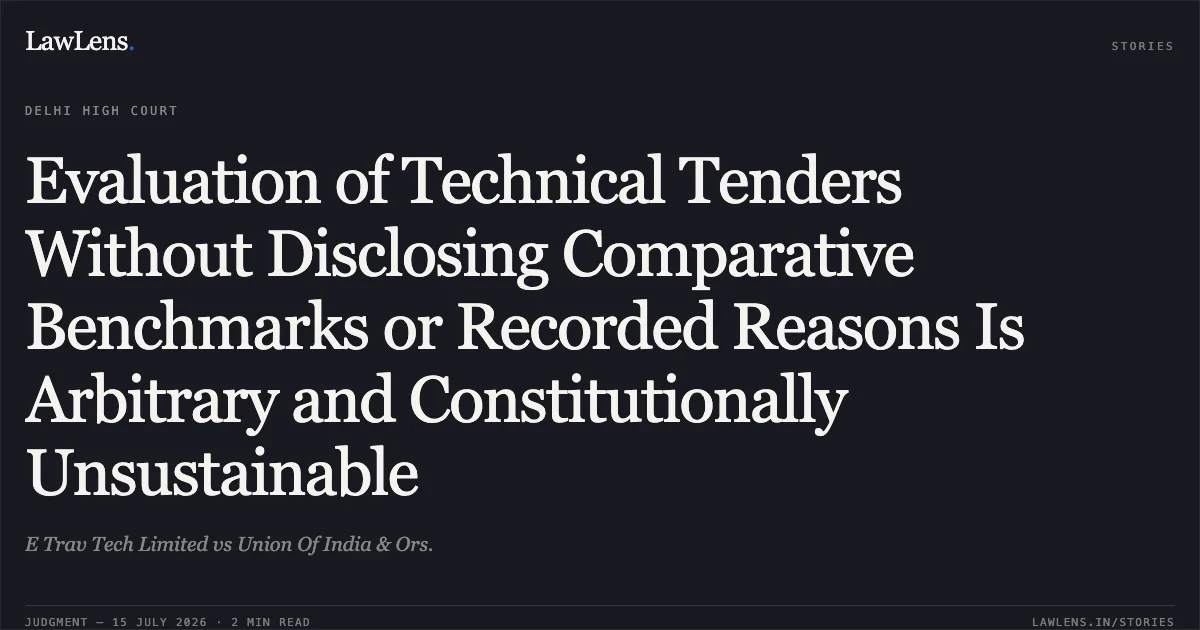
The Court found that the Respondents' evaluation was flawed as it applied undisclosed comparative benchmarks without explaining what constituted the "best offer".
Source reference: para. 62-63For objective criteria (e.g., parking, office area, and turnaround time), the Respondents awarded inconsistent marks—sometimes zero—despite the petitioners' documented compliance with RFP standards.
Source reference: para. 68-70Specifically, the Court noted the irrationality of awarding vastly different marks for identical corporate credentials across different Missions.
Source reference: para. 65-66, 81The Court rejected the Respondents' argument that oral presentations justified the scores, holding that oral explanations cannot substitute for recorded, contemporaneous reasons in the evaluation sheets.
Source reference: para. 83, 95The lack of reasons prevented any meaningful scrutiny and breached the undertaking previously given to the Court.
Source reference: para. 92-94Holding
The Court held that the technical evaluation was arbitrary, lacked transparency, and violated Article 14.
The plea of res judicata was rejected as the disclosure of marks created a fresh cause of action.
Source reference: para. 52The Court set aside the technical evaluations and nullified the award of tenders to the private Respondents.
Source reference: para. 99It directed the Union of India to issue fresh RFPs for all four Missions within one month.
Source reference: para. 100To prevent service disruption, existing incumbents were permitted to continue until the conclusion of the new tender process.
Source reference: para. 101Acts & Sections Cited
1 provisions across 1 statute referred to in this judgment. Each provision opens on LawLens.
Code of Civil Procedure, 19081
Original Court PDF
E Trav Tech LimitedvsUnion Of India & Ors.
Click to open original judgment
Original judgment, available to read, download and summarize on LawLens.in