01Facts
The appellants occupied a rooftop portion of Hastings Chambers, a building treated as high-risk and used for commercial purposes.
¶ 1–6They sought a new electricity connection under Section 43 of the Electricity Act, 2003.
¶ 1–6The building’s other occupants opposed the request, alleging that the appellants’ construction obstructed a staircase and access to the roof, creating fire-safety risks.
¶ 1–6Although the Kolkata Municipal Corporation (KMC) had ordered that the rooftop construction could be regularized, it made regularization conditional on specified compliance, including a structural-safety certificate; the record before the Court did not establish whether those conditions had been fulfilled.
¶ 12–17, 19The Single Judge dismissed the writ petition, and the appellants appealed
¶ 1–6, 12–17, 1902Issues
i.1. Whether the appellants, as long-standing occupiers of the premises, were entitled to an electricity connection notwithstanding the disputed legality of the rooftop construction and the building’s fire-safety concerns
¶ 8–10ii.2. If a connection could be granted, whether it should be domestic or commercial, and what conditions were necessary before supply could be provided
¶ 10, 19–2003Law Applied
Section 43 of the Electricity Act, 2003 imposes a duty on a distribution licensee to supply electricity to a premises on an application by its owner or occupier, ordinarily within the prescribed period
¶ 8The Court also recognized access to electricity as connected with the rights to life and shelter under Article 21 of the Constitution, and stated that even a trespasser in settled occupation may be entitled to electricity
¶ 8In Rajendra Kumar Barjatya & Anr. v. U.P. Avas Evam Vikas Parishad & Ors., 2024 INSC 990, the Supreme Court stated, among other directions, that service connections should be provided to buildings only after production of a completion or occupation certificate
¶ 18The KMC order permitting retention of the rooftop construction was conditional on compliance with requirements including production of a structural-safety certificate and payment of retention fees; non-compliance could lead to demolition
¶ 13Provisions in the judgment · 1 · Linked ones open on LawLens
Electricity Act, 2003 Section 43
04Reasoning
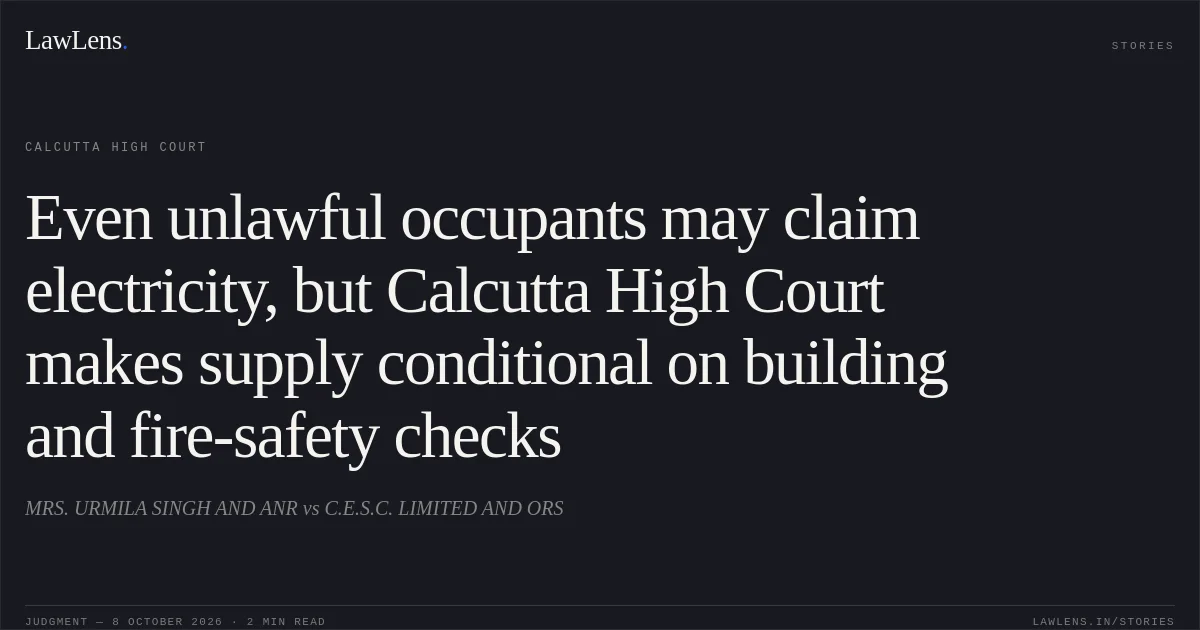
The appellants’ long-standing occupation was undisputed, so the Court accepted that they had a statutory entitlement to seek electricity; the disputed legality of their occupation did not, by itself, defeat that entitlement
¶ 8However, the construction’s regularization remained uncertain because the KMC order imposed conditions whose fulfilment was not established, and the Fire Department had raised concerns about a blocked route to the roof and had not renewed the fire licence
¶ 13, 17, 19–20Given the building’s high-risk status and commercial use, the Court found that an unconditional domestic connection would be inappropriate.
¶ 10, 19–20It therefore made supply subject to verification by CESC, through reports from KMC and the Fire Department, and prohibited residential use, LPG, and other equipment involving an open flame
¶ 10, 19–2005Holding
The Court modified the Single Judge’s order and held that the appellants could receive an electricity connection, but only a commercial connection and subject to CESC verifying, through the relevant KMC and Fire Department reports, whether the regularization conditions had been fulfilled and addressing the fire-safety concerns
¶ 20The connection could not be used for residential purposes, and LPG or other open-flame equipment was prohibited.
¶ 20The appeal and connected applications were disposed of
¶ 21–22Original Court PDF
MRS. URMILA SINGH AND ANRvsC.E.S.C. LIMITED AND ORS
Click to open original judgment
Original judgment, available to read, download and summarize on LawLens.in