Facts
The respondent (landlord) filed two eviction suits against the petitioner (tenant) regarding premises in Danilimda, Ahmedabad, let for a screen-printing business
Source reference: p. 2H.R.P. Suit No. 370/2017 was filed on grounds of non-user for over six months, unauthorized permanent construction, and subletting
Source reference: p. 3H.R.P. Suit No. 236/2018 was filed for arrears of rent from 2005 to 2018
Source reference: p. 3The tenant contended that he owned the superstructure, that construction was necessary repairs following damage by a fallen tree, and that rent had been deposited in a previous suit
Source reference: pp. 3-4The Trial Court and the Appellate Bench both decreed eviction on grounds of non-user, unauthorized construction, and arrears of rent
Source reference: p. 5Issues
1. Whether the tenant failed to use the premises for the purpose let for a continuous period of six months preceding the suit without reasonable cause under Section 13(1)(k) of the Rent Act.
Source reference: p. 19 / para 112. Whether the tenant breached the terms of the tenancy and Section 13(1)(b) by erecting a permanent structure without the landlord's written consent.
Source reference: p. 22 / para 143. Whether the case is governed by Section 12(3)(a) or 12(3)(b) regarding arrears of rent and if the eviction decree was validly passed.
Source reference: p. 25 / para 16.3Law Applied
The court applied Section 12(3)(a) of the Gujarat Rents, Hotel and Lodging House Rates Control Act, 1947, which mandates an eviction decree if rent is payable monthly, undisputed, in arrears for six months, and not paid within one month of notice
Source reference: p. 15Sections 13(1)(a), (b), and (k) were applied regarding breaches of Section 108(o) of the Transfer of Property Act, unauthorized permanent structures, and non-user without reasonable cause
Source reference: p. 15The court relied on the precedent Hotel Kings v. Sara Farhan Lukmani (2007) 1 SCC 202, establishing that even if a tenant is liable for municipal taxes, if the lease specifies monthly rent, the case is governed by Section 12(3)(a) rather than 12(3)(b)
Source reference: pp. 26-28Revisional limits were guided by Hindustan Petroleum Corp. Ltd. v. Dilbahar Singh (2014) 9 SCC 78
Source reference: pp. 30-32Reasoning
Regarding non-user, the court found the landlord discharged the initial burden as the Court Commissioner’s report (Exh. 49) showed the premises were locked and the tenant lacked keys
Source reference: p. 19The tenant's "reasonable cause"—damage by a fallen tree—was rejected because the Commissioner found no traces of a fallen tree, and the tenant failed to produce electricity bills or business receipts for 2016-2018
Source reference: pp. 19-20Regarding unauthorized construction, the court held that Conditions 3 and 8 of the Rent Note (Exh. 60) explicitly required the landlord's prior permission for any new construction, which the tenant admittedly bypassed, triggering Section 13(1)(b)
Source reference: pp. 22-23On arrears, the court rejected the tenant's argument that Section 12(3)(b) applied due to his liability for municipal taxes. Applying Hotel Kings, the court found that since the rent of Rs. 270 was payable monthly, Section 12(3)(a) applied
Source reference: pp. 28-29The tenant’s failure to pay within 30 days of the statutory notice (Exh. 73) necessitated an eviction decree, regardless of subsequent deposits during trial
Source reference: p. 29Holding
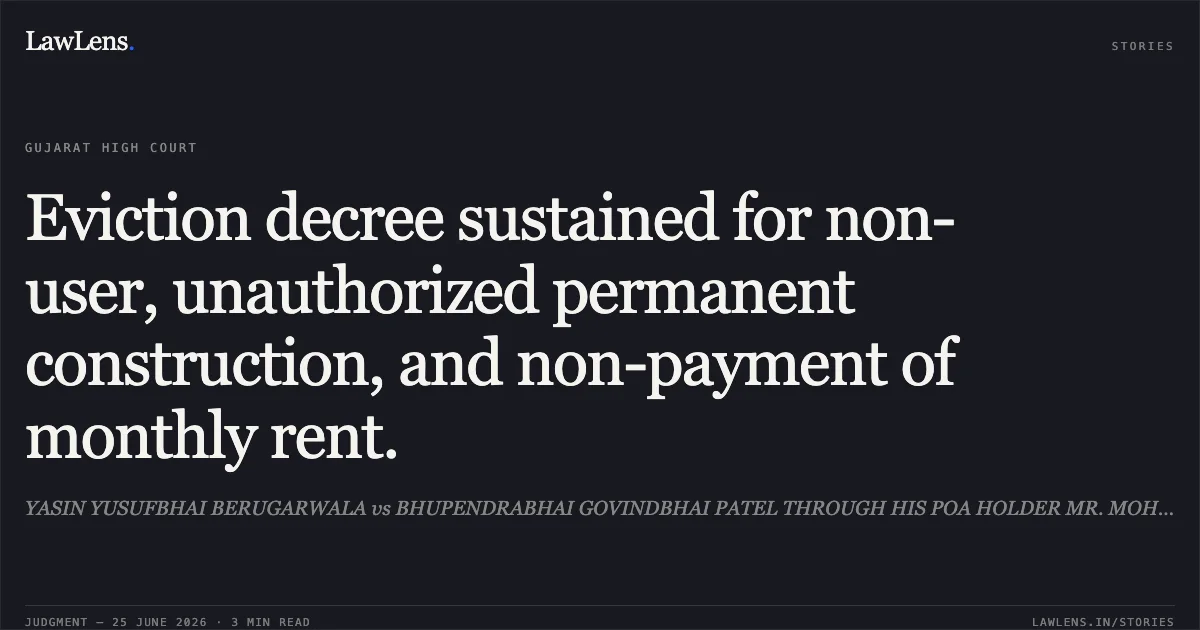
The landlord successfully proved non-user under Section 13(1)(k), unauthorized permanent construction under Section 13(1)(b), and default in rent under Section 12(3)(a)
The High Court dismissed the Revision Applications and confirmed the eviction decrees
Source reference: p. 33The court concluded that there was no "miscarriage of justice" or "perversity" in the concurrent findings of the lower courts that would warrant interference under its limited revisional jurisdiction. Rule discharged.
Source reference: pp. 32-33Acts & Sections Cited
7 provisions across 2 statutes referred to in this judgment. Each provision opens on LawLens.
Gujarat Rents, Hotel and Lodging House Rates Control Act, 19475
Transfer of Property Act, 18822
Original Court PDF
YASIN YUSUFBHAI BERUGARWALAvsBHUPENDRABHAI GOVINDBHAI PATEL THROUGH HIS POA HOLDER MR. MOHMMAD IRFAN MOHMMAD YASIN MACHISWALA
Click to open original judgment
Original judgment, available to read, download and summarize on LawLens.in