Facts
The petitioner, Rajendra Prasad Singh, challenged a notice dated 29 July 2026 issued by the South Eastern Railway and pasted on the wall of his residence.
Source reference: p.2, paras. 3–3.1The notice, addressed to “Unknown/Om Prakash Singh,” alleged unauthorized occupation of Railway land at Barigora Gate, LC-138, and directed vacation by 13 August 2026, failing which the Railway Administration threatened to forcibly dismantle the structure.
Source reference: p.2, paras. 3–3.1The petitioner contended that he occupied the premises, that no person named Om Prakash Singh resided there, that the property was not Railway land, and that the notice did not identify the statutory provision under which it was issued.
Source reference: p.2, para. 4The Railway submitted that the notice was affixed because the petitioner was found to be in unauthorized occupation.
Source reference: p.3, para. 5Issues
1. Whether the Railway’s notice, addressed to “Unknown/Om Prakash Singh” and affixed to the petitioner’s residence, was legally sustainable when it did not name the petitioner or specify the statutory provision invoked?
Source reference: p.3, para. 62. Whether the petitioner could be evicted or his structure demolished without following the procedure prescribed under the Public Premises (Eviction of Unauthorised Occupants) Act, 1971?
Source reference: p.3, paras. 7–8.2Law Applied
The Court applied the fundamental principle that no person can be evicted from property except by following due process of law.
Source reference: p.3, para. 7It further directed that any eviction action by the Railway against the petitioner must be initiated and pursued under the Public Premises (Eviction of Unauthorised Occupants) Act, 1971, including issuance of a proper notice in the petitioner’s name and compliance with the statutory procedure.
Source reference: p.3, paras. 8.1–8.2No precedent was cited, and the Court expressly stated that it had not adjudicated the merits of the parties’ competing claims regarding ownership or unauthorized occupation.
Source reference: p.4, para. 9Reasoning
The Court found that the impugned notice was not addressed to the petitioner but to “Unknown/Om Prakash Singh,” despite having been affixed to premises where the petitioner resided.
Source reference: p.3, para. 6The notice also failed to disclose the legal provision under which eviction and forcible dismantling were threatened.
Source reference: p.3, para. 6Since eviction cannot be effected without due process, the Railway could not proceed on the basis of an improperly addressed and legally unspecified notice.
Source reference: p.3, para. 7The Court therefore set aside the notice, while leaving the merits of the alleged Railway ownership and unauthorized occupation open, and permitted the respondents to initiate fresh proceedings under the 1971 Act.
Source reference: p.3, paras. 8–9Holding
The writ petition was allowed.
The notice dated 29 July 2026 was set aside because it was not issued in the petitioner’s name and did not specify the statutory basis for the proposed eviction.
Source reference: p.3, para. 8The Railway was directed to issue a fresh notice to the petitioner under the Public Premises (Eviction of Unauthorised Occupants) Act, 1971 and proceed in accordance with that Act.
Source reference: p.3, para. 8.1The Court clarified that eviction could take place only after compliance with due process, and directed the petitioner to cooperate in the proceedings.
Source reference: p.3, paras. 8.2–8.3Original Court PDF
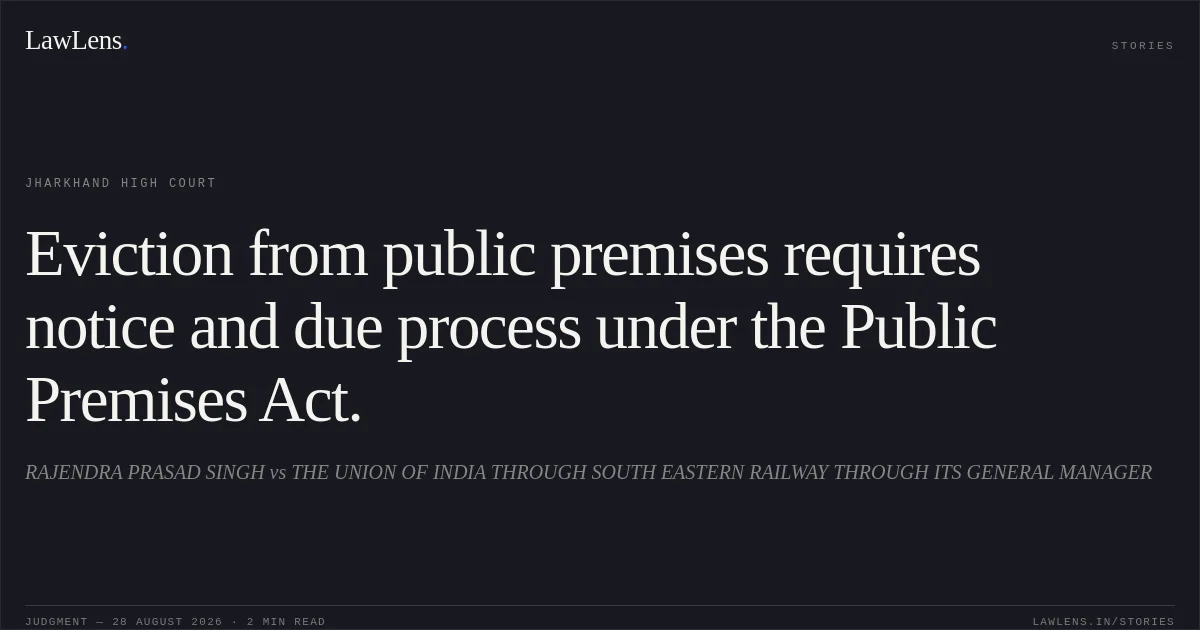
RAJENDRA PRASAD SINGHvsTHE UNION OF INDIA THROUGH SOUTH EASTERN RAILWAY THROUGH ITS GENERAL MANAGER
Click to open original judgment
Original judgment, available to read, download and summarize on LawLens.in
![Courts will not interfere with transfers absent mala fides or violation of statutory rules.. M Ramya vs EMPLOYEES STATE INSURANCE CORPORATION (ESIC). CAT - ['Chennai']. LawLens](/stories/thumbnails/courts-will-not-interfere-with-transfers-absent-mala-fides-or-violation-of-statutory-rules-a6845e9ca6f548fca284c51c8351957f.webp)
![Courts cannot direct one-time recruitment age relaxation absent authority in the governing rules or advertisement.. UT OF PUDUCHERRY vs M ANDAL. CAT - ['Chennai']. LawLens](/stories/thumbnails/courts-cannot-direct-one-time-recruitment-age-relaxation-absent-authority-in-the-governing-895d78fde47143e2a8ed0207c4b6a44f.webp)
![A review cannot correct an allegedly erroneous decision absent an error apparent on the record.. Ajit Kumar Jha vs RAILWAY BOARD. CAT - ['Delhi']. LawLens](/stories/thumbnails/a-review-cannot-correct-an-allegedly-erroneous-decision-absent-an-error-apparent-on-the-re-8ac952fd4eba470c92f7da20af72a220.webp)