01Facts
The petitioner’s family claimed continuous possession of a plot of land in North Lakhimpur for over 33 years, asserting it was covered under Touji Patta no. 31 & Dag no. 625.
p. 2The petitioner regularly paid Touji Bahira (encroachment penalty).
p. 2On 06.06.2026, the Circle Officer (Respondent No. 4) issued an eviction notice alleging the petitioner had unauthorizedly constructed a shop on land reserved for National Highway 15 (Dag no. 602).
pp. 2-3The petitioner challenged this notice, arguing it violated the procedure prescribed by law and that the land was not actually part of the NH-15 reservation.
p. 302Issues
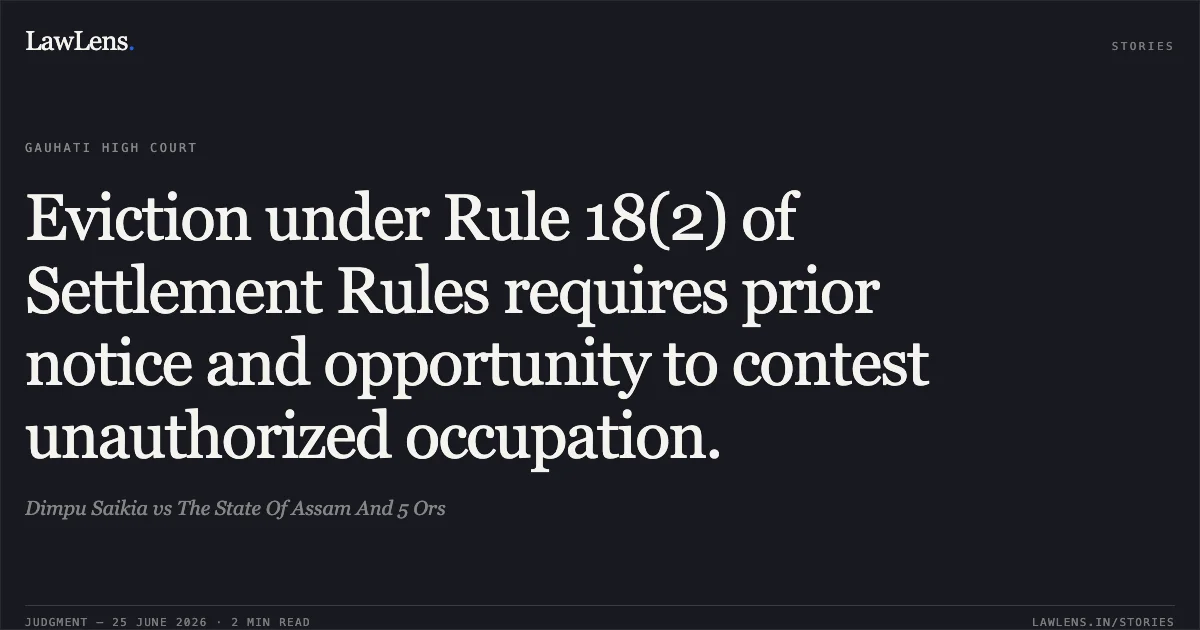
i.1. Whether the notice of eviction dated 06.06.2026 complied with the statutory procedures and principles of natural justice required for evicting an unauthorized occupant of Government land.
p. 5 / para. 10ii.2. Whether the payment of Touji Bahira revenue confers any legal right, title, or interest upon the occupant over Government land.
p. 3 / para. 703Law Applied
Rule 18 of the Settlement Rules framed under the Assam Land and Revenue Regulation, 1886, which empowers the Deputy Commissioner to eject persons from Government khas land or reserved land.
pp. 3-4Salak Uddin (Md.) v. State of Assam and others (2024 [4] GLT 857), which established that even unauthorized indigenous occupants have a "procedural legitimate expectation" to be served a notice and provided an opportunity to explain why they should be considered for settlement under the Land Policy, 2019, prior to eviction.
pp. 4-5Provisions in the judgment · 1
Assam Land and Revenue Regulation, 1886 Section 18
04Reasoning
While the court clarified that paying encroachment penalties (Touji Bahira) does not grant any title or right to the land, it emphasized that the State must follow due process before eviction.
p. 3The court found that the notice dated 06.06.2026 was essentially a summary eviction order rather than a "show cause" notice. It failed to provide the petitioner with a meaningful opportunity to explain his long-term occupation or his potential eligibility for land settlement under existing Government policies.
p. 5By giving only seven days to vacate without a prior hearing, the authority violated the procedural safeguards inherent in Rule 18(2) as interpreted by previous judicial mandates.
p. 505Holding
The court held that while the petitioner has no inherent right to the land by virtue of paying penalties, he is entitled to a fair hearing.
p. 5The court allowed the writ petition and quashed the impugned notice dated 06.06.2026, granting the competent authority the liberty to initiate fresh eviction proceedings, provided they comply with the law by affording the petitioner a due opportunity to be heard.
p. 5Original Court PDF
Dimpu SaikiavsThe State Of Assam And 5 Ors
Click to open original judgment
Original judgment, available to read, download and summarize on LawLens.in