Facts
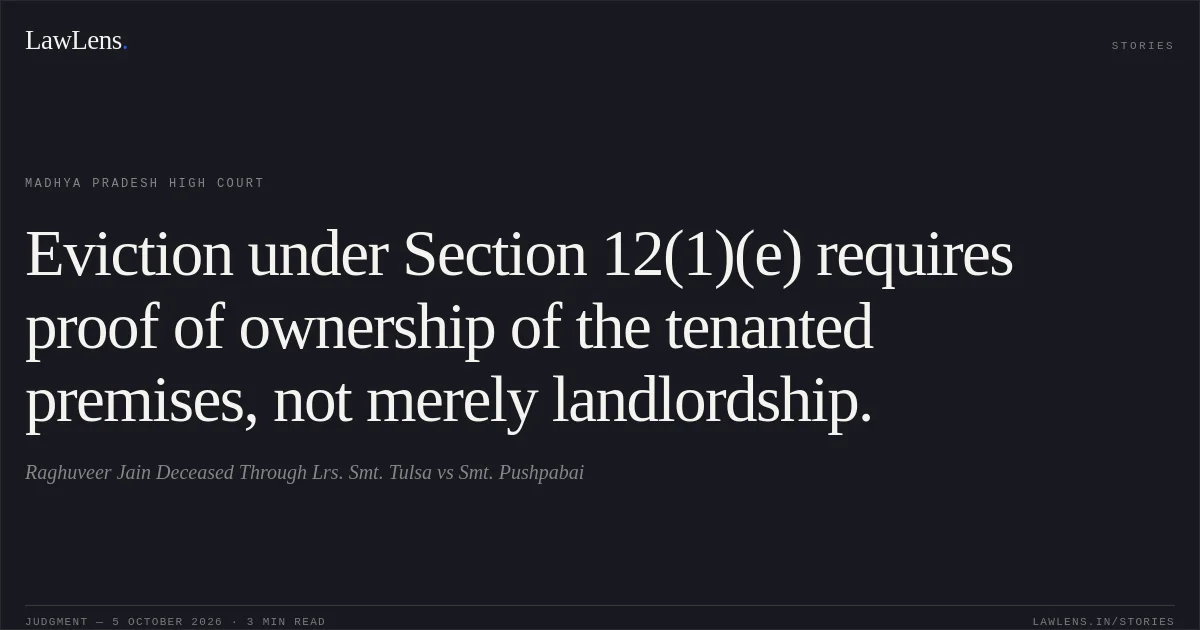
The plaintiff sued for eviction under Section 12(1)(e) of the Madhya Pradesh Accommodation Control Act, 1961, asserting that she had become owner of the house through a joint purchase with Sumitra Somani and a subsequent release deed, and that the defendant was her tenant.
Source reference: para. 2.1–2.9The defendant acknowledged an earlier tenancy under Hukumchand and Govindibai but disputed the plaintiff’s ownership and landlord–tenant relationship.
Source reference: para. 2.1–2.9The Trial Court dismissed the suit, finding that the relationship had not been proved, although it accepted the plaintiff’s bona fide requirement; the First Appellate Court reversed and decreed eviction on the basis of oral evidence and inferences.
Source reference: para. 2.1–2.9In the second appeal, the parties’ applications under Order XLI Rule 27 CPC resulted in the sale deed being admitted as additional evidence.
Source reference: paras. 5–9, 22It showed that the plaintiff and Sumitra Somani had purchased the southern part of the property, while the defendant occupied the western part.
Source reference: paras. 5–9, 22Issues
Whether the First Appellate Court erred in finding a landlord–tenant relationship on the basis of the plaintiff’s oral evidence.
Source reference: para. 3(a)Whether, without proof of a document of title, the plaintiff could be held to be the owner and landlord of the suit premises.
Source reference: para. 3(b)Whether the defendant had legally attorned to the plaintiff as landlord.
Source reference: para. 3(c)Law Applied
Section 12(1)(e) of the Madhya Pradesh Accommodation Control Act, 1961 requires a landlord seeking eviction for bona fide residential need to establish both landlordship and ownership of the accommodation; under Section 2(b), however, “landlord” is not synonymous with “owner,” since a person entitled to receive rent may be a landlord without being the owner.
Source reference: paras. 19–21In a landlord–tenant eviction dispute, the burden of proving ownership is less onerous than in a title suit, but the plaintiff must still establish ownership where the statutory ground requires it.
Source reference: paras. 20–21The Court also considered Mahendra Raghunathdas Gupta v. Vishwanath Bhikaji Mogul, (1997) 5 SCC 329, and Ku. Shakuntala Guha v. Jasmit Kaur Narula, 2017 SCC OnLine MP 2128, cited for the principle that formal attornment is not necessary for a transferee landlord to enforce the transferred landlord’s rights.
Source reference: paras. 11.1–11.2The appeal was brought under Section 100 CPC, with the substantial questions of law set out at paragraph 3.
Source reference: paras. 1, 3Reasoning
The plaintiff’s oral evidence and the defendant’s conduct did not credibly establish that she was entitled to receive rent from him; the plaintiff had not produced title documents at trial, could not explain their absence, and the asserted rent of ₹1,500 per month was unsupported by receipts or other evidence.
Source reference: paras. 14–18, 23Once admitted as additional evidence, the sale deed showed that the plaintiff and her co-purchaser acquired the southern part of the house, whereas the suit concerned the western part occupied by the defendant.
Source reference: paras. 22–23The Court therefore found that the plaintiff had failed to prove ownership of the suit accommodation and that the First Appellate Court had erred in inferring ownership and landlordship from oral evidence alone.
Source reference: paras. 22–23Although formal attornment was not necessary under the cited authorities, that principle could not cure the failure to prove the plaintiff’s entitlement to the premises or the landlord–tenant relationship in this case.
Source reference: paras. 11.1–11.2, 22–23Holding
The High Court allowed the second appeal and answered the substantial questions accordingly.
It set aside the First Appellate Court’s eviction decree and restored the Trial Court’s dismissal of the suit.
Source reference: para. 24The plaintiff was directed to bear her own costs and the appellants’ costs.
Source reference: para. 24Acts & Sections Cited
3 provisions across 2 statutes referred to in this judgment. Each provision opens on LawLens.
Code of Civil Procedure, 19082
Transfer of Property Act, 18821
Original Court PDF
Raghuveer Jain Deceased Through Lrs. Smt. TulsavsSmt. Pushpabai
Click to open original judgment
Original judgment, available to read, download and summarize on LawLens.in