01Facts
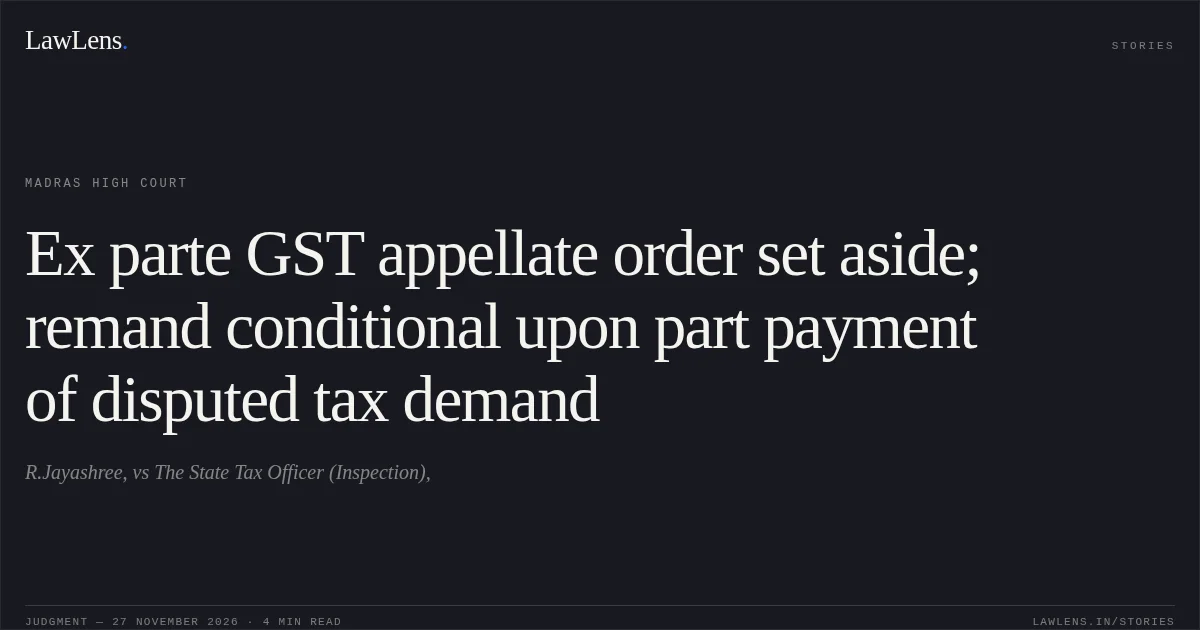
Two partners of the erstwhile partnership firm "Vectra Computer Solution" challenged two appellate orders under Article 226, primarily for breach of natural justice
¶ 1In WP(MD) No. 34122/2026, the firm's appeal was filed through a deceased partner, Mr. Suresh Babu. The firm was set ex parte and the original order was confirmed
¶ 2The order refers to the deceased partner as "Suresh Babu" while the petitioner is "S. Ramasubbu"; the discrepancy is not addressed.
p. 1In WP(MD) No. 34123/2026, the Department filed the appeal. The appellate order records that the original order was communicated on 26.11.2019 and the appeal was filed on 07.09.2020, which the petitioners say is beyond the prescribed and condonable period under Section 107. The respondent was again set ex parte, and the appellate authority allowed the Department's appeal by enhancing the tax and penalty
¶ 2The Department contended that the firm filed GSTR-1 disclosing taxable turnover of ₹69,69,559 but did not file GSTR-3B returns, so no tax was paid. It further contended that the Department's appeal was manually filed within limitation, as shown by a rubber stamp dated 12.03.2020
¶ 3The original order imposed a tax liability of ₹6,01,312. The appellate order enhanced the demand on the ground that the original order covered only April to December and omitted January to March 2019
¶ 4The petitioners agreed to pay ₹9,00,000 towards the tax demand, less about ₹1,00,000 already recovered or pre-deposited
¶ 502Issues
i.1. Whether the appellate orders, passed after the firm was set ex parte and in the absence of an effective hearing, are vitiated by breach of natural justice and liable to be set aside
¶ 1 · ¶ 2ii.2. Whether the Department's appeal was barred by limitation under Section 107 and the condonable period, given the recorded communication date of 26.11.2019 and filing date of 07.09.2020
¶ 2 · ¶ 4iii.3. Whether, in the circumstances, the matters should be remanded for fresh consideration, and on what terms
¶ 5 · ¶ 603Law Applied
The Court relied on Article 226 of the Constitution as the basis for writ jurisdiction to issue certiorari and mandamus against the appellate orders.
p. 1It examined the appellate orders under Section 107 of the GST enactment, which governs appeals to the Appellate Authority and their limitation period and condonable extension; the Court noted that the petitioners' limitation objection rests on that provision.
¶ 2 · ¶ 4It also treated breach of the principles of natural justice, namely denial of an opportunity to be heard after an ex parte setting, as a ground for interference.
¶ 1 · ¶ 2The Court's power to set aside appellate orders and remand on conditions, including a pre-deposit or part-payment requirement, is exercised as a matter of discretion in the writ jurisdiction.
¶ 5 · ¶ 6The order cites no judicial precedent.
The order does not separately identify the substantive GST liability provisions relied on by the authorities.
Provisions in the judgment · 1
the Act (alias, unresolved) Section 107
04Reasoning
The Court first noted that both appellate orders were passed with the firm set ex parte, and that the petitioners' grievance was principally about the denial of a fair hearing.
¶ 1 · ¶ 2On the Department's appeal, the Court examined the recorded dates. It observed that the appellate order itself records a filing date of 07.09.2020, while the Department relied on a rubber stamp dated 12.03.2020.
¶ 3 · ¶ 4The Court made no definitive finding on the point but held that the petitioners had made out an arguable case that the appeal was time-barred.
¶ 4On the merits, the Court acknowledged the undisputed fact that GSTR-1 disclosed substantial turnover without corresponding tax payment.
¶ 4Having regard to the "facts and circumstances cumulatively," however, the Court held that the matters warranted reconsideration by the appellate authority rather than final adjudication in the writ proceedings.
¶ 5To mitigate prejudice to the Department while securing the revenue, the Court made relief conditional on the petitioners paying ₹9,00,000 within 60 days, with credit for the pre-deposit.
¶ 5 · ¶ 6It also expressly preserved the petitioners' right to raise limitation along with their merits contentions.
¶ 605Holding
The Court held that the appellate orders could not stand given the arguable limitation issue and the ex parte procedure, and that a case was made out for reconsideration.
¶ 4 · ¶ 5Both impugned appellate orders are set aside and the matters are remanded to the Deputy Commissioner (Appeals), Madurai, for consolidated reconsideration. The relief is subject to: (i) verification of the pre-deposit and earlier recoveries (about ₹1,00,000); (ii) remittance of ₹9,00,000 by the petitioners within 60 days of receiving the order.
¶ 6The appellate authority must issue a fresh order within six months of that remittance, and the petitioners may raise limitation as well as merits. Upon fulfilment of these conditions, the bank attachments relating to the impugned orders are to be lifted. Both writ petitions are disposed of with no order as to costs, and the connected miscellaneous petitions are closed.
¶ 6 · ¶ 7Original Court PDF
R.Jayashree,vsThe State Tax Officer (Inspection),
Click to open original judgment
Original judgment, available to read, download and summarize on LawLens.in