Facts
The case concerns the appointment of seven staff members (3 teaching, 4 non-teaching) at a Sarva Shiksha Abhiyan (SSA) residential school in Khurai, Manipur.
Source reference: no citationIn 2012, an ad-hoc committee chaired by a local MLA (rather than the District Project Manager) appointed the respondents.
Source reference: p. 3This committee was later approved ex-post facto by the Deputy Commissioner (DC) on 17.10.2012.
Source reference: p. 3, 5After the respondents rendered "blemishless service" for nearly a decade, the same DC issued show-cause notices in 2021, alleging their appointments were irregular due to the committee's chairmanship.
Source reference: p. 4On 30.01.2021, the DC issued an order disengaging them.
Source reference: p. 4The respondents challenged this before a Single Bench, which allowed their writ petition.
Source reference: p. 4The State appealed this decision.
Source reference: p. 4Issues
1. Whether the initial appointment of the respondents was void ab initio due to the ad-hoc committee being chaired by a local legislator instead of the District Project Manager.
Source reference: p. 52. Whether the state's action was discriminatory given that similar appointments in 19 other schools remained undisturbed.
Source reference: p. 63. Whether ex-post facto approval by the competent authority (DC) validates an initially irregular appointment process.
Source reference: p. 8Law Applied
The Court applied the principle that an appointment cannot be interfered with solely on the grounds of lack of authorization if there is no specific Rule demonstrating a lack of authority, as established in *State of Manipur v. Yaikhom Joykumar Singh*.
Source reference: p. 8It also referenced the doctrine from *Bhartiya Seva Samaj Trust v. Yogeeshbhai Ambalal Patel*, which suggests that a party (the State/DC) responsible for an alleged infamy or procedural lapse cannot later benefit from it to the detriment of the appointee.
Source reference: p. 9Furthermore, the Court relied on Article 14 of the Constitution regarding the prohibition of discriminatory State action.
Source reference: p. 7Reasoning
The Court reasoned that the State's "sheet anchor" argument—that the committee was improperly chaired—was "flattened" by the fact that the DC had formally approved the committee's constitution on 17.10.2012.
Source reference: p. 5Since this ex-post facto approval was never nullified, the State could not now claim the appointments were originaly invalid.
Source reference: p. 8The Court found the State's action "clearly discriminatory" under Article 14 because staff in 19 other similarly situated schools, appointed through identical processes, were allowed to continue.
Source reference: p. 7The Bench noted that the respondents were fully qualified at the time of appointment and had served for over 10 years without blemish.
Source reference: p. 10-11Finally, the Court observed that the DPM (the "correct" chairman) had actually participated in the appointment meeting as Vice Chairman, further validating the process.
Source reference: p. 10Holding
The Court dismissed the State's appeal and upheld the Single Bench's order.
It held that the respondents cannot be penalized for a decades-old procedural irregularity that the State itself had ratified through ex-post facto approval.
Source reference: p. 11The Court directed the State to ensure the seven respondents resume their work "forthwith" to avoid understaffing the school.
Source reference: p. 11All interim stay orders were vacated.
Source reference: p. 12Original Court PDF
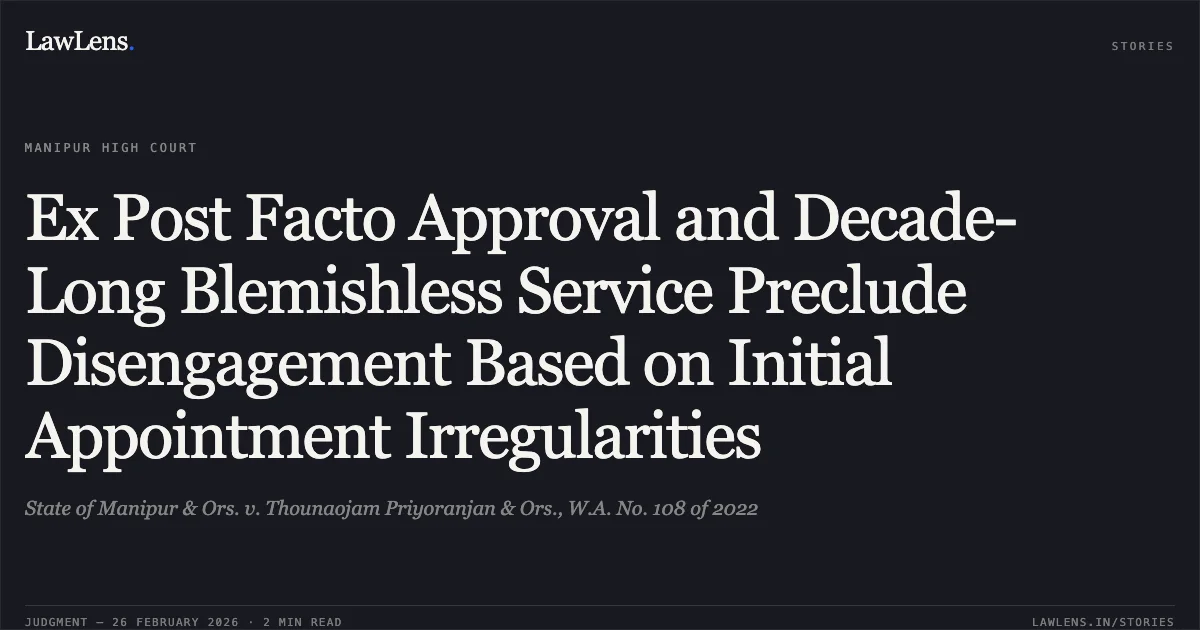
State of Manipur & Ors. v. Thounaojam Priyoranjan & Ors., W.A. No. 108 of 2022
Click to open original judgment
Original judgment, available to read, download and summarize on LawLens.in