Facts
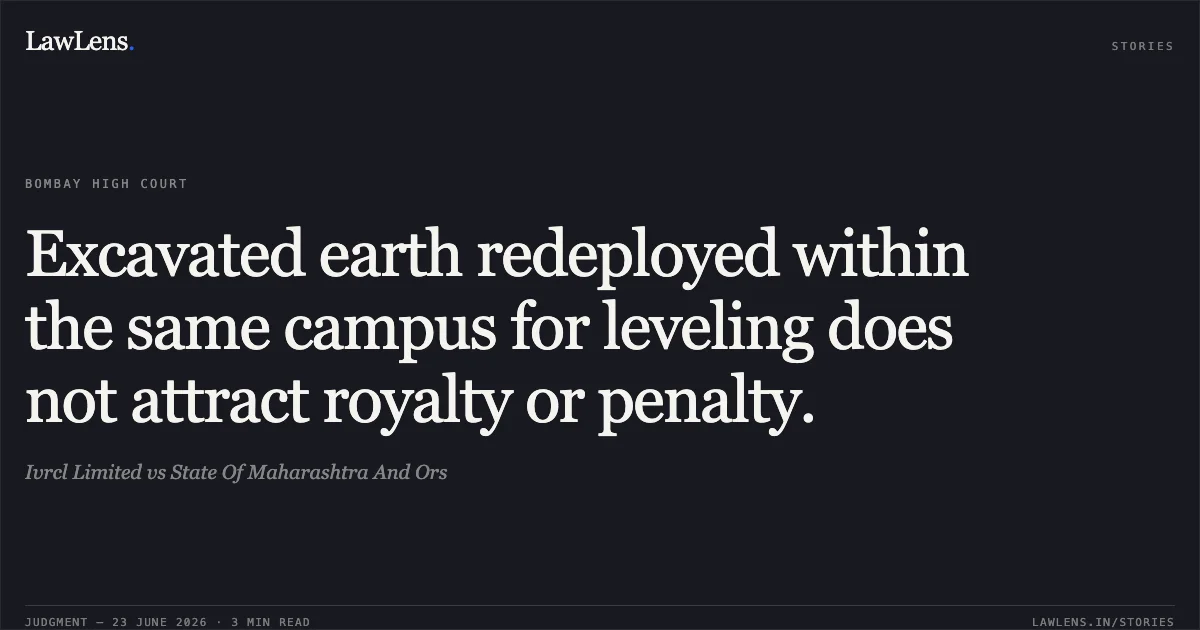
The Petitioner, a construction company, was awarded a contract by the Department of Atomic Energy for work at the IIT Powai campus. The work order mandated that surplus excavated material be disposed of at designated dumping pits within the IIT campus.
Source reference: p. 3In 2010, the Sub-Divisional Officer (SDO) issued a Show Cause Notice alleging the Petitioner excavated 3,800 brass of minor minerals without permission, invoking Section 48(7) of the Maharashtra Land Revenue Code (MLRC), 1966.
Source reference: p. 4Despite clarifications that the material remained within the campus for leveling purposes, the SDO imposed a penalty of ₹54,08,811/-, which was subsequently upheld by the Collector and the Additional Commissioner in two rounds of litigation.
Source reference: p. 5-7The Petitioner challenged these orders, contending that moving excavated earth within the same campus does not constitute "unauthorized removal" of minerals.
Source reference: p. 7Issues
1. Whether the excavation and transfer of earth from one survey number to another within the same campus constitutes unauthorized extraction or removal of minor minerals under Section 48(7) of the MLRC.
Source reference: p. 12 / para. 25-262. Whether the impugned Show Cause Notice was valid given its reliance on non-existent statutory provisions.
Source reference: p. 16 / para. 36-37Law Applied
The Court applied Section 48(7) of the Maharashtra Land Revenue Code, 1966, which penalizes the unauthorized extraction or disposal of minerals belonging to the State.
Source reference: p. 17It relied on the Supreme Court precedent in Promoters and Builders Association of Pune v. State of Maharashtra, which held that excavation of ordinary earth for construction does not attract penalties unless the material is commercially exploited.
Source reference: p. 18 / para. 41The Court also referenced the Notification dated 11th May 2015 under the Mines and Minerals (Development and Regulation) Act, 1957, which explicitly exempts royalty on earth utilized for leveling on the same plot.
Source reference: p. 18-19Additionally, it applied the "model litigant" doctrine derived from Dilbagh Rai Jarry v. Union of India and State of Punjab v. Geeta Iron & Brass Works Ltd., requiring the State to act fairly and avoid frivolous litigation.
Source reference: p. 14Reasoning
The Court found the SDO’s approach "mechanical and casual". It reasoned that since the land was allotted to IIT, the State’s reservation of minerals did not extend to common earth used for a foundation within the same premises.
Source reference: p. 2, 7The Court noted that the "movement" of earth between survey numbers within a single campus does not satisfy the ingredients of Section 48(7) of the MLRC, as there was no commercial disposal or removal from the site.
Source reference: p. 12, 18Furthermore, the Show Cause Notice was deemed legally "vitiated" because it cited a non-existent provision—Section 29(4) of the "Mumbai Minor Minerals Act, 1955".
Source reference: p. 16The Court criticized the Respondents for failing to file a reply for eight years and for disregarding settled law that development-related excavation on-site is exempt from royalty.
Source reference: p. 19-20Holding
The Court answered both issues in the negative. It held that the impugned orders were arbitrary, perverse, and based on a non-existent legal foundation.
The High Court quashed the Order dated 14th November 2014 and the Demand Notice dated 13th January 2015. The Petition was allowed with compensatory costs of ₹5 lakhs imposed on the State of Maharashtra for compelling the Petitioner into decade-long avoidable litigation. The Court further directed the Deputy Secretary of the Revenue and Forest Department to file a compliance affidavit regarding remedial measures.
Source reference: p. 20, 21-22Acts & Sections Cited
1 provisions across 1 statute referred to in this judgment. Each provision opens on LawLens.
Maharashtra Land Revenue Code, 19661
Original Court PDF
Ivrcl LimitedvsState Of Maharashtra And Ors
Click to open original judgment
Original judgment, available to read, download and summarize on LawLens.in