Facts
The applicant was awarded Contract No. 511687784746189 by West Central Railway under a Letter of Acceptance dated 25 August 2023 for mechanized cleaning of coaches at Coaching Depot, Jabalpur.
Source reference: para. 2The contract was valued at ₹5,35,30,910.51 for 24 months, and the applicant furnished a performance guarantee of ₹53,53,100.
Source reference: para. 2The applicant alleged that the scope of work was enhanced by approximately 33%, beyond the permissible 25% variation limit, resulting in additional financial liability and deductions from its bills.
Source reference: para. 2By letter dated 27 June 2025, it objected to undertaking work beyond the permissible limit without a formal amendment and compensation.
Source reference: paras. 2–4The respondent thereafter issued a seven-day notice and terminated the contract on 7 July 2025.
Source reference: paras. 2–4The applicant disputed the termination, alleged retaliatory action, challenged the deductions, debarment and withholding of bank guarantees, and invoked Clause 8.2 of the GCC, 2018, seeking appointment of an arbitrator through representations dated 3 October 2025 and 17 February 2026.
Source reference: paras. 2–5The respondent rejected the request on 9 April 2026, contending that the disputes concerned “Excepted Matters” under Clause 8.1 of the GCC and were therefore not arbitrable.
Source reference: paras. 2–5The applicant consequently filed the present application under Section 11 of the Arbitration and Conciliation Act, 1996, for appointment of a sole arbitrator.
Source reference: para. 1Issues
Whether a valid arbitration agreement existed between the parties and whether the disputes arising from the contract were referable to arbitration under Section 11 of the Arbitration and Conciliation Act, 1996?
Source reference: paras. 1, 3–4, 11Whether the respondent’s objection that termination and related disputes constituted “Excepted Matters” under Clause 8.1 of the GCC was required to be decided by the High Court at the referral stage?
Source reference: paras. 5, 7, 11Whether questions concerning limitation, jurisdiction, contractual variation, termination, deductions, debarment and withholding of securities should be left for determination by the Arbitral Tribunal?
Source reference: paras. 7–11Law Applied
The Court applied Section 11(6-A) of the Arbitration and Conciliation Act, 1996, under which the referral court is confined to examining the existence of an arbitration agreement.
Source reference: para. 7Section 16 embodies the kompetenz-kompetenz principle, enabling the Arbitral Tribunal to rule on its own jurisdiction, including objections concerning the existence, scope or validity of the arbitration agreement and limitation.
Source reference: paras. 7–10Relying on Uttarakhand Purv Sainik Kalyan Nigam Ltd. v. Northern Coal Field Ltd., (2020) 2 SCC 455, the Court held that threshold issues, including jurisdiction and limitation, ordinarily fall within the Tribunal’s jurisdiction at the post-reference stage.
Source reference: paras. 7–8It also relied on Central Organisation for Railway Electrification v. ECI SPIC SMO MCML (JV), (2025) 4 SCC 641, and Aslam Ismail Khan Deshmukh v. ASAP Fluids (P) Ltd., (2025) 1 SCC 502, for the principle that the referral court must not conduct an intricate evidentiary inquiry into limitation or the merits of the claims.
Source reference: paras. 9–10The contractual arbitration mechanism under Clause 8.2 of the GCC, 2018, and the respondent’s reliance on the “Excepted Matters” exclusion under Clause 8.1 were also considered.
Source reference: paras. 5, 11Reasoning
The existence of the arbitration clause in the contract was not disputed.
Source reference: paras. 3–4, 11The applicant’s claims concerning enhanced work, deductions, termination, performance, debarment and retention of bank guarantees arose out of the contractual relationship and were therefore capable of being placed before the Arbitral Tribunal.
Source reference: paras. 3–4, 11Although the respondent argued that the variation had been accepted, payments had been made, the applicant had committed fundamental breaches, and termination fell within the “Excepted Matters” clause, these contentions involved disputed questions of fact and contractual interpretation.
Source reference: para. 5Applying Section 11(6-A) and Section 16, the Court held that it was not required to undertake a detailed examination of those objections at the referral stage.
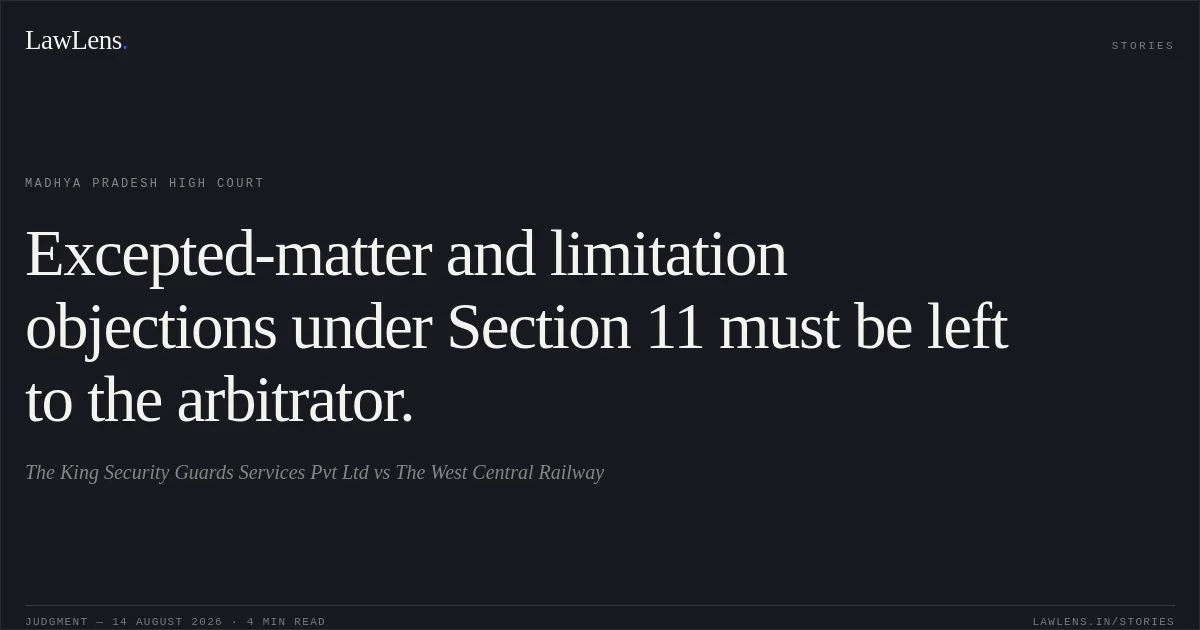
Source reference: paras. 7–11The question whether particular disputes were excluded as “Excepted Matters,” as well as limitation and other jurisdictional objections, was left open for determination by the appointed arbitrator.
Source reference: paras. 7–11Holding
The application under Section 11 was allowed because a subsisting arbitration agreement existed and disputes continued between the parties.
The Court appointed Shri Sujoy Paul, Retired Chief Justice of the Calcutta High Court, as the sole arbitrator to adjudicate the disputes.
Source reference: para. 12(i)The arbitration was directed to take place at Jabalpur; the arbitrator was to issue notices and fix the venue and dates, while the parties were directed to deposit fees and charges in accordance with the applicable M.P. Arbitration Centre Rules, 2019.
Source reference: paras. 12(ii)–(iii)The issue of whether the disputes were “Excepted Matters,” along with limitation and all other rights and contentions, was expressly left open for adjudication by the Arbitral Tribunal.
Source reference: paras. 11–12The arbitration case was accordingly disposed of.
Source reference: para. 14Acts & Sections Cited
8 provisions across 2 statutes referred to in this judgment. Each provision opens on LawLens.
Arbitration and Conciliation Act, 19967
Indian Contract Act, 18721
Original Court PDF
The King Security Guards Services Pvt LtdvsThe West Central Railway
Click to open original judgment
Original judgment, available to read, download and summarize on LawLens.in