Facts
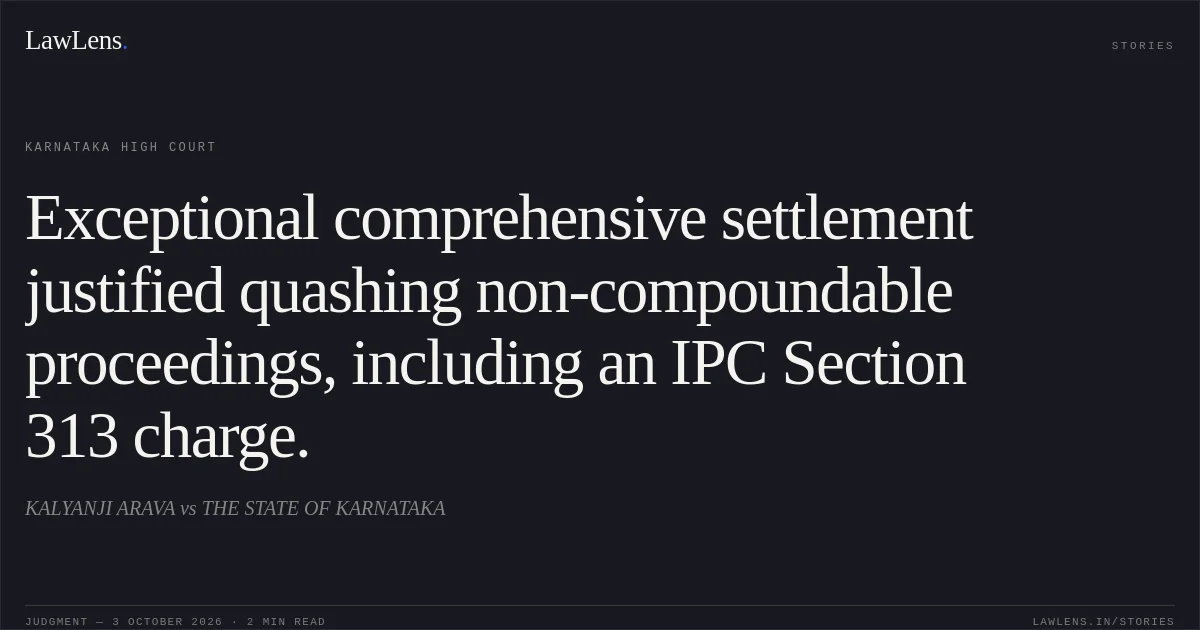
The petitioner and respondent No. 2, former colleagues at Infosys, developed a personal relationship. Respondent No. 2 alleged that the petitioner promised to marry her after obtaining a divorce, obtained money from her on that basis, and attempted to have physical relations with her, after which she was compelled to undergo an abortion. A case was registered for offences under Sections 420, 313 and 354 IPC, and a charge sheet was filed; the petitioner sought quashing of the resulting proceedings.
Source reference: p. 2–3During the petition, the parties filed a joint memo recording a voluntary, comprehensive settlement, including payment of ₹10,00,000 to respondent No. 2 and her agreement to withdraw other proceedings between them.
Source reference: p. 4–5Respondent No. 2 personally confirmed that the settlement was voluntary and that she did not wish to pursue the proceedings.
Source reference: p. 5Issues
1. Whether the High Court should exercise its inherent jurisdiction to quash the criminal proceedings following the parties’ settlement, notwithstanding the non-compoundable offences alleged, including Section 313 IPC.
Source reference: p. 6–72. Whether, in the circumstances of this case, continuation of the prosecution would serve the ends of justice or amount to an abuse of process.
Source reference: p. 7–9Law Applied
The Court considered its inherent jurisdiction under Section 482 CrPC, referred to in the petition as Section 528 BNSS, to prevent abuse of process and secure the ends of justice.
Source reference: p. 7It held that the non-compoundable character of an offence does not, by itself, exclude the exercise of that jurisdiction; the Court must assess the circumstances as a whole.
Source reference: p. 7The Court also treated the allegation under Section 313 IPC—termination of pregnancy without the woman’s consent—as serious and one that cannot ordinarily be terminated merely because of a private settlement.
Source reference: p. 6No judicial precedents are cited in the order.
Source reference: no citationReasoning
The Court acknowledged the gravity of the Section 313 allegation and cautioned that settlement alone would not ordinarily justify quashing such a charge.
Source reference: p. 6It nevertheless found that the dispute arose from a personal relationship, the settlement covered the parties’ inter se disputes and other pending proceedings, and respondent No. 2 personally and unequivocally confirmed its voluntary nature and her wish not to proceed.
Source reference: p. 7–8Considering these circumstances together—not merely the payment—the Court concluded that continuing the prosecution would not advance the ends of justice and would amount to an abuse of process.
Source reference: p. 8–9It expressly confined its decision to the peculiar facts of the case and stated that it did not establish a general rule permitting settlement-based quashing of Section 313 IPC allegations.
Source reference: p. 10Holding
The Court allowed the petition and quashed the proceedings in C.C. No. 5701/2025, arising from Crime No. 569/2024, pending before the Chief Judicial Magistrate, Bengaluru Rural.
The operative order quashes the C.C. proceedings; the Court’s decision is expressly limited to the circumstances of this case.
Source reference: p. 10Acts & Sections Cited
7 provisions across 4 statutes referred to in this judgment. Each provision opens on LawLens.
Code of Criminal Procedure, 19731
Bharatiya Nagarik Suraksha Sanhita, 20231
Indian Penal Code, 18604
Bharatiya Nyaya Sanhita, 20231
Original Court PDF
KALYANJI ARAVAvsTHE STATE OF KARNATAKA
Click to open original judgment
Original judgment, available to read, download and summarize on LawLens.in