01Facts
The appellant was appointed as a Grade II Police Constable on 15 December 2008, later promoted as Grade I Constable and subsequently serving as a Sub-Inspector of Police.
p. 2While serving as a Grade I Constable in the Armed Reserve, he remained unauthorisedly absent for approximately 21 days.
p. 2Following disciplinary proceedings and an opportunity of hearing, the disciplinary authority imposed the punishment of reduction of pay by one stage for one year, with the punishment operating to affect his future increments, by proceedings dated 9 April 2013.
p. 2His appeal and review were rejected.
p. 2He thereafter filed a writ petition, which was dismissed on 28 March 2023, leading to the present writ appeal.
p. 2The appellant contended that his absence was due to illness arising from a piles-related complaint and treatment in his native district, Thoothukudi, and that he had no intention to remain unauthorisedly absent.
pp. 2–302Issues
i.Whether the punishment of reduction in pay imposed for the appellant’s unauthorised absence of approximately 21 days was disproportionate or otherwise unsustainable under the disciplinary rules applicable to the police force.
pp. 2–3ii.Whether the appellant’s explanation that his absence was caused by illness, coupled with his subsequent continuous service and promotion, warranted reconsideration of the quantum of punishment.
pp. 3–403Law Applied
The Court applied the principle that the police force is a disciplined force and that continuous unauthorised absence by a police personnel for 21 days constitutes serious misconduct; ordinarily, such absence may result in the personnel being treated as having deserted the force.
p. 3The punishment must therefore be assessed with reference to the applicable Discipline and Appeal Rules and the requirement of maintaining discipline in the police service.
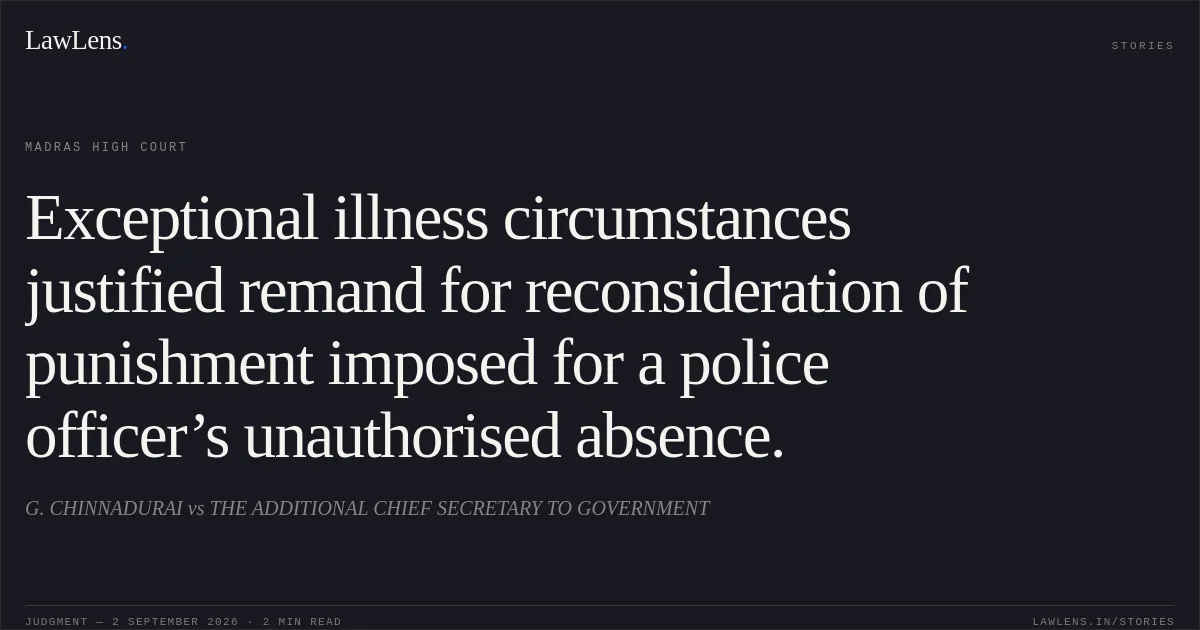
p. 3At the same time, exceptional circumstances such as illness may be considered while determining the appropriate quantum of punishment.
p. 304Reasoning
The Court held that the punishment could not ordinarily be regarded as inconsistent with the disciplinary framework because the appellant, being a member of a disciplined police force, had remained absent without authorisation for 21 days.
p. 3However, the appellant’s explanation that he had travelled to his native district for treatment of his illness and was unable to immediately inform his superiors was considered a circumstance warranting individual reconsideration.
pp. 3–4The Court also took into account that he had rejoined duty after the period of absence, had thereafter continued in service, and had been promoted as Sub-Inspector of Police.
p. 4Although these circumstances did not exonerate the misconduct, they justified reconsideration of the quantum of punishment as an exceptional case.
p. 405Holding
The writ appeal was allowed.
p. 4The order dismissing W.P. No. 28251 of 2019 dated 28 March 2023 was set aside.
p. 4The matter was remanded to the disciplinary authority to reconsider the punishment imposed and pass appropriate orders on merits and in accordance with law as expeditiously as possible.
p. 4The Court clarified that the order was confined to the appellant’s exceptional circumstances and was not to be treated as a precedent applicable to other cases.
p. 4No costs were awarded.
p. 4Original Court PDF
G. CHINNADURAIvsTHE ADDITIONAL CHIEF SECRETARY TO GOVERNMENT
Click to open original judgment
Original judgment, available to read, download and summarize on LawLens.in