Facts
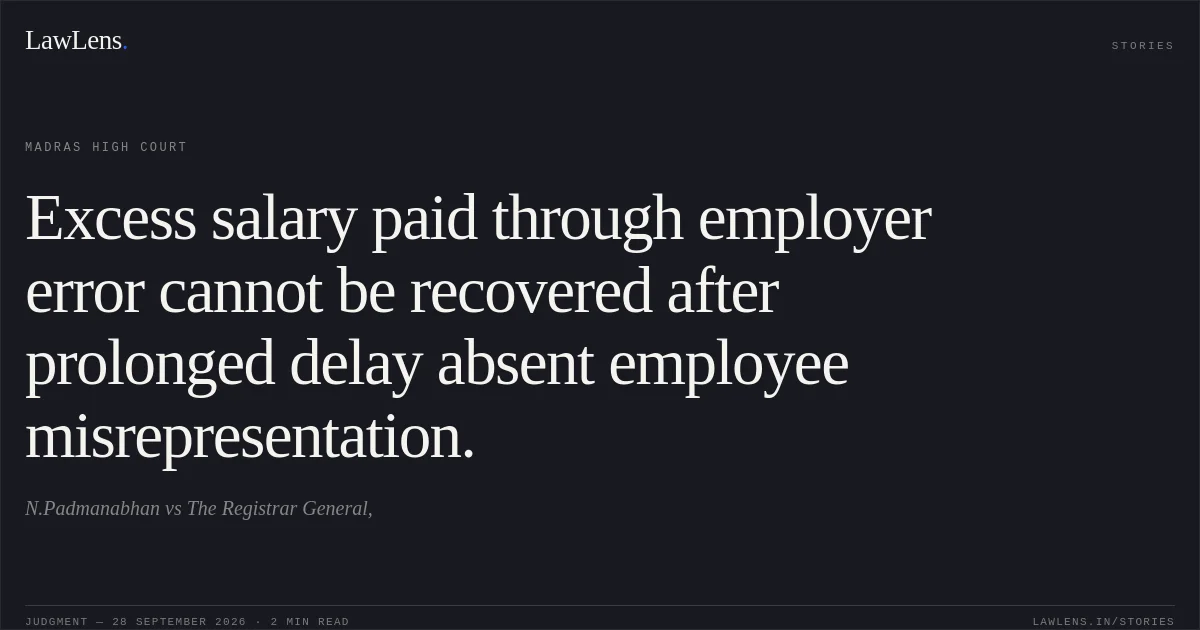
The petitioner, appointed as a copyist in 1998 and later promoted to Sheristadar, received excess pay of ₹1,01,946 between 1 October 2020 and 31 July 2026 due to an erroneous pay fixation.
Source reference: p.1–2The second respondent issued a show-cause notice concerning recovery and re-fixation of pay, which the petitioner challenged under Article 226 of the Constitution
Source reference: p.1–2The Court recorded that the pay revision followed an audit objection and that the respondents had not established misrepresentation by the petitioner
Source reference: p.2, p.4Issues
Whether the respondents could revise the petitioner’s pay to correct an erroneous fixation under the applicable pay rules
Source reference: p.2Whether recovery of the excess pay was permissible where the error was attributable to the establishment and the employee had not misrepresented any facts
Source reference: p.2–4Law Applied
The Court recognised that competent authorities may correct erroneous pay fixation and revise pay in accordance with applicable Pay Rules and Government Orders
Source reference: p.2It also applied the principles in State of Punjab v. Rafiq Masih, (2015) 4 SCC 334, which identify circumstances in which recovery of excess payments may be impermissible, including where recovery would be iniquitous, harsh, or arbitrary and outweigh the employer’s equitable right to recover
Source reference: p.3The Court further relied on the principle that an employee should not be penalised for an establishment’s pay-fixation error, particularly where recovery after a lapse of time would cause extreme hardship
Source reference: p.2Reasoning
The Court distinguished between correcting the pay fixation and recovering amounts already paid.
Source reference: p.2It found that the revision was supported by the audit objection and applicable pay rules, but that the excess payment resulted from an establishment error and was not shown to have been procured by the petitioner’s misrepresentation
Source reference: p.2, p.4In those circumstances, recovery would cause undue hardship; applying Rafiq Masih, the Court upheld the revised pay fixation but disallowed recovery
Source reference: p.3–4Holding
The writ petition was partly allowed.
The revision of pay was confirmed, but recovery of the excess pay was set aside; any amount already recovered was directed to be repaid to the petitioner within 12 weeks of receipt of the order
Source reference: p.4No costs were awarded
Source reference: p.4Original Court PDF
N.PadmanabhanvsThe Registrar General,
Click to open original judgment
Original judgment, available to read, download and summarize on LawLens.in