01Facts
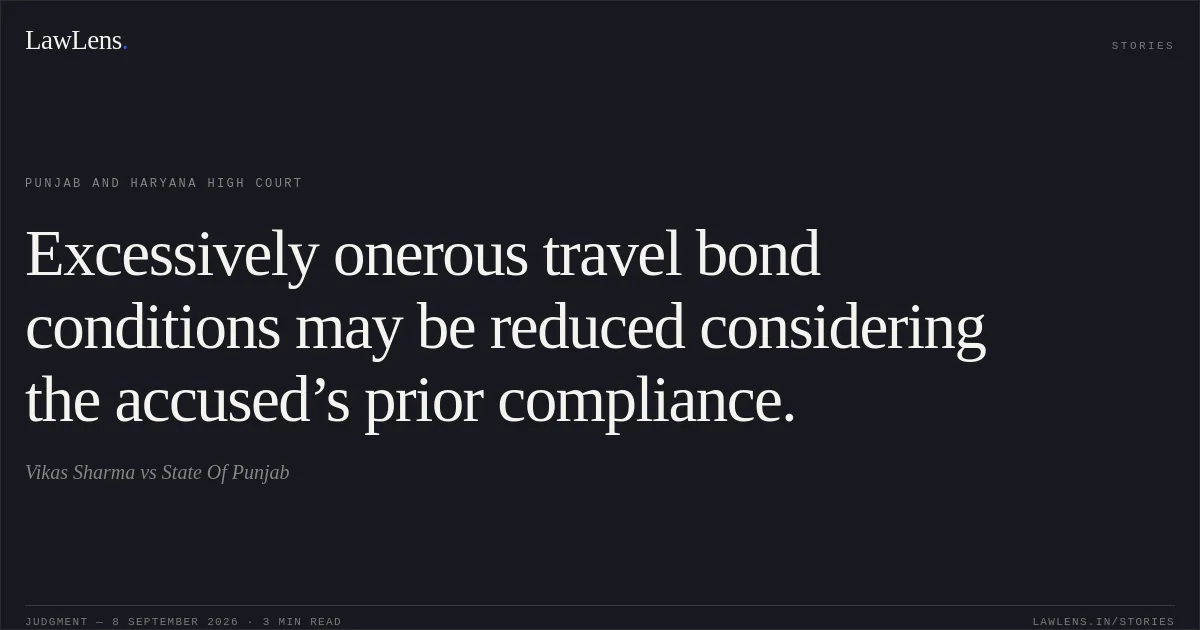
The petitioner invoked Section 528 of the Bharatiya Nagarik Suraksha Sanhita, 2023, corresponding to Section 482 of the Code of Criminal Procedure, 1973, seeking modification of a travel-related condition imposed by the Additional Sessions Judge, Mohali.
¶ 1The condition arose from FIR No. 10 dated 21.06.2019, registered for offences under Sections 409, 420, 465, 467, 468, 471 and 120-B IPC, the corresponding provisions of the Bharatiya Nyaya Sanhita, 2023, and Sections 7 and 13(1)(A) read with Section 13(2) of the Prevention of Corruption Act, 1988.
¶ 1By order dated 17.08.2026, the trial Court permitted the petitioner to travel to the United Kingdom from 19.08.2026 to 10.01.2027, subject to several conditions, including furnishing a personal bond of ₹1 crore with one surety, or an FDR/bank guarantee for the equivalent amount.
¶ 2The petitioner had previously travelled abroad with the Court’s permission and had returned within the stipulated period without misusing the concession.
¶ 3, 7, 902Issues
i.Whether the condition requiring the petitioner to furnish a personal bond of ₹1 crore with one surety, or an equivalent FDR/bank guarantee, was excessively onerous and warranted modification?
¶ 4, 7, 9ii.Whether, in exercise of jurisdiction under Section 528 BNSS, the High Court should reduce the security amount while retaining the remaining conditions governing the petitioner’s foreign travel?
¶ 1, 9–1103Law Applied
The Court exercised its inherent jurisdiction under Section 528 of the Bharatiya Nagarik Suraksha Sanhita, 2023, corresponding to Section 482 CrPC, to secure the ends of justice and prevent oppressive or impracticable conditions in criminal proceedings.
¶ 1The governing principle applied was that a condition attached to permission to travel abroad must be reasonable and proportionate to its legitimate purpose—namely, securing the accused’s return and availability for trial—and must not be so onerous as to effectively defeat the permission granted.
¶ 5, 7, 9Provisions in the judgment · 15 · Linked ones open on LawLens
Bharatiya Nagarik Suraksha Sanhita, 2023 Section 528
Code of Criminal Procedure, 1973 Section 482
Indian Penal Code, 1860 Section 409Section 420Section 465Section 467Section 468Section 471
Bharatiya Nyaya Sanhita, 2023 Section 316Section 318Section 336Section 338Section 340
Prevention of Corruption Act, 1988 Section 7Section 13
04Reasoning
The Court acknowledged that the petitioner’s return to India and availability for trial were legitimate concerns.
¶ 7, 9However, it considered the ₹1 crore security requirement disproportionate in light of the petitioner’s unblemished previous conduct, including his earlier compliance with foreign-travel conditions and timely return to India.
¶ 7, 9The petitioner’s prior exemption from personal appearance was also noted.
¶ 7The Court further considered the surrounding circumstances, including the petitioner’s defence that he had resigned as a company director before the alleged fraud and was neither an authorised signatory nor legally empowered under the Joint Venture Agreement.
¶ 8Although these aspects were not finally adjudicated, they formed part of the overall assessment of whether the condition was unduly onerous.
¶ 8Balancing the State’s interest in securing the petitioner’s presence with the petitioner’s established compliance, the Court held that the amount required suitable reduction.
¶ 7, 9–1005Holding
The petition was allowed in part.
¶ 10The condition imposed by the Additional Sessions Judge was modified by reducing the required amount from ₹1 crore to ₹25 lakhs.
¶ 10The revised condition required the petitioner to furnish personal bonds of ₹25 lakhs with one surety, or an FDR/bank guarantee for the equivalent amount, before the trial Court.
¶ 10All other conditions in the order dated 17.08.2026—including disclosure of the UK address and contact details, submission of passport particulars, restriction on changing counsel, disclosure of immovable assets, and return to India by 10.01.2027—were maintained.
¶ 11The petition was accordingly disposed of.
¶ 12Original Court PDF
Vikas SharmavsState Of Punjab
Click to open original judgment
Original judgment, available to read, download and summarize on LawLens.in