Facts
The respondent, a licensed manufacturer and exporter of bottled country liquor, dispatched 30,77,011.57 proof litres of country liquor from Madhya Pradesh to importing units in Chhattisgarh under permits.
Source reference: para. 2The destination units acknowledged receipt of 30,60,581.88 proof litres, resulting in an alleged shortage of 16,429.69 proof litres during September 2006 to November 2007.
Source reference: para. 2Following audit observations by the Comptroller and Auditor General, the Excise Commissioner issued a demand notice and subsequently, by order dated 5 October 2010, demanded Rs. 21,79,768.60 as excise duty on an assessed deficit of 16,492.2 proof litres under the Madhya Pradesh Country Spirit Rules, 1995.
Source reference: para. 2The respondent challenged the demand before the Board of Revenue, relying upon verification reports from Chhattisgarh authorities and disputing the calculation of the shortage and the existence of statutory authority to levy duty on transit loss.
Source reference: paras. 2, 8By order dated 19 July 2012, the Board of Revenue allowed the appeal and set aside the demand, holding that the demand lacked statutory sanction and that the Excise Commissioner had failed to properly consider the Chhattisgarh verification reports.
Source reference: para. 2The State challenged that order under Articles 226 and 227 of the Constitution.
Source reference: para. 1Issues
1. Whether the Madhya Pradesh Excise Act and the Madhya Pradesh Country Spirit Rules, 1995 authorised the levy and recovery of excise duty merely on account of a shortage of bottled country liquor allegedly occurring during transit to another State
Source reference: paras. 6, 10–112. Whether the Excise Commissioner’s determination of the alleged shortage was sustainable when relevant verification reports from the State of Chhattisgarh had not been properly considered or reconciled
Source reference: paras. 4–5, 12–133. Whether the Board of Revenue erred in setting aside the demand instead of remanding the matter to the Excise Commissioner for fresh adjudication
Source reference: para. 7, 144. Whether the Board of Revenue’s order disclosed perversity, jurisdictional error, patent illegality, or any other ground warranting interference under Articles 226 and 227
Source reference: paras. 15–17Law Applied
The Court applied the constitutional and fiscal principle that no tax, duty, fee, or other fiscal impost may be levied or collected except by authority of law, and that statutory conditions creating fiscal liability must be strictly satisfied; ambiguity as to the source of fiscal power operates in favour of the assessee.
Source reference: para. 10Sections 9, 25 and 26 of the Madhya Pradesh Excise Act, read with the Madhya Pradesh Country Spirit Rules, 1995, were required to contain a specific enabling basis for recovering excise duty on the alleged transit shortage.
Source reference: paras. 6, 11The Court further applied the rule that a quasi-judicial authority must consider all relevant evidence and cannot base its decision on selective material while ignoring material verification reports.
Source reference: para. 13Finally, under Articles 226 and 227, the High Court exercises supervisory jurisdiction and interferes with a statutory appellate order only for patent illegality, perversity, jurisdictional error, or manifest miscarriage of justice.
Source reference: para. 15Reasoning
The Court held that the State failed to identify any specific provision in the Madhya Pradesh Excise Act or the 1995 Rules authorising recovery of excise duty solely because a quantity of bottled liquor dispatched for export was allegedly short on arrival in Chhattisgarh.
Source reference: para. 11Sections 9, 25 and 26, relied upon by the State, did not establish the necessary statutory authority in the circumstances of the case.
Source reference: para. 11Independently, the demand was factually unsustainable because it was founded substantially on audit calculations, while the Excise Commissioner had failed to properly consider and reconcile verification reports from Chhattisgarh indicating a materially different quantity received.
Source reference: paras. 12–13Since the demand lacked statutory foundation, remand for a fresh computation would serve no legal purpose; remand could be ordered only where jurisdiction to impose the demand existed but factual adjudication remained incomplete.
Source reference: para. 14The Board of Revenue’s reasoning therefore did not suffer from perversity or jurisdictional error warranting supervisory interference.
Source reference: paras. 15–16Holding
The Court answered the principal issues against the State.
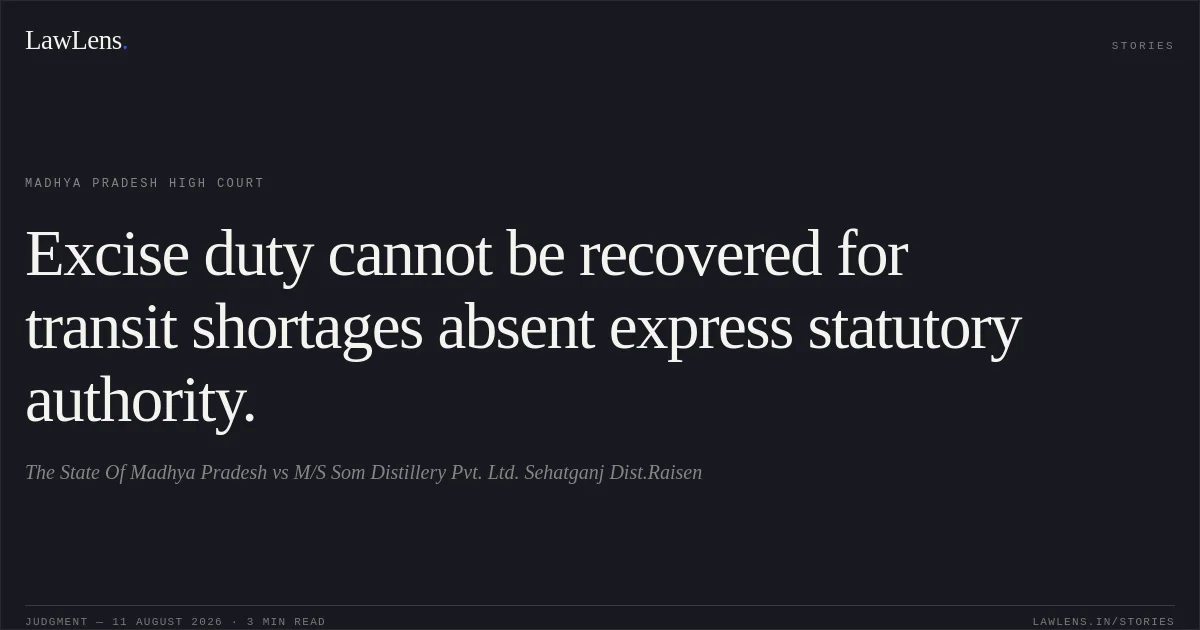
It held that no excise duty could be recovered on the alleged transit shortage in the absence of clear statutory authority, and that the Excise Commissioner’s order was additionally defective for failing to properly consider relevant verification reports from Chhattisgarh.
Source reference: paras. 11–13The Board of Revenue was not required to remand the matter because the demand itself lacked statutory sanction.
Source reference: para. 14Accordingly, the writ petition was dismissed, and the Board of Revenue’s order dated 19 July 2012 in Appeal No. 1511-PBR/10, setting aside the demand of Rs. 21,79,768.60, was affirmed.
Source reference: paras. 17–18Acts & Sections Cited
3 provisions across 1 statute referred to in this judgment. Linked provisions open on LawLens.
M.P. Excise Act, 19153
Original Court PDF
The State Of Madhya PradeshvsM/S Som Distillery Pvt. Ltd. Sehatganj Dist.Raisen
Click to open original judgment
Original judgment, available to read, download and summarize on LawLens.in