Facts
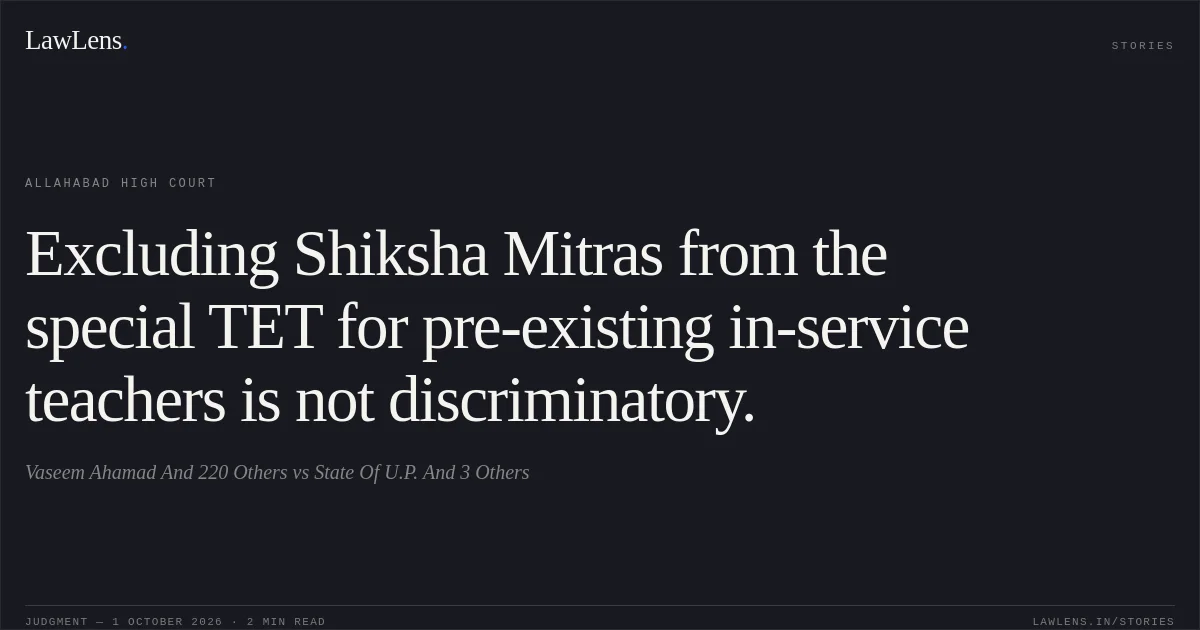
The 221 petitioners, who were working as Shiksha Mitras in Uttar Pradesh, challenged the Government Order dated 2 September 2026 and the consequential notification dated 3 September 2026, insofar as they limited eligibility for the Special Teacher Eligibility Test (Special TET) to specified categories of in-service teachers and excluded Shiksha Mitras.
Source reference: para. 2–3, 9–14The respondents contended that the Special TET implemented the Supreme Court’s directions concerning in-service teachers required to acquire TET, and that the petitioners could have taken the regular TET conducted in July 2026.
Source reference: para. 39–45The High Court heard the matter with the parties’ consent.
Source reference: para. 46Issues
Whether excluding Shiksha Mitras from the Special TET, while permitting specified in-service teachers to appear, violated Articles 14 and 16 of the Constitution.
Source reference: para. 9–14, 56–72Whether the petitioners could claim inclusion in the Special TET on the basis that they performed teaching functions and were otherwise eligible for the regular TET.
Source reference: para. 61–63, 76, 87–88Law Applied
Section 23 of the Right of Children to Free and Compulsory Education Act, 2009, read with the NCTE notification dated 23 August 2010, makes TET a prescribed qualification for teachers covered by the statutory regime.
Source reference: para. 39, 57The Supreme Court’s decision in Anjuman Ishaat-e-Taleem Trust v. State of Maharashtra and its subsequent review order required the relevant in-service teachers to acquire TET within the extended period and directed periodic examinations to provide an opportunity to comply.
Source reference: para. 51–53, 66, 74Under Article 14, reasonable classification is permissible where it rests on an intelligible differentia having a rational nexus with the measure’s object; Article 16 guarantees equality of opportunity among persons similarly situated in public employment.
Source reference: para. 58–60, 68A qualifying examination does not, by itself, confer a right to appointment.
Source reference: para. 67, 70–73Reasoning
The Court treated the Special TET as a transitional compliance measure for teachers already in service who became subject to the TET requirement after entering service—not as a recruitment process or a general opportunity for all candidates.
Source reference: para. 47–50, 67, 69–70It found that Shiksha Mitras’ separate mode and legal framework of engagement distinguished them from pre-existing regular Assistant Teachers, notwithstanding similarities in teaching duties.
Source reference: para. 48–50, 61–63The classification therefore had a rational connection to enabling the identified in-service teachers to meet the subsequent qualification requirement within the time allowed by the Supreme Court.
Source reference: para. 65–66, 81–86The petitioners’ asserted eligibility for regular TET did not make them similarly situated for the purpose of this special examination.
Source reference: para. 79–80The Court also noted their reported opportunity to take the regular TET, while clarifying that non-participation in that examination was not, by itself, decisive of the constitutional challenge.
Source reference: para. 79–80Holding
The Court held that restricting the Special TET to the specified in-service teachers did not violate Articles 14 or 16 and that the petitioners had no entitlement to inclusion merely because they performed teaching-related duties or could take the regular TET.
The writ petition was dismissed, with no order as to costs.
Source reference: para. 89–90Acts & Sections Cited
1 provisions across 1 statute referred to in this judgment. Each provision opens on LawLens.
Right of Children to Free and Compulsory Education Act, 20091
Original Court PDF
Vaseem Ahamad And 220 OthersvsState Of U.P. And 3 Others
Click to open original judgment
Original judgment, available to read, download and summarize on LawLens.in