Facts
The suit properties were purchased by Vedhamuthu Udaiyar, who died intestate.
Source reference: no citationHis widow and two daughters sought partition and a declaration that sales made by their son/brother, the first defendant, to defendants 5–9 would not bind them.
Source reference: no citationThe first defendant claimed exclusive title under an alleged family settlement/partition deed (Ex.B.16) and a sale deed from two brothers (Ex.B.15), and pleaded ouster, limitation and incorrect court fee.
Source reference: para. 4(a)–(c), 23–24The trial court rejected his claim to exclusive ownership and passed a preliminary decree for shares. The first defendant appealed.
Source reference: para. 7–8The first plaintiff died after the hearing had concluded but before judgment was pronounced.
Source reference: para. 30–32Issues
Whether Ex.B.16, the alleged settlement/partition deed, was valid and effective in law.
Source reference: para. 22(1)Whether the first defendant proved ouster of the plaintiffs.
Source reference: para. 22(2)Whether the suit was barred by limitation.
Source reference: para. 22(3)Whether the decree was invalid because it allotted a share to the first plaintiff, who had died before judgment.
Source reference: para. 22(4)Whether the trial court’s judgment and decree were otherwise unsustainable.
Source reference: para. 22(5)Law Applied
Under Sections 17 and 49 of the Registration Act, a document that requires registration cannot operate to create or transfer rights in immovable property if unregistered; an unregistered document may be considered for a permissible collateral purpose.
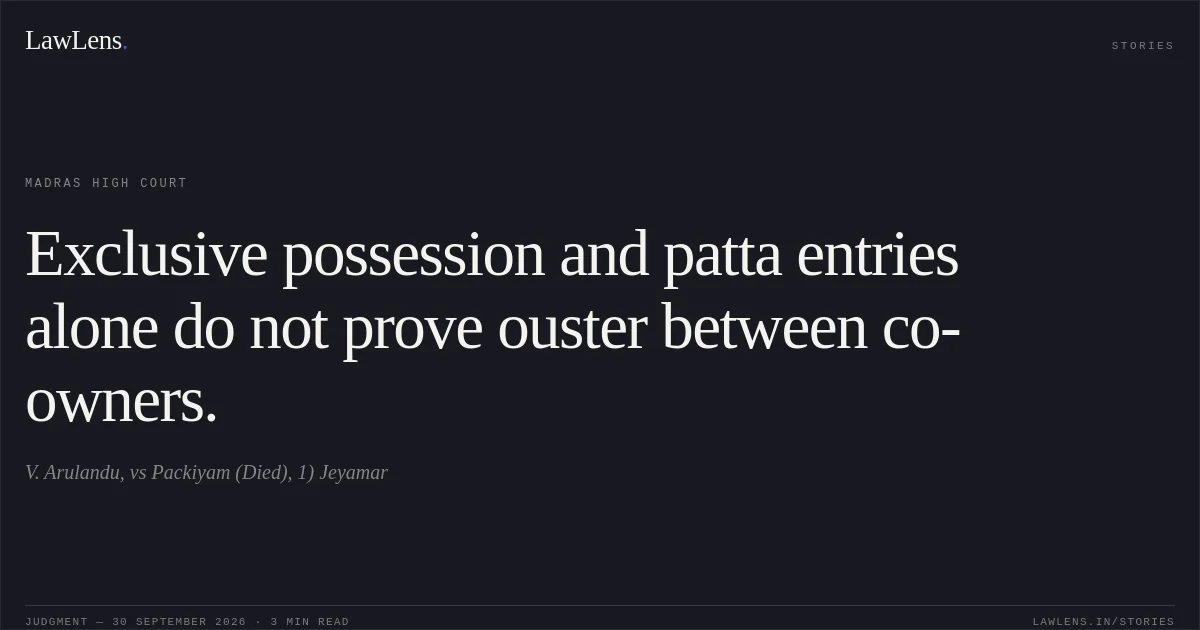
Source reference: para. 14(1)Revenue entries and patta do not, by themselves, establish title.
Source reference: para. 21(6)A co-owner’s possession is presumed to be on behalf of all co-owners; ouster requires open assertion of hostile title, exclusive and continuous possession, and knowledge of the other co-owners (P. Lakshmi Reddy v. L. Lakshmi Reddy; Syed Shah Ghulam Ghouse Mohiuddin v. Syed Shah Ahmed Mohiuddin Kamisul Quadri).
Source reference: para. 24–29Order XXII Rule 6 CPC provides that death between conclusion of hearing and pronouncement of judgment does not cause abatement, and the judgment has the same effect as if pronounced before the death (N.P. Thirugnanam v. Dr. R. Jagan Mohan Rao).
Source reference: para. 30–32A co-owner is presumed to be in constructive possession unless ouster or exclusive title is established; accordingly, court fee under Section 37(2) of the Tamil Nadu Court-Fees and Suits Valuation Act was appropriate.
Source reference: para. 33The court also relied on the principle that partition is a continuing right and cause of action, and no limitation period is prescribed for a co-sharer’s partition claim.
Source reference: para. 34Reasoning
Ex.B.16 was unregistered, the alleged executant was not shown as a party, other heirs were excluded without explanation, and the first defendant did not examine its attesting witnesses. The court therefore upheld the finding that it did not establish his exclusive title; Ex.B.15 was also unregistered, and the evidence did not disprove the brothers’ allegation that it had been obtained by force.
Source reference: para. 24–26Patta, tax payments and custody of the parent documents did not prove title or ouster. The first defendant failed to establish the hostile, exclusive possession required to exclude the other co-owners.
Source reference: para. 27–29The partition claim was not time-barred; the plaintiffs sought a declaration that the sales would not bind their shares, rather than cancellation of deeds to which they were not parties.
Source reference: para. 34Finally, because the first plaintiff died after hearing concluded, Rule 6 prevented abatement; her share could be dealt with among her legal heirs at final-decree proceedings.
Source reference: para. 30–32In the absence of proved ouster, the plaintiffs were also deemed in possession for court-fee purposes.
Source reference: para. 33Holding
The High Court answered the issues against the appellant, held that the first defendant had not established exclusive title or ouster, and found no basis to disturb the preliminary partition decree.
It dismissed the appeal and confirmed the trial court’s judgment and decree; there was no order as to costs, and the connected civil miscellaneous petition was closed.
Source reference: para. 35–36Acts & Sections Cited
4 provisions across 2 statutes referred to in this judgment. Each provision opens on LawLens.
Code of Civil Procedure, 19083
Limitation Act, 19631
Original Court PDF
V. Arulandu,vsPackiyam (Died), 1) Jeyamar
Click to open original judgment
Original judgment, available to read, download and summarize on LawLens.in