Facts
The respondent-landlord instituted Regular Civil Suit No. 596 of 2008 seeking eviction of the defendant-tenant from a shop on the grounds of breach of the rent-note conditions, unlawful subletting, arrears of rent, and permanent construction without permission.
Source reference: paras. 4, 6The tenancy was created under a rent note dated 6 July 1979 at a monthly rent of Rs.50, which prohibited subletting.
Source reference: para. 12The Trial Court dismissed the suit on 25 September 2017, holding that subletting, permanent construction, and arrears of rent had not been proved.
Source reference: para. 6.2In Regular Civil Appeal No. 66 of 2017, the Appellate Court reversed the decree, finding that the tenant’s brother, Bharatbhai, was in exclusive possession of the shop and that the tenant was in arrears of rent; it consequently passed a decree of eviction.
Source reference: paras. 6.3–6.4The tenant’s legal heirs challenged that decree under Section 29(2) of the Gujarat Rents, Hotel and Lodging House Rates Control Act, 1947.
Source reference: para. 4Issues
Whether the Appellate Court erred in holding that the tenant had sublet the suit shop to his brother, Bharatbhai, without the landlord’s consent.
Source reference: paras. 13–18; pp. 15–25Whether the tenant had proved payment or deposit of the arrears of rent within the statutory period so as to avoid eviction under Section 12(3)(a) of the Rent Act.
Source reference: paras. 22–30; pp. 28–35Whether the findings of the Appellate Court suffered from perversity, gross error of law, or jurisdictional error warranting interference under the revisional jurisdiction conferred by Section 29(2).
Source reference: paras. 10–11, 18, 29–32Law Applied
The Court applied Section 29(2) of the Gujarat Rent Act, under which revisional interference is limited to examining the legality, correctness, propriety, and regularity of the decision and does not permit re-appreciation of evidence merely because another factual view is possible.
Source reference: para. 10Relying on Hindustan Petroleum Corporation Ltd. v. Dilbahar Singh, (2014) 9 SCC 78, the Court held that findings of fact may be corrected only where they are perverse, based on no evidence, arrived at by ignoring material evidence, or are grossly erroneous so as to cause miscarriage of justice.
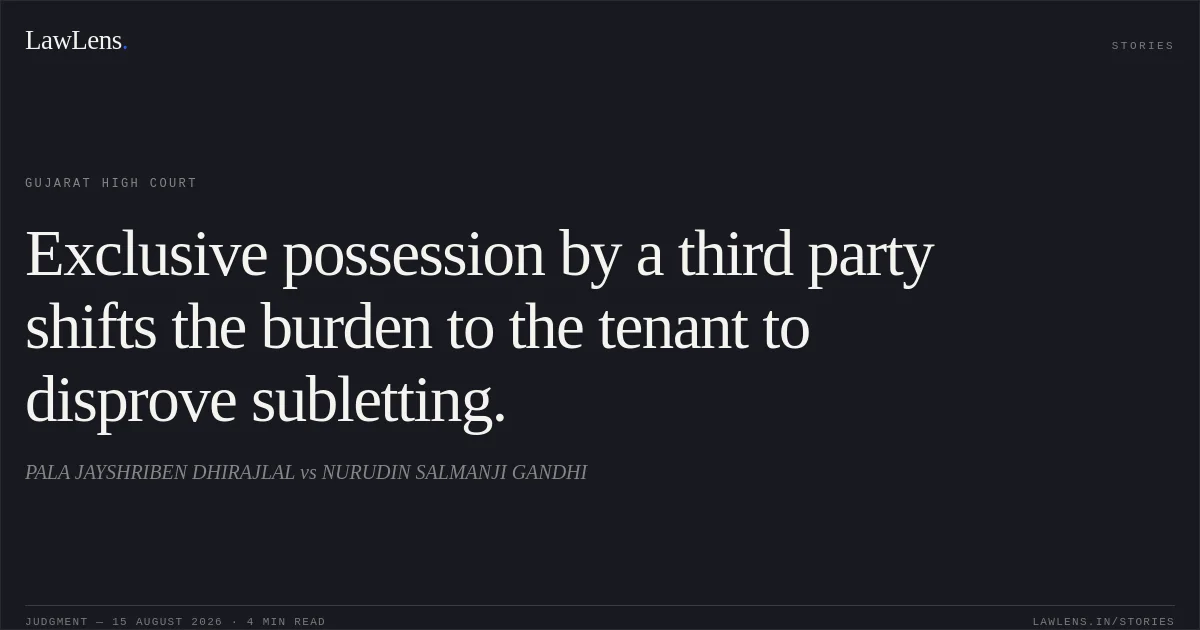
Source reference: para. 10On subletting, the Court relied on S.F. Engineer v. Metal Box India Ltd., (2014) 6 SCC 780, Joginder Singh Sodhi v. Amar Kaur, and the principles reiterated in Sri M.V. Ramachandrasa v. Mahendra Watch Company, 2026 SCC OnLine SC 582: the landlord must initially establish the third party’s exclusive possession and parting of possession; once such prima facie possession is shown, the evidentiary burden shifts to the tenant to explain that possession as lawful and non-subtenancy.
Source reference: paras. 16–16.3Direct proof of monetary consideration is not always necessary and may be inferred from exclusive possession and surrounding circumstances.
Source reference: para. 16.2For arrears, Section 12(3)(a) applies where rent is payable monthly, arrears exceed six months, no dispute regarding standard rent is raised, and the tenant fails to pay within one month of receiving the statutory notice; in such circumstances, eviction follows mandatorily.
Source reference: paras. 28–28.1The Court relied on Arjun Khiamal Makhijani v. Jamnadas C. Tuliani, (1989) 4 SCC 612.
Source reference: paras. 28–28.1Reasoning
The landlord examined himself and two independent witnesses, who testified that Bharatbhai alone was using and possessing the shop for conducting a watch business, while the tenant was not carrying on business there.
Source reference: paras. 15.1–15.2This established the initial case of exclusive possession and shifted the burden to the tenant to explain the nature of Bharatbhai’s occupation.
Source reference: paras. 16.1–16.3The tenant failed to provide a satisfactory explanation. His witnesses admitted that they had not personally visited the shop and could not confirm that he was conducting business there.
Source reference: para. 17.2The Shops and Establishments certificate and telephone connection standing in the tenant’s name were insufficient to establish present control or possession, particularly as the tenant was conducting business from other premises and had received the proceedings at another business address.
Source reference: para. 17.3The Appellate Court’s finding of subletting was therefore supported by evidence and was neither perverse nor jurisdictionally erroneous.
Source reference: paras. 18, 20–21On arrears, the tenant claimed that he had deposited Rs.1,300 in a separate suit and had sent money orders, but produced no receipt or reliable proof showing payment of the demanded arrears within one month of the statutory notice.
Source reference: paras. 22–27The judgment in the parallel suit and the referenced money-order documents did not establish payment of the entire arrears to the landlord or the co-owners; in any event, arrears remained outstanding for the later period.
Source reference: paras. 27.1–27.2Since the tenancy was governed by Section 12(3)(a), the absence of timely payment compelled an eviction decree.
Source reference: paras. 28–30Holding
The Court held that the landlord had proved that Bharatbhai was in exclusive possession of the suit shop and that the tenant had failed to rebut the resulting inference of unlawful subletting.
It further held that the tenant had not proved payment of the arrears within the statutory period and was consequently liable to eviction under Section 12(3)(a) of the Rent Act.
Source reference: para. 30Finding no perversity, patent illegality, gross error of law, or jurisdictional error in the Appellate Court’s decree, the High Court dismissed the Civil Revision Application, discharged the Rule, and made no order as to costs.
Source reference: paras. 31–33Acts & Sections Cited
3 provisions across 2 statutes referred to in this judgment. Each provision opens on LawLens.
Gujarat Rents, Hotel and Lodging House Rates Control Act, 19472
Transfer of Property Act, 18821
Original Court PDF
PALA JAYSHRIBEN DHIRAJLALvsNURUDIN SALMANJI GANDHI
Click to open original judgment
Original judgment, available to read, download and summarize on LawLens.in