Facts
The respondents’ original suit for declaration and permanent injunction concerning 463 sq. ft. of land was dismissed.
Source reference: para. 2In appeal, the plaint was returned under Order 7 Rule 10 CPC for presentation before the competent court.
Source reference: para. 2The respondents subsequently brought a suit for specific performance, which was decreed ex parte on 13 February 2017.
Source reference: para. 2The original defendant had appeared and filed a written statement, but did not challenge the decree by appeal or an application under Order 9 Rule 13 CPC; he died in July 2019.
Source reference: para. 2In execution, his legal representatives sought to challenge the decree under Section 47 CPC, alleging that the specific-performance suit was time-barred under Article 54 of the Limitation Act, barred by Order 2 Rule 2 CPC, and improperly brought after return of the earlier plaint.
Source reference: paras. 3–4, 9, 17The executing court rejected their application, prompting this petition under Article 227 of the Constitution.
Source reference: paras. 3–4, 9, 17Issues
1. Whether the legal representatives could use Section 47 CPC in execution to challenge the decree as barred by limitation or Order 2 Rule 2 CPC.
Source reference: paras. 10, 15–162. Whether the alleged alteration of the claim after return of the earlier plaint, or the other objections raised, rendered the decree a nullity and therefore inexecutable.
Source reference: paras. 10, 15, 21, 24Law Applied
Section 47 CPC requires an executing court to decide questions between the parties or their representatives relating to execution, discharge or satisfaction of a decree, but does not permit the court to go behind the decree or sit in appeal over it.
Source reference: paras. 11–14Under Vasudev Dhanjibhai Modi v. Rajbhai Abdul Rehman, an erroneous decree remains binding unless set aside in appropriate proceedings; only a decree passed without inherent jurisdiction, or otherwise a nullity, may be resisted in execution.
Source reference: para. 12Brakewel Automotive Components (India) Pvt. Ltd. v. P.R. Selvam Alagappan and Maurice W. Innis v. Lily Kazrooni reaffirm that limited exception and the executing court’s duty to enforce the decree as passed.
Source reference: paras. 13–14, 23Limitation under Article 54 of the Limitation Act and the bar under Order 2 Rule 2 CPC concern the suit’s maintainability and merits; they do not, without more, establish that the decree is a nullity.
Source reference: paras. 15–16, 24Reasoning
The objections required reconsideration of the earlier proceedings, the pleadings and terms of the agreement, the cause of action and the trial court’s limitation determination—matters for the suit court or an appropriate challenge to the decree, not execution.
Source reference: paras. 15–16, 18The trial court was competent to hear the specific-performance suit; the original defendant had been served, appeared and filed a written statement, and the decree was not challenged through the available procedures.
Source reference: paras. 17, 19, 21Even if the suit involved an error concerning limitation, Order 2 Rule 2 CPC or the effect of returning the earlier plaint, that would be an error in adjudication rather than an inherent lack of jurisdiction.
Source reference: paras. 18, 21–22Virgo Industries therefore did not assist the petitioners in execution, and the asserted hardship of losing their home could not justify disregarding a final decree.
Source reference: paras. 18, 21–22Holding
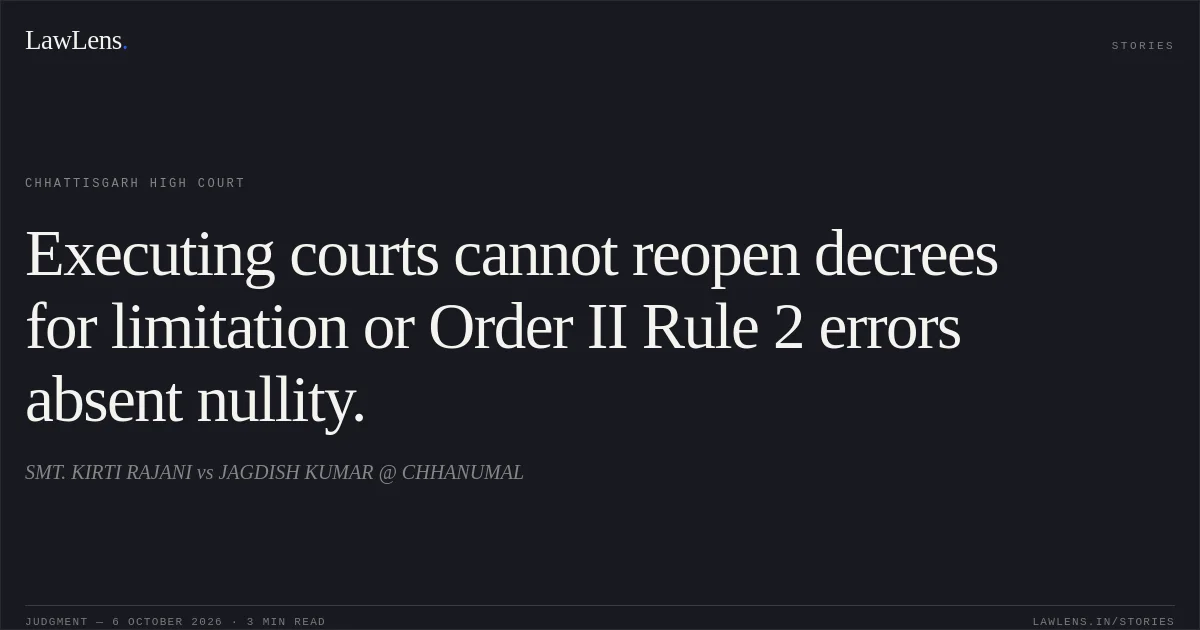
The High Court held that the petitioners’ objections challenged the correctness of the decree, not its inherent validity or executability.
The decree was not shown to be a nullity, and the executing court committed no jurisdictional error in rejecting the Section 47 CPC application.
Source reference: paras. 24–26The Article 227 petition was dismissed, with no order as to costs.
Source reference: paras. 24–26Acts & Sections Cited
2 provisions across 2 statutes referred to in this judgment. Each provision opens on LawLens.
Code of Civil Procedure, 19081
Limitation Act, 19631
Original Court PDF
SMT. KIRTI RAJANIvsJAGDISH KUMAR @ CHHANUMAL
Click to open original judgment
Original judgment, available to read, download and summarize on LawLens.in