Facts
The respondents/landlords initiated R.L.T.O.P. No. 484 of 2024 under Section 21(2)(a) of the Tamil Nadu Regulation of Rights and Responsibilities of Landlords and Tenants Act, 2017, seeking eviction of the petitioners from the premises on the ground that no fresh written tenancy agreement had been executed after commencement of the Act.
Source reference: para. 2The Rent Controller allowed the application and directed the petitioners to vacate and deliver possession within two months.
Source reference: para. 3The petitioners challenged that order in R.L.T.A. No. 187 of 2025 before the XX Additional Judge, Chennai.
Source reference: para. 4During the pendency of the appeal, the respondents filed E.P. No. 1216 of 2025 for execution of the eviction order.
Source reference: para. 5The Executing Court held that filing an appeal did not automatically stay execution, dispensed with notice to the judgment-debtors, and ordered delivery of possession.
Source reference: para. 5The petitioners consequently filed the present revision under Section 115 CPC.
Source reference: no citationThe High Court noted that the appeal could not progress owing to the vacancy of the Presiding Officer of the Appellate Court.
Source reference: para. 10After pronouncement, the respondents stated that R.L.T.A. No. 197 of 2020 had been disposed of on 16 September 2026; the Court recorded that, since the appeal stood disposed of, the respondents were entitled to proceed with execution in accordance with law.
Source reference: para. 11Issues
Whether the Executing Court was justified in ordering delivery of possession while the tenants’ appeal against the eviction order was pending?
Source reference: paras. 5, 7–10Whether execution ought to be restrained where the pending appeal could not progress because of the vacancy of the Appellate Court and execution might result in multiplicity of proceedings or miscarriage of justice?
Source reference: para. 10Whether the respondents could proceed with execution after being informed that the relevant appellate proceedings had been disposed of?
Source reference: para. 11Law Applied
The Court exercised revisional jurisdiction under Section 115 of the Code of Civil Procedure, 1908, as invoked in the petition.
Source reference: prayer; para. 6The eviction proceedings were governed by Section 21(2)(a) of the Tamil Nadu Regulation of Rights and Responsibilities of Landlords and Tenants Act, 2017, concerning eviction on the statutory ground relied upon by the landlords.
Source reference: para. 2The Court accepted the general procedural principle that the mere filing of an appeal does not automatically operate as a stay of execution.
Source reference: para. 5However, it applied the equitable and supervisory principle that execution may be regulated or deferred where immediate delivery during pendency of an appeal could cause irreparable prejudice, multiplicity of proceedings, or miscarriage of justice, particularly where the appellate remedy is practically unavailable.
Source reference: para. 10Reasoning
The Executing Court correctly proceeded on the basis that the pending appeal did not, by itself, stay execution.
Source reference: para. 5Nevertheless, the High Court considered the exceptional circumstance that the petitioners’ appeal was pending and could not be effectively prosecuted because the Presiding Officer’s post in the Appellate Court was vacant.
Source reference: para. 10Delivery of possession in those circumstances could render the appeal practically ineffective and create further proceedings if the eviction order were later reversed.
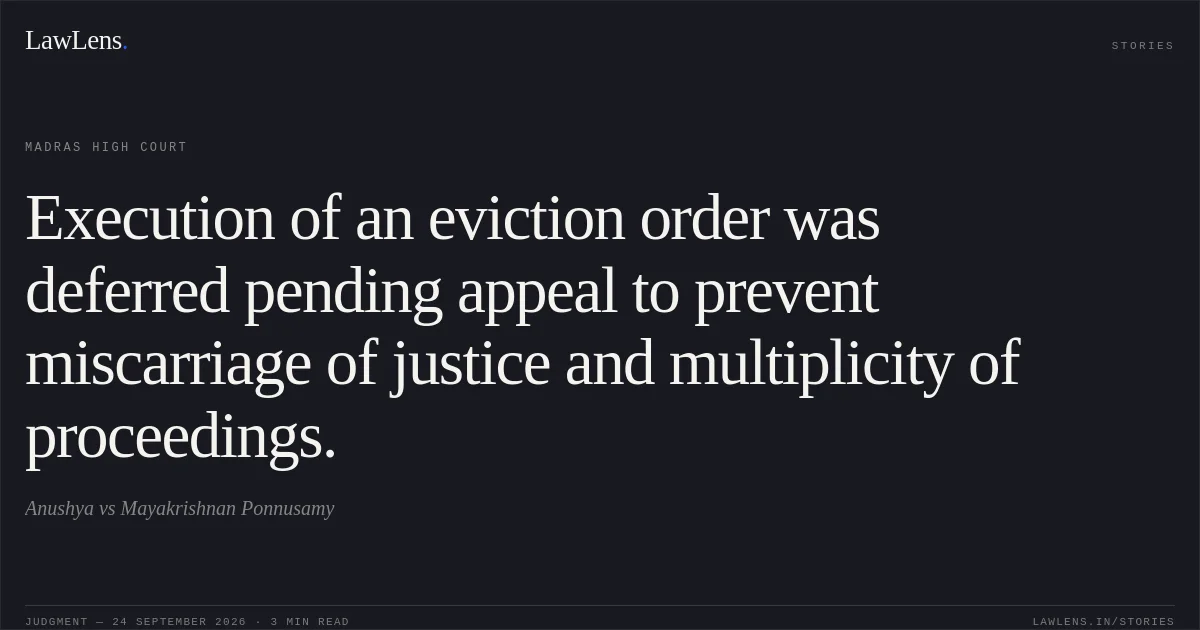
Source reference: no citationThe Court therefore held that immediate execution would risk multiplicity of proceedings and miscarriage of justice, and set aside the delivery order.
Source reference: no citationHowever, after the order was pronounced, the Court recorded the respondents’ submission that the appellate proceedings had already been disposed of on 16 September 2026; consequently, the justification for restraining execution no longer subsisted, and execution could proceed in accordance with law.
Source reference: para. 11Holding
The Civil Revision Petition was allowed, and the order of the XV Court of Small Causes, Chennai, in E.P. No. 1216 of 2025 was set aside.
The Executing Court was initially directed not to pass further orders in the execution petition until disposal of R.L.T.A. No. 187 of 2025.
Source reference: para. 10No costs were awarded and the pending miscellaneous petition was closed.
Source reference: para. 10In the post-pronouncement clarification, the Court recorded that, since the relevant appellate proceedings had been disposed of, the respondents were entitled to proceed with execution in accordance with law.
Source reference: para. 11Acts & Sections Cited
1 provisions across 1 statute referred to in this judgment. Each provision opens on LawLens.
Code of Civil Procedure, 19081
Original Court PDF
AnushyavsMayakrishnan Ponnusamy
Click to open original judgment
Original judgment, available to read, download and summarize on LawLens.in