Facts
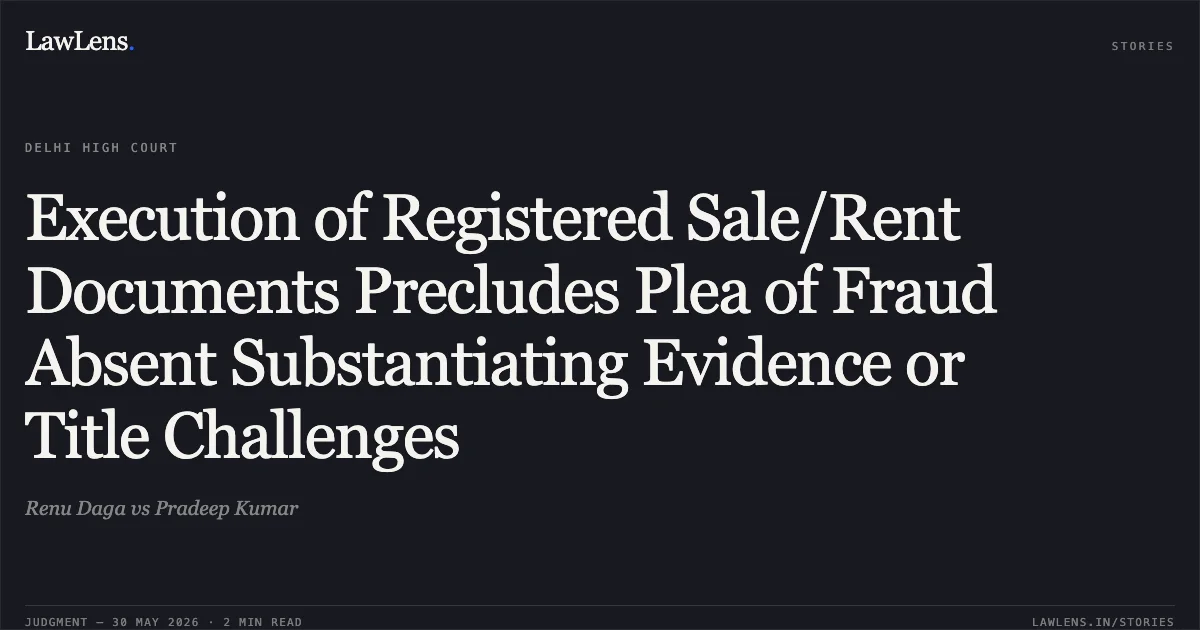
The Respondent (Plaintiff) filed a suit for recovery of possession, arrears of rent, and permanent injunction, claiming ownership of Flat No. 28, Sector-16, Rohini (the "Suit Property") through transfer documents executed by the Appellant (Defendant) and a previous owner, Ms. Shashi Taneja
Source reference: p. 2The Respondent alleged that the Appellant was inducted as a tenant at a monthly rent of Rs. 10,000 but defaulted on payments from August 2012
Source reference: p. 3The Appellant contested the suit, denying the landlord-tenant relationship and asserting absolute ownership. She claimed the Suit Property comprised two portions (A and B) and that her signatures on the Respondent’s title documents and the Rent Agreement were obtained via fraud and misrepresentation while she intended to purchase Portion 'B' from Shashi Taneja
Source reference: p. 3-5The Trial Court decreed the suit in favor of the Respondent
Source reference: p. 1-2Issues
1. Whether the Respondent established a valid cause of action for possession based on the transfer documents and a landlord-tenant relationship?
Source reference: p. 6, Issue (i) & (iv)2. Whether the documents in favor of the Respondent were forged or fabricated through fraud and misrepresentation?
Source reference: p. 6, Issue (ii)3. Whether there existed a valid landlord-tenant relationship between the parties?
Source reference: p. 6, Issue (iii)Law Applied
The Court applied Section 96 and Section 151 of the Code of Civil Procedure, 1908, regarding the maintainability of the appeal
Source reference: p. 1Section 116 of the Indian Evidence Act, 1872, which provides the principle of estoppel, preventing a tenant from denying the landlord’s title at the commencement of the tenancy
Source reference: p. 14Suraj Lamps & Industries Pvt. Ltd. v. State of Haryana, which clarifies that an Agreement to Sell, General Power of Attorney, and Will do not constitute a formal transfer of title (conveyance) but can establish possessory rights or superior claims over a party with no title
Source reference: p. 9, 13Reasoning
The Court observed that the Appellant admitted her signatures, photographs, and thumb impressions on the registered Agreement to Sell and allied documents (Ex.PW-2/1 and Ex.PW-2/2) before the Sub-Registrar
Source reference: p. 11It held that a "bald plea of fraud" without cogent evidence is insufficient to invalidate registered documents
Source reference: p. 12Regarding the property's division, the Court found that despite being used as two shops, the site plan (Ex.DW1/1) confirmed it was a single composite flat
Source reference: p. 10Under Section 116 of the Evidence Act, since the Appellant signed the Rent Agreement (Mark-C) and was inducted into possession by the Respondent, she was estopped from challenging his title for the purposes of an eviction suit
Source reference: p. 14The Court rejected the argument that a Suit for Specific Performance was required, noting the Respondent’s claim was properly founded on the landlord-tenant relationship and the subsequent termination of tenancy
Source reference: p. 12-13Holding
The High Court dismissed the appeal and upheld the Trial Court's judgment
The Court held that the Respondent proved superior rights to the property and established a landlord-tenant relationship
Source reference: p. 13-14The Respondent was held entitled to the recovery of possession of the Suit Property and arrears of rent amounting to Rs. 3,70,000, along with the payment of electricity and water charges by the Appellant until the date of handing over possession
Source reference: p. 2, 14-15Acts & Sections Cited
3 provisions across 1 statute referred to in this judgment. Each provision opens on LawLens.
Code of Civil Procedure, 19083
Original Court PDF
Renu DagavsPradeep Kumar
Click to open original judgment
Original judgment, available to read, download and summarize on LawLens.in