Facts
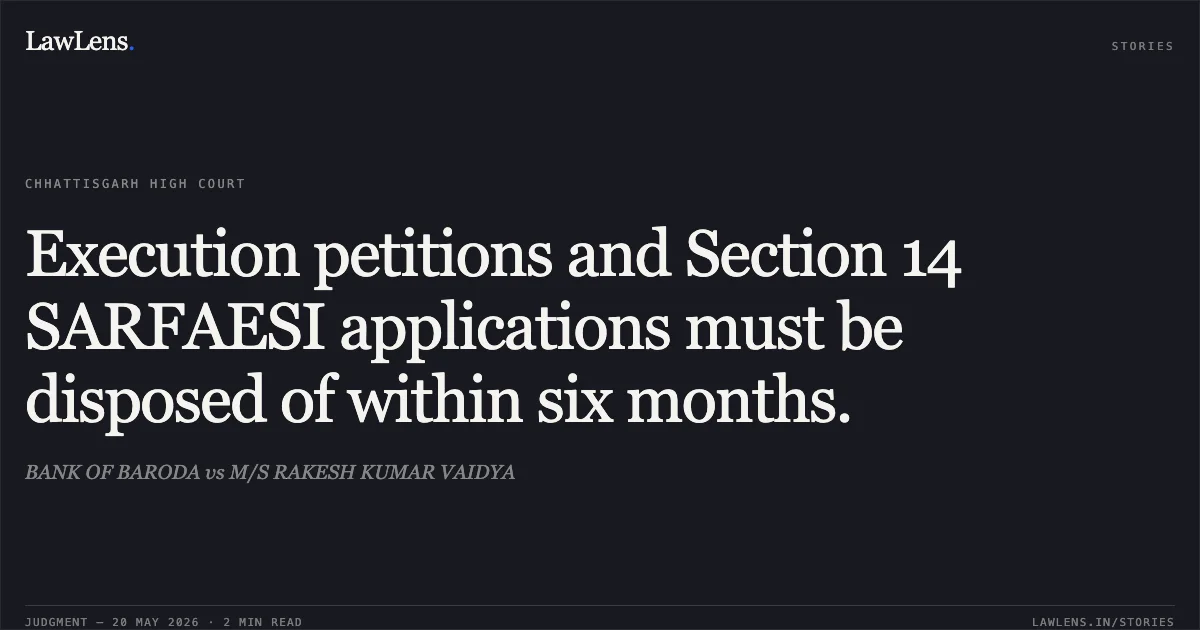
The Petitioner, Bank of Baroda, provided financial assistance to the respondents (borrowers). Following a default in repayment, the loan account was declared a Non-Performing Asset (NPA).
Source reference: para 2The Bank initiated recovery proceedings under the Securitization and Reconstruction of Financial Assets and Enforcement of Security Interest Act, 2002 (SARFAESI Act), issuing notices under Section 13(2) and subsequently for possession.
Source reference: para 2The Bank filed an application under Section 14 of the SARFAESI Act before the lower court seeking assistance for taking physical possession of the secured assets.
Source reference: para 1.2, 2Despite the statutory expectation of disposal within sixty days, the application remained pending since September 24, 2024.
Source reference: para 2, 4Consequently, the Bank filed this writ petition under Article 227 of the Constitution of India seeking a direction for expeditious disposal.
Source reference: para 1Issues
Whether the High Court should exercise its supervisory jurisdiction under Article 227 to direct the lower court to conclude the Section 14 SARFAESI proceedings within a specific timeframe.
Source reference: para 1.2, 5Law Applied
Section 14 of the SARFAESI Act, 2002, which mandates that orders on applications for possession should ideally be taken within sixty days.
Source reference: para 2Supreme Court precedent in Periyammal (Dead) through LRs & Ors. vs. V. Rajamani & Anr. (2025 INSC 329), which established a general directive that execution petitions and related proceedings should ordinarily be disposed of within six months to prevent undue delays in the judicial process.
Source reference: para 5Reasoning
The Court examined the order-sheets of the lower court and confirmed that the execution proceedings had been pending since September 2024, exceeding the reasonable period contemplated by the SARFAESI Act.
Source reference: para 4, 5The Court reasoned that the nature of the dispute required an "earnest endeavour" by the Executing Court to prevent prejudice to the financial institution.
Source reference: para 5By integrating the Supreme Court’s mandate in Periyammal, the High Court emphasized that stagnant execution proceedings undermine the recovery mechanism.
Source reference: para 5The Court found that while the district judiciary is accountable for delays, the primary objective is to ensure that statutory timelines for debt recovery are respected subject to the cooperation of the parties involved.
Source reference: para 5, 6Holding
The High Court allowed the petition by issuing a direction to the learned Executing Court to proceed with the matter expeditiously.
The court held that the execution proceedings must be concluded at the earliest in accordance with the law and the timelines suggested by the Apex Court.
Source reference: para 5, 6The writ petition was disposed of with a mandate to the lower court to make an earnest effort to resolve the application within a reasonable period.
Source reference: para 5, 7Acts & Sections Cited
2 provisions across 1 statute referred to in this judgment. Each provision opens on LawLens.
Securitisation and Reconstruction of Financial Assets and Enforcement of Security Interest Act, 20022
Original Court PDF
BANK OF BARODAvsM/S RAKESH KUMAR VAIDYA
Click to open original judgment
Original judgment, available to read, download and summarize on LawLens.in