Facts
The respondent, appointed as a Civil Police Constable on 13 March 2008 and promoted to Civil Head Constable on 4 June 2020, served in the Shivamogga District Unit.
Source reference: pp. 2–4, paras. 2–3He sought transfer to the Vijayanagara District Unit on a couple-case basis, with loss of seniority.
Source reference: pp. 2–4, paras. 2–3The Karnataka State Administrative Tribunal directed the State authorities to consider his request if a vacancy arose and he was otherwise eligible.
Source reference: pp. 3–5, paras. 1, 3–4The State challenged that direction, contending that a 15 July 2024 Government Order required seven years’ service in the employee’s current post.
Source reference: pp. 5–7, paras. 6–7Issues
1. Whether the respondent’s eligibility for inter-unit transfer under the Karnataka State Police Department (Transfer) (Special) Rules, 2022 depended on completing seven years’ service in his current post, rather than seven years’ service as a police constable.
Source reference: pp. 9–11, paras. 8–92. Whether the Government Order dated 15 July 2024 could impose a post-specific eligibility requirement inconsistent with the Rules, 2022.
Source reference: pp. 10–12, paras. 9–10Law Applied
The Court applied the Karnataka State Police Department (Transfer) (Special) Rules, 2022, which regulate inter-unit transfers of police personnel.
Source reference: pp. 8–10, para. 8Rule 3(iii), as referred to in the judgment, requires a police constable to complete a minimum of seven years’ service to seek transfer; the Rules also provide for transfer on a couple-case basis, subject to prescribed conditions, and placement below the last person in the cadre at the receiving unit.
Source reference: pp. 8–10, para. 8The Court recognised that executive orders may supplement statutory rules where the rules leave a matter unprovided for, but may not contradict the rules or take away a benefit they confer.
Source reference: pp. 11–12, para. 10The petition was brought under Articles 226 and 227 of the Constitution.
Source reference: p. 2Reasoning
The respondent had completed more than seven years’ service as a police constable before seeking transfer.
Source reference: pp. 9–11, paras. 9–10The State relied on the 15 July 2024 Government Order, which required seven years’ service in the employee’s current post and unit; because the respondent had been promoted to Head Constable in 2020, he had not completed seven years in that post.
Source reference: pp. 9–11, paras. 9–10The Court held that the Rules measured the required period by service, not service in the current post.
Source reference: pp. 10–12, paras. 9–11The Government Order’s additional post-specific condition therefore contradicted the Rules and could not displace their effect.
Source reference: pp. 10–12, paras. 9–11The Court consequently found no basis to interfere with the Tribunal’s direction to consider the transfer request, subject to a vacancy and the respondent’s other eligibility.
Source reference: pp. 10–12, paras. 9–11Holding
The Court dismissed the State’s writ petition and left in place the Tribunal’s direction to consider the respondent’s transfer request to the Vijayanagara District Unit on a couple-case basis, with loss of seniority, if a vacancy arose and he was otherwise eligible.
It ordered the petitioners to pay costs of Rs. 25,000 to the Karnataka State Legal Services Authority within two weeks.
Source reference: p. 12, para. 12Original Court PDF
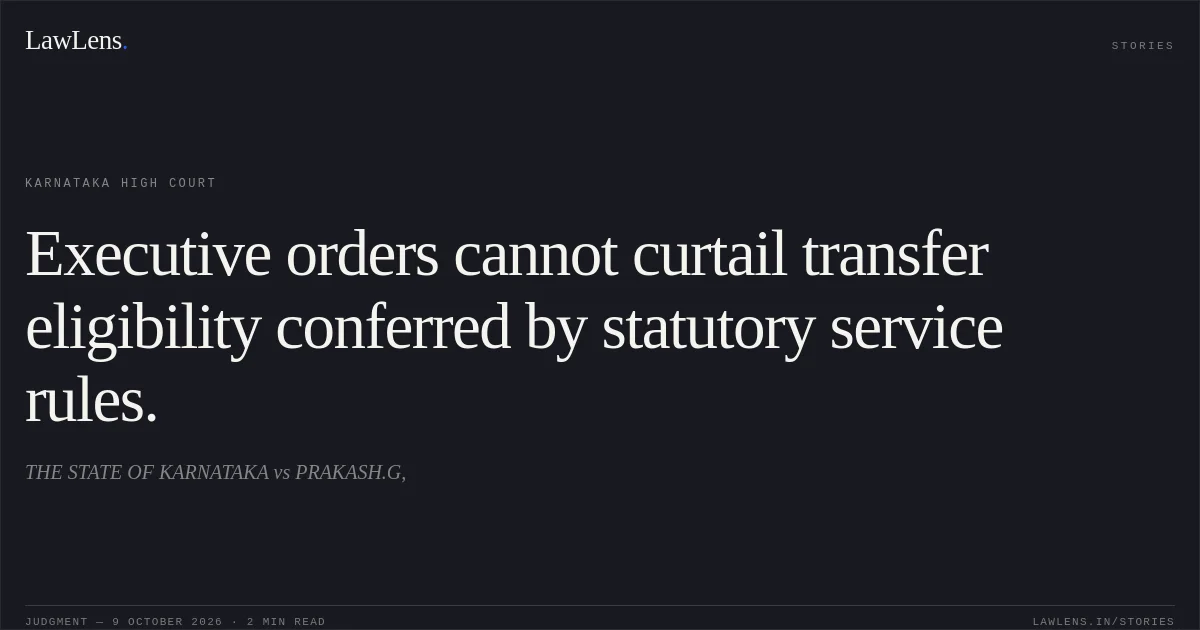
THE STATE OF KARNATAKAvsPRAKASH.G,
Click to open original judgment
Original judgment, available to read, download and summarize on LawLens.in