01Facts
Departmental disciplinary proceedings were initiated against G. Manickam, a police officer, in connection with a criminal case registered pursuant to directions of the State Human Rights Commission. The criminal case ultimately ended in acquittal
¶ 2 · p. 2Disciplinary proceedings had also been initiated against co-delinquent police officers involved in the same Human Rights cases, and the punishments imposed on them were subsequently set aside.
¶ 3 · p. 3The learned Single Judge, by orders dated 05.11.2020 in W.P. Nos. 16744 and 16745 of 2007, set aside the punishment imposed on the respondent. The State and police authorities challenged those orders in the present intra-court appeals.
¶ 1 · p. 2The appellants also challenged the Single Judge’s finding that the Director General of Police lacked review jurisdiction under Rule 15A(1) and (2) of the Tamil Nadu Police Subordinate Services (Discipline and Appeal) Rules.
¶ 5–7 · pp. 3–502Issues
i.Whether the respondent was entitled to have the punishment imposed in the departmental proceedings set aside on the ground of parity with co-delinquents whose punishments had already been quashed
¶ 3–4 · p. 3ii.Whether the Director General of Police possesses the power of review under Rule 15A(1) and (2) of the Tamil Nadu Police Subordinate Services (Discipline and Appeal) Rules
¶ 5–7 · pp. 3–5iii.Whether the State’s appeals against the setting aside of the respondent’s punishment should otherwise be allowed
¶ 7 · p. 503Law Applied
The Court applied the principle of administrative parity in disciplinary proceedings: similarly situated co-delinquents should not be treated differently when the factual and disciplinary basis is common
¶ 4 · p. 3It further applied Rule 15A of the Tamil Nadu Police Subordinate Services (Discipline and Appeal) Rules, which confers review power on the competent higher authority.
¶ 6 · pp. 3–5Relying on the Full Bench decision in Director General of Police v. C. Vijaya Bhaskar, W.A.(MD) No. 686 of 2015, dated 14.02.2020, the Court held that the Director General of Police is empowered to exercise review jurisdiction under Rule 15A
¶ 6 · pp. 3–5The Full Bench also clarified that the word “or” in Rule 15A(1) prevents simultaneous or successive review by multiple authorities and that, upon merger of the disciplinary authority’s order with the appellate or departmental-head order, the Head of Department or State Government may review that operative order and enhance or remit the punishment
¶ 6 · pp. 4–504Reasoning
Since the respondent and the co-delinquents were proceeded against in relation to the same Human Rights cases, and the punishments imposed on the co-delinquents had been set aside, the Court held that the respondent could not be singled out for differential treatment
¶ 3–4 · p. 3Accordingly, the Court declined to interfere with the Single Judge’s decision setting aside the respondent’s punishment.
¶ 3–4 · p. 3However, the Court found that the Single Judge’s separate conclusion denying review power to the Director General of Police was contrary to the binding Full Bench ruling in C. Vijaya Bhaskar.
¶ 6–7 · pp. 3–5That portion of the Single Judge’s reasoning was therefore set aside, while the substantive relief granted to the respondent was maintained
¶ 6–7 · pp. 3–505Holding
The writ appeals were disposed of without disturbing the setting aside of the punishment imposed on G. Manickam, because the punishments of the co-delinquents had also been quashed
¶ 7 · p. 5The finding that the Director General of Police lacked review power under Rule 15A was set aside, and the Court affirmed that such review jurisdiction exists in accordance with the Full Bench ruling in C. Vijaya Bhaskar
¶ 6–7 · pp. 3–5No costs were awarded, and the connected miscellaneous petitions were closed
¶ 8 · p. 6Original Court PDF
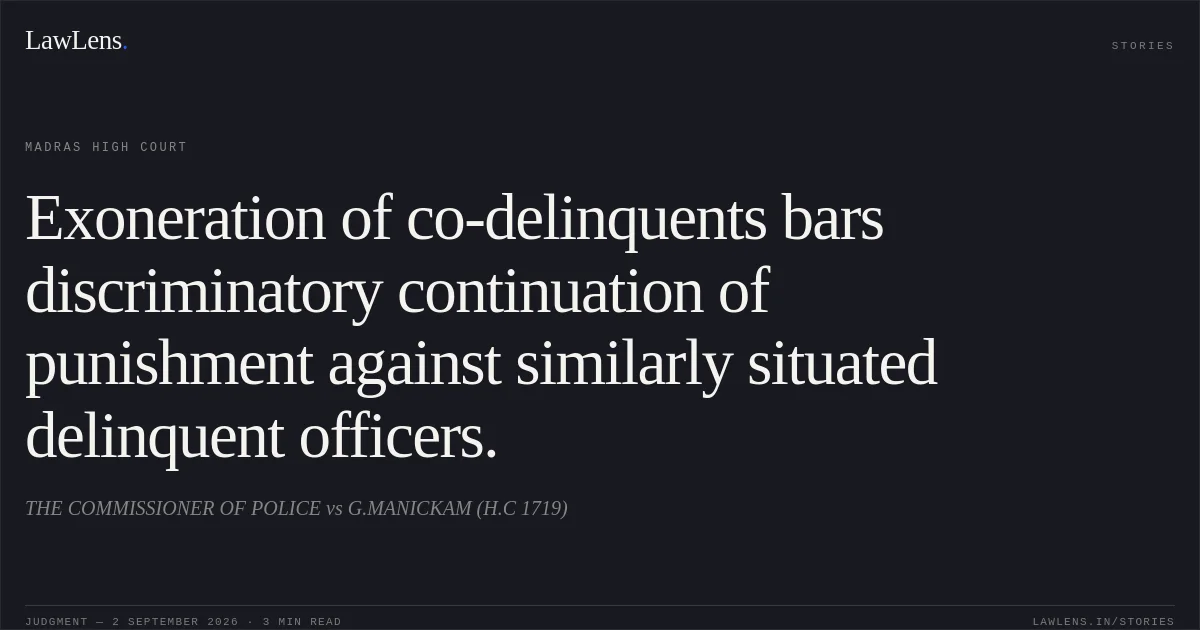
THE COMMISSIONER OF POLICEvsG.MANICKAM (H.C 1719)
Click to open original judgment
Original judgment, available to read, download and summarize on LawLens.in