Facts
The appellant, a cement manufacturer, claimed CENVAT credit on contractor services used during April 2011–December 2015 for work connected with a captive power plant and the cement factory.
Source reference: para. 2–8The Department alleged that the services were used for construction of civil structures or for foundations and structures supporting capital goods, and issued a notice on 26 April 2016 seeking recovery of ₹1,30,66,792, with interest and penalty.
Source reference: para. 2–8The adjudicating authority confirmed the demand; the Commissioner (Appeals) allowed credit for certain providers but upheld the balance.
Source reference: para. 2–8On appeal, the appellant challenged denial of ₹1,30,43,913 relating to six contractors, as well as limitation, interest and penalty.
Source reference: para. 2–8Issues
1. Whether the six contractors’ services fell within the exclusion in Rule 2(l)(A) of the CENVAT Credit Rules, 2004, and what test governed that determination
Source reference: para. 13–192. Whether the extended period under Section 11A(4) of the Central Excise Act, 1944, was validly invoked
Source reference: para. 23–303. Whether interest and penalty under Rule 15(2) of the CENVAT Credit Rules, read with Section 11AC of the Act, could be sustained
Source reference: para. 32–34Law Applied
Rule 2(l) of the CENVAT Credit Rules, 2004, as applicable from 1 April 2011, broadly covers services used directly or indirectly in or in relation to manufacture, but excludes specified services only insofar as they are used for construction of a building or civil structure, or for laying foundations or making structures to support capital goods; both the specified-service and excluded-purpose requirements must be met.
Source reference: para. 14–17The exclusion is not established merely because work occurs at a project site or involves steel, fabrication or a works contract; eligibility must be assessed from the work order and invoice, transaction by transaction.
Source reference: para. 17Rule 9(6) places the burden of establishing credit eligibility on the manufacturer, but requires the authority to assess the evidence produced rather than presume that all contractor work is construction.
Source reference: para. 19Under Section 11A(4), the extended period requires fraud, collusion, wilful misstatement, suppression or contravention with intent to evade duty; the Revenue bears the burden of proving the requisite wilful conduct. Cosmic Dye Chemical v. Collector of Central Excise, Pahwa Chemicals Pvt. Ltd. v. CCE, Continental Foundation Joint Venture v. CCE, Lipi Boilers Ltd. v. Commissioner of Central Excise and Tata Steel Ltd. v. Union of India were relied on for these principles.
Source reference: para. 24–25Interest under Rule 14 read with Section 11AA is payable only on credit found ineligible and utilised; penalty under Rule 15(2) read with Section 11AC cannot stand where the alleged suppression with intent to evade is unproved.
Source reference: para. 32Reasoning
The Tribunal found that the lower authorities had not adequately examined the work orders and invoices or established that each service was used for an excluded purpose.
Source reference: para. 20–22The adjudication order largely relied on a general conclusion, while the appellate order’s contractor-by-contractor findings were also insufficiently supported; the Department’s treatment of TPM Constructions’ work in the subsequent period was relevant and had to be considered.
Source reference: para. 20–22On limitation, the credit appeared in statutory records and ER-1 returns, the audit had examined the transactions by 2012, and the appellant had described the contractors’ work to the Range officer in 2014.
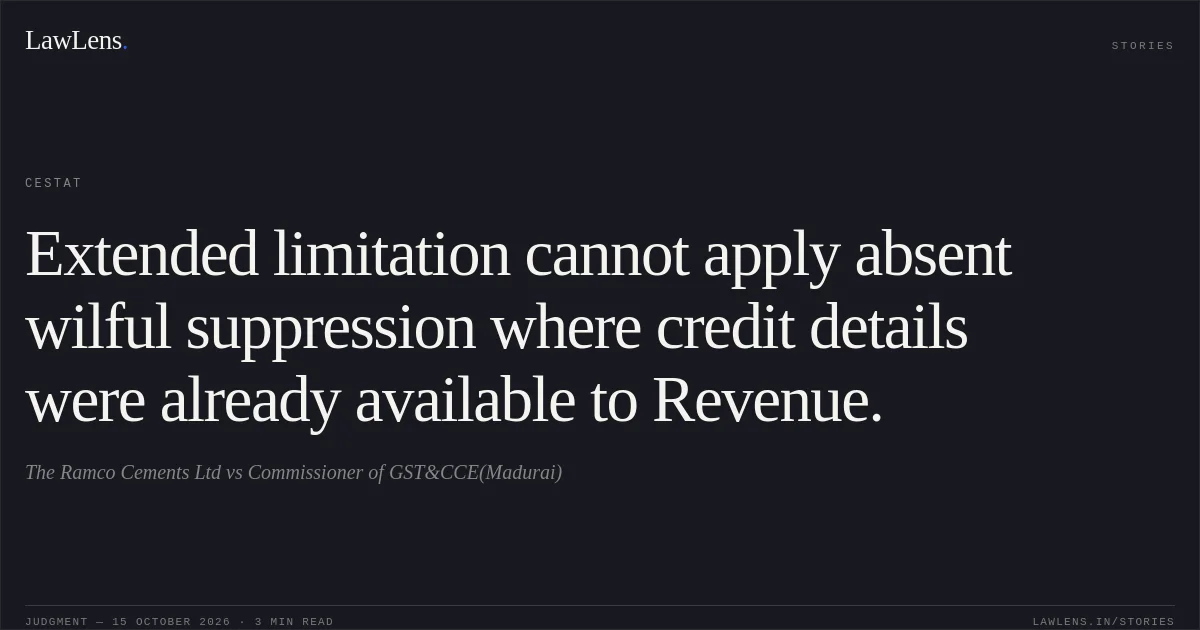
Source reference: para. 26–30The notice identified no withheld fact or positive act of concealment and did not explain its delay. The Tribunal therefore held that suppression with intent to evade had not been established.
Source reference: para. 26–30Because the merits had not been properly determined, any credit within the normal limitation period required fresh, evidence-based examination; the Tribunal left the merits of time-barred credit undecided.
Source reference: para. 30–31Holding
The Tribunal held that the extended period was unavailable and set aside recovery of credit taken more than one year before the notice dated 26 April 2016, together with interest on that amount.
It set aside the penalty in its entirety.
Source reference: para. 30–34The matter was remanded only for quantification and fresh determination of the eligibility of any credit within the normal period, contractor by contractor and on the relevant work orders and invoices, with the subsequent-period orders concerning TPM Constructions taken into account.
Source reference: para. 30–34Interest may be charged only on credit found ineligible and utilised; no penalty may be imposed in the remand proceedings.
Source reference: para. 30–34The appeal was partly allowed on limitation and otherwise allowed by way of remand.
Source reference: para. 30–34Acts & Sections Cited
2 provisions across 2 statutes referred to in this judgment. Each provision opens on LawLens.
Central Excise Act, 19441
Central Goods and Services Tax Act, 20171
Original Court PDF
The Ramco Cements LtdvsCommissioner of GST&CCE(Madurai)
Click to open original judgment
Original judgment, available to read, download and summarize on LawLens.in