Facts
Wipro provided IT facility management services and maintained that they were not taxable, claiming they fell within “Business Auxiliary Services.”
Source reference: paras. 5–9The Commissioner classified the services as “Management Consultant Service” and confirmed service-tax demands of ₹22,52,87,920 for April 2002 to March 2007, invoking the extended limitation period.
Source reference: paras. 5–9CESTAT upheld the classification on merits but found no suppression of facts and restricted the demand to the normal limitation period, remanding the matter for redetermination and setting aside penalties.
Source reference: paras. 10, 19–20The Revenue appealed under Section 35G of the Central Excise Act, 1944.
Source reference: para. 2The High Court condoned a 93-day delay in filing.
Source reference: para. 1Issues
1. Whether the Revenue was entitled to invoke the extended limitation period under the proviso to Section 73(1) of the Finance Act, 1994.
Source reference: para. 42. Whether Wipro’s treatment of the services as non-taxable, in circumstances where the services were disclosed to the Department, constituted suppression of facts warranting the extended period.
Source reference: paras. 13–15Law Applied
Section 73(1) of the Finance Act, 1994, as applicable to the dispute, ordinarily permitted recovery of unpaid or short-paid service tax by notice within one year from the relevant date.
Source reference: para. 11Its proviso substituted a five-year period where non-payment or short-payment occurred by reason of fraud, collusion, wilful misstatement, suppression of facts, or a specified contravention with intent to evade service tax.
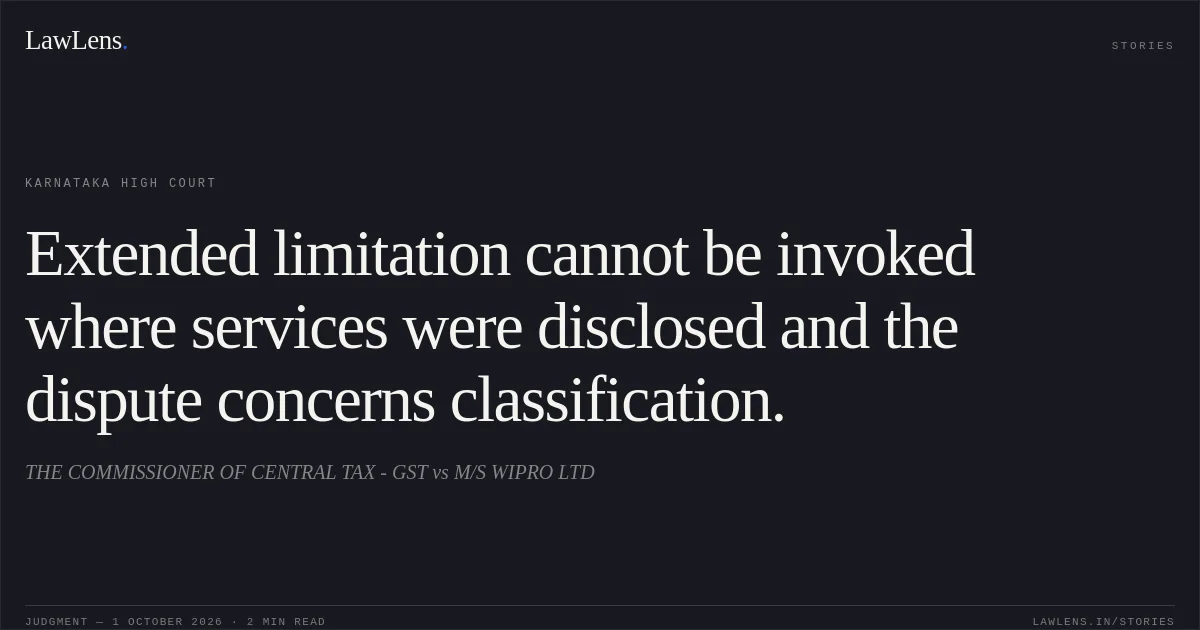
Source reference: para. 11The extended period therefore depended on establishing at least one of those statutory grounds; a dispute over the classification or taxability of disclosed services, without suppression or the requisite intent, was insufficient.
Source reference: paras. 12–15Reasoning
The Court treated the dispute as one concerning the classification of Wipro’s services, rather than concealment of the services themselves.
Source reference: para. 15CESTAT had found that Wipro’s trial balance, the audit report dated 31 March 2004, and Wipro’s explanatory letter dated 19 April 2004 disclosed the relevant services and its position that they were exempt.
Source reference: para. 10The Revenue did not contest that those documents disclosed the services.
Source reference: para. 15In those circumstances, Wipro’s claim that the services were not taxable did not establish suppression within Section 73(1), and the extended period was unavailable.
Source reference: paras. 13–16Holding
The High Court held that the Revenue could not invoke the extended limitation period under Section 73(1).
It dismissed the appeal, leaving in place CESTAT’s order upholding the classification on merits, restricting the demand to the normal period, remanding for redetermination, and setting aside penalties.
Source reference: paras. 10, 17Acts & Sections Cited
1 provisions across 1 statute referred to in this judgment. Each provision opens on LawLens.
Central Excise Act, 19441
Original Court PDF
THE COMMISSIONER OF CENTRAL TAX - GSTvsM/S WIPRO LTD
Click to open original judgment
Original judgment, available to read, download and summarize on LawLens.in