Facts
The petitioner manufactured and sold unbranded Sada Kimam and Kali Patti Zarda tobacco through a small-scale unit. He claimed exemption under Notification No. 1/1993, asserting that his annual clearances remained below ₹30 lakhs, and submitted a declaration under Rule 174 of the Central Excise Rules, 1944 in April 1994. He also claimed to have submitted declarations for the subsequent financial years.
Source reference: paras. 3–7, 38–40Following a search and seizure operation, the Department alleged that the petitioner had cleared goods valued at ₹69,06,605 between 9 April 1994 and 23 September 1996 without paying Additional Excise Duty (AED). A show-cause notice dated 14 March 1997 demanded AED of ₹6,27,086 under Section 11-A of the Central Excise Act, 1944, read with Rule 9(2) and Section 3(3) of the Additional Duties of Excise (Goods of Special Importance) Act, 1957, invoking the extended limitation period and proposing penalty.
Source reference: paras. 8–11, 42The petitioner contended that the Department had knowledge of his manufacturing activity, that there was no fraud, wilful misstatement or suppression of facts, and that the issue of AED liability for small-scale units was itself unclear. The Additional Commissioner confirmed the demand and imposed an equivalent penalty on 20 October 1997. The Commissioner (Appeals) affirmed the order on 18 November 1997.
Source reference: paras. 12–32, 45–47Issues
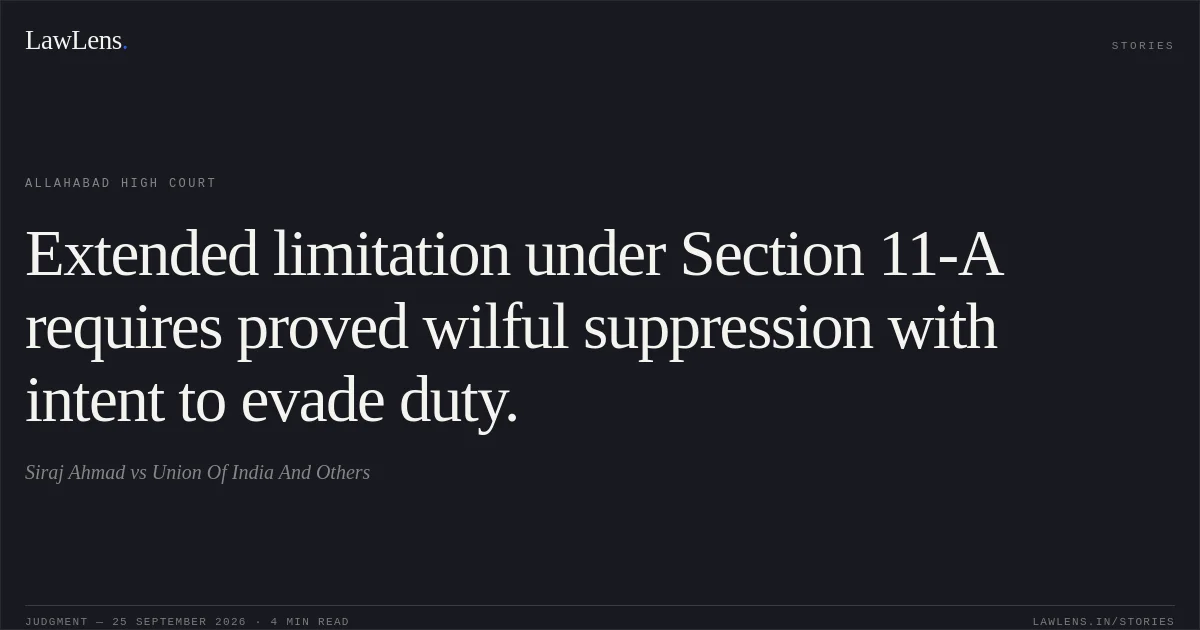
Whether the Department was entitled to invoke the extended limitation period under the proviso to Section 11-A(1) of the Central Excise Act, 1944, in the absence of proof of fraud, collusion, wilful misstatement, deliberate suppression or intent to evade duty?
Source reference: paras. 92–102, 115–126Whether the petitioner’s failure to obtain separate registration or the alleged non-filing/non-production of subsequent declarations, by themselves, established wilful suppression with intent to evade AED?
Source reference: paras. 97–112, 119–125Whether the demand for AED and the equivalent penalty could survive once the extended period of limitation was held to be unavailable?
Source reference: paras. 117–118, 126–131Whether exemption from basic excise duty extended to AED and whether the goods were marketable in their crude form?
Source reference: paras. 69–73, 106–114, 121–123Law Applied
The Court applied the proviso to Section 11-A(1) of the Central Excise Act, 1944, under which the ordinary limitation period can be extended only where non-payment or short-payment results from fraud, collusion, wilful misstatement, suppression of facts, or contravention of the Act or Rules with intent to evade duty.
Source reference: paras. 94–96Relying on Collector of Central Excise v. H.M.M. Ltd., Cosmic Dye Chemical v. Collector of Central Excise, Pushpam Pharmaceuticals Co. v. Collector of Central Excise and Tamil Nadu Housing Board v. Collector of Central Excise, the Court held that suppression must be deliberate and accompanied by the requisite intent; mere non-payment, procedural default, non-registration or omission is insufficient.
Source reference: paras. 95–102The Department bears the initial burden of establishing the circumstances attracting the extended period, which must be strictly construed.
Source reference: para. 102The Court also considered Dhoot Compack Pvt. Ltd. v. Union of India and Union of India v. Modi Rubber Ltd., which hold that exemption from basic excise duty does not automatically extend to additional or special excise duties unless the relevant notification so provides; however, those decisions do not dispense with the separate statutory requirement of proving wilful suppression for invoking extended limitation.
Source reference: paras. 106–108, 121–122Reasoning
The Court found that the petitioner had not clandestinely concealed the existence or nature of his manufacturing activity: he had disclosed the unit to the Department and filed at least the 1994 declaration, thereby placing the relevant manufacturing activity within departmental knowledge.
Source reference: paras. 97–101Any deficiency in the form of the declaration or dispute regarding the receipt of later declarations concerned procedural compliance, not necessarily deliberate suppression with intent to evade duty.
Source reference: para. 98The Department’s reliance on the search material could establish the quantum of clearances, but discovery of the clearances did not establish that the underlying manufacturing activity had been wilfully suppressed.
Source reference: paras. 100–101The Court further considered the Department’s own clarification regarding AED liability and the contemporaneous departmental communication recording confusion on the issue. These circumstances supported the petitioner’s bona fide claim of exemption and negated, rather than established, deliberate evasion.
Source reference: paras. 103–105Although the Court accepted that the substantive question of AED liability could be distinct from the question of basic excise duty exemption, that distinction could not cure the Department’s failure to prove the statutory ingredients for extended limitation.
Source reference: paras. 106–108, 121–123The Court therefore did not finally decide either the substantive AED liability or the marketability of the goods because the demand was independently unsustainable on limitation.
Source reference: paras. 113–114, 123Holding
The writ petition was allowed. The Court held that the Department failed to establish fraud, wilful misstatement, deliberate suppression or intent to evade duty sufficient to invoke the extended period under the proviso to Section 11-A(1).
The show-cause notice dated 14 March 1997, the adjudication order dated 20 October 1997 confirming AED of ₹6,27,086 and imposing an equivalent penalty, and the appellate order dated 18 November 1997 were quashed.
Source reference: paras. 127–130The respondents were restrained from recovering the AED demand and consequential penalty; any recovery already made was to be dealt with in accordance with law.
Source reference: para. 131The Court expressly left open the substantive questions concerning the applicability of AED and the marketability of the tobacco products.
Source reference: para. 132No order as to costs was made.
Source reference: para. 134Acts & Sections Cited
2 provisions across 1 statute referred to in this judgment. Each provision opens on LawLens.
Central Excise Act, 19442
Original Court PDF
Siraj AhmadvsUnion Of India And Others
Click to open original judgment
Original judgment, available to read, download and summarize on LawLens.in