Facts
The son of the de-facto complainant went missing on 30.10.2012 after leaving his home with three companions (the accused) on motorbikes
Source reference: p. 3-4His body was discovered the following day in a field with brutal injuries, including lacerations and burns
Source reference: p. 1, 7The prosecution’s case rested on circumstantial evidence: the "last seen together" theory, extra-judicial confessions made to villagers, and the recovery of a stone and glass shards allegedly used as weapons
Source reference: p. 1-2The Trial Court convicted the three accused of premeditated murder, and the High Court of Calcutta affirmed the sentence
Source reference: p. 2Two of the accused (A1 and A2) appealed to the Supreme Court
Source reference: p. 2Issues
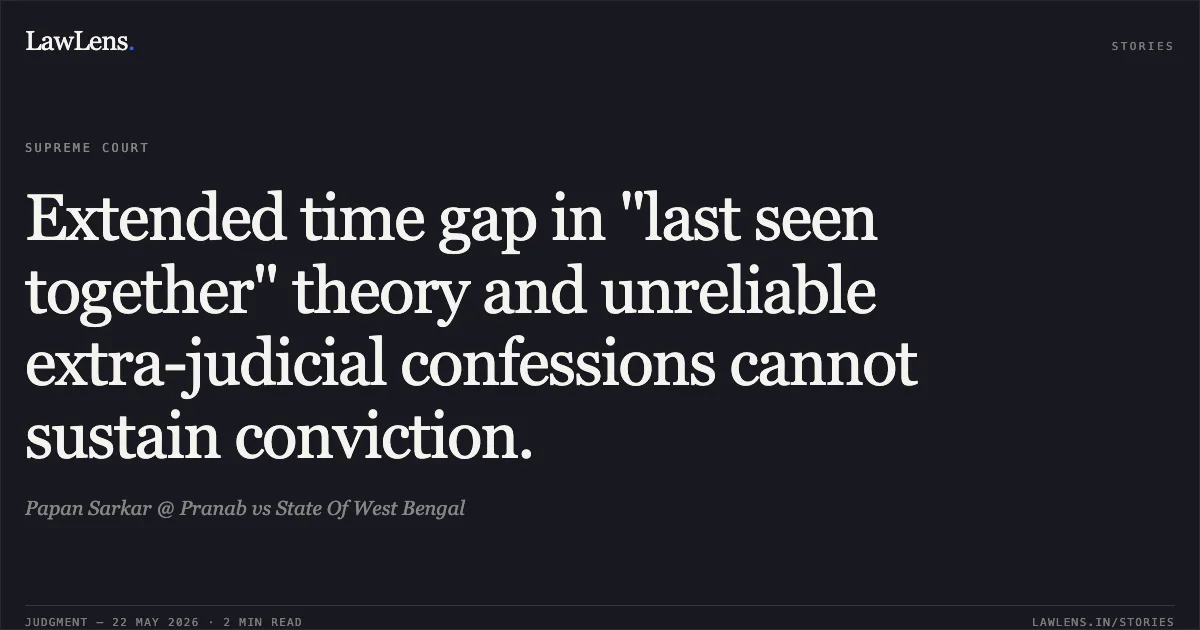
1. Whether the "last seen together" theory was sufficient to establish a complete chain of circumstances given the time gap between the sighting and the death
Source reference: p. 6-72. Whether the alleged extra-judicial confessions were legally sustainable and voluntary
Source reference: p. 8-103. Whether the recoveries made from the place of occurrence satisfied the requirements of Section 27 of the Indian Evidence Act
Source reference: p. 10-12Law Applied
The Court applied the principles governing circumstantial evidence, specifically the "last seen together" doctrine as interpreted in State of Goa v. Sanjay Thakran, which requires the time gap between the sighting and death to be so small as to exclude the possibility of any other person committing the crime
Source reference: p. 6It applied Section 27 of the Indian Evidence Act regarding the "fact discovered" through an accused’s statement, emphasizing that the statement must lead to the discovery of a concealed object known only to the accused
Source reference: p. 10-12Furthermore, it evaluated the reliability of extra-judicial confessions, noting they are "weak pieces of evidence" that must be free from duress or threat
Source reference: p. 9-10Reasoning
The Court found the chain of circumstances to be broken. First, the "last seen" sighting at 5 PM on 30.10.2012 compared to a time of death potentially much later rendered the time frame too "elastic" to be incriminating
Source reference: p. 7-8Second, the extra-judicial confessions were deemed unreliable: they were made while the accused were detained by a pressing mob (implying duress) and were largely exculpatory rather than confessional, with A1 merely accusing the others
Source reference: p. 9-10Third, the recoveries of the stone and glass failed Section 27 requirements because there was no recorded statement of "concealment"; the objects were recovered from an open field already known to be the place of occurrence, and the weapons were never shown to the medical officer for an opinion
Source reference: p. 10-13Finally, the Court noted the absence of motive and inconsistencies in the testimony of key witnesses
Source reference: p. 14-15Holding
The Court held that the prosecution failed to establish a complete chain of circumstances that excluded every hypothesis of innocence
The Supreme Court allowed the appeals and set aside the convictions of A1 and A2. The appellants were ordered to be released forthwith
Source reference: p. 15Notably, despite the third accused (A3) not filing an appeal, the Court directed the National Legal Services Authority to provide him legal assistance to file an appeal based on the parity of the current acquittal
Source reference: p. 15-16Acts & Sections Cited
1 provisions across 1 statute referred to in this judgment. Each provision opens on LawLens.
Indian Penal Code, 18601
Original Court PDF
Papan Sarkar @ PranabvsState Of West Bengal
Click to open original judgment
Original judgment, available to read, download and summarize on LawLens.in