Facts
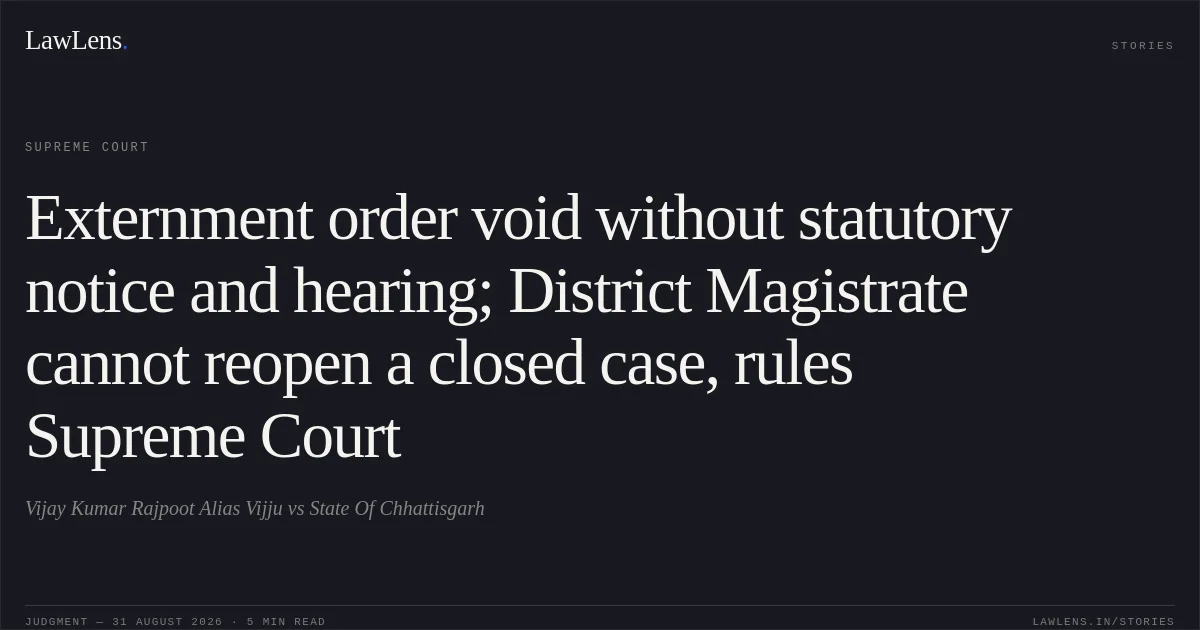
The appellant challenged an ex parte externment order dated 4 November 2025 passed by the District Magistrate, Raigarh, directing him to leave Raigarh and adjoining districts for one year under Sections 5(a) and 5(b) of the Chhattisgarh Rajya Suraksha Adhiniyam, 1990 (“Adhiniyam”).
Source reference: p.1The proceedings originated from a 2019 police recommendation based on the appellant’s alleged involvement in ten criminal cases registered between 2009 and 2019.
Source reference: p.2After noting that the appellant had been acquitted in those cases and that no fresh police report had been submitted after 2019, the authority closed the externment proceedings on 6 October 2025, issuing only a warning.
Source reference: p.2Subsequently, FIR No. 117/2023 concerning alleged unauthorised colony development and FIR No. 483/2025 concerning allegedly abusive remarks against Baba Guru Ghasidas were brought to the authority’s notice.
Source reference: pp.3–4The Superintendent of Police submitted a fresh report on 3 November 2025, following which the District Magistrate recalled the closure order and passed the externment order without serving a fresh notice or providing the appellant an opportunity of hearing, while the appellant was in judicial custody.
Source reference: pp.3–4, 7The High Court dismissed the appellant’s writ petition, declining to exercise jurisdiction under Article 226 on the ground that he had an alternative statutory appeal under Section 9 of the Adhiniyam.
Source reference: p.1Issues
1. Whether the externment order passed upon revival of the closed proceedings, without fresh notice and an opportunity of hearing under Section 8 of the Adhiniyam, was legally valid?
Source reference: paras. 17–222. Whether the District Magistrate had jurisdiction to recall or reopen the earlier closure order in the absence of an express statutory power of review?
Source reference: para. 253. Whether the externment order satisfied the substantive requirements of Sections 5(a) and 5(b) of the Adhiniyam, including the existence of objective material and a legally permissible basis for externment?
Source reference: paras. 29–344. Whether the High Court was justified in refusing to exercise its writ jurisdiction on the ground that the appellant had an alternative remedy under Section 9 of the Adhiniyam?
Source reference: paras. 16–17, 26–27Law Applied
Section 5 of the Adhiniyam permits externment where the person’s acts or movements cause or are calculated to cause alarm, danger or harm, or where there are reasonable grounds to believe that the person is engaged or about to be engaged in specified offences involving force, violence, or offences falling within the statutory categories.
Source reference: p.8Section 8(1) makes prior written notice of the general nature of the material allegations and a reasonable opportunity to explain mandatory conditions precedent to an order under Sections 3 to 6; Section 8(5) permits ex parte proceedings only where the person fails to execute a required bond or fails to appear during the inquiry.
Source reference: pp.8–12An administrative authority has no power to review or reopen its own final order unless such power is conferred by statute.
Source reference: para. 25Externment is an extraordinary measure affecting the fundamental right to free movement under Article 19(1)(d), and must be based on objective material supporting the authority’s subjective satisfaction, with a discernible nexus between the material and the necessity for externment.
Source reference: paras. 31–33The Court relied on Nawabkhan Abbaskhan v. State of Gujarat, (1974) 2 SCC 121, for the principle that breach of a statutory hearing requirement affecting fundamental rights renders the order void ab initio.
Source reference: para. 23The Court relied on Godrej Sara Lee Ltd. v. Excise and Taxation Officer-cum-Assessing Authority, 2023 SCC OnLine SC 95, on exceptions to the alternative-remedy rule under Article 226.
Source reference: para. 26The Court relied on Deepak v. State of Maharashtra, (2023) 14 SCC 707, on the need for objective material, application of mind, and non-arbitrary exercise of externment powers.
Source reference: para. 33Reasoning
The Supreme Court held that the District Magistrate could not dispense with Section 8 merely because the proceedings had previously been initiated or because fresh allegations had emerged.
Source reference: paras. 18–22, 25The closure order had ended the earlier proceedings, and the receipt of a fresh police report required a fresh statutory inquiry, including notice and an effective opportunity of hearing.
Source reference: paras. 18–22, 25None of the exceptional circumstances under Section 8(5) existed, particularly since the appellant was in custody and had not failed to appear after being lawfully called upon to do so.
Source reference: para. 22The District Magistrate also lacked statutory authority to recall or review the closure order; the alleged breach of a warning did not confer such jurisdiction.
Source reference: para. 25On the merits, Section 5(b) was wrongly invoked because the offences relied upon did not involve force or violence and did not fall within the specified IPC categories incorporated by the provision.
Source reference: paras. 29–30The allegations concerning insults to a religious figure related to offences affecting religion, corresponding to Chapter XV of the IPC, rather than the categories contemplated by Section 5(b).
Source reference: paras. 29–30Even assuming reliance solely on Section 5(a), the order merely referred to public resentment and outrage without identifying supporting material, explaining the gravity of the situation, or demonstrating why externment was necessary.
Source reference: paras. 31–34The order therefore failed to disclose a bona fide and informed subjective satisfaction based on objective material.
Source reference: paras. 31–34Given the patent breach of natural justice and lack of jurisdiction, the High Court should have entertained the writ petition notwithstanding the alternative remedy under Section 9.
Source reference: paras. 26–27Holding
The Supreme Court held that the externment order was invalid because it was passed in breach of the mandatory notice and hearing requirements under Section 8, without the District Magistrate possessing jurisdiction to reopen the closed proceedings, and without satisfying the substantive requirements of Section 5.
The High Court’s order relegating the appellant to the statutory appeal under Section 9 was set aside, and both the externment order and the High Court judgment were quashed.
Source reference: para. 36The appellant was declared free to enter the districts from which he had been externed.
Source reference: para. 37The Court clarified that its observations would not affect the merits of the criminal cases pending against him.
Source reference: para. 38The appeal was accordingly allowed.
Source reference: para. 39Acts & Sections Cited
19 provisions across 5 statutes referred to in this judgment. Each provision opens on LawLens.
Chhattisgarh Municipal Corporation Act, 19566
Bharatiya Nyaya Sanhita, 20235
Indian Penal Code, 18606
Scheduled Castes and the Scheduled Tribes (Prevention of Atrocities) Act, 19891
Limitation Act, 19631
Original Court PDF
Vijay Kumar Rajpoot Alias VijjuvsState Of Chhattisgarh
Click to open original judgment
Original judgment, available to read, download and summarize on LawLens.in