Facts
The dispute concerned mutation of agricultural land at Village Navlihaar, Tehsil Ater, District Bhind, comprising several survey numbers under Khatas Nos. 38–43.
Source reference: p.1The mutation was recorded pursuant to the Tehsildar’s order dated 24 April 1982, allegedly on the basis of a registered Will.
Source reference: p.1Respondents Nos. 1 and 2 challenged the mutation only in 2024, approximately 43 years later, along with an application under Section 5 of the Limitation Act, 1963 for condonation of delay.
Source reference: pp.1, 4The Sub-Divisional Officer rejected the condonation application and consequently dismissed the appeal on 15 April 2025, holding that the delay was not satisfactorily explained.
Source reference: pp.1, 4In revision, the Additional Collector, Bhind, by order dated 18 November 2025, condoned the delay and remanded the matter to the SDO for decision on merits.
Source reference: pp.1–2, 4The petitioner challenged the revisional order under Article 226 of the Constitution.
Source reference: p.1Issues
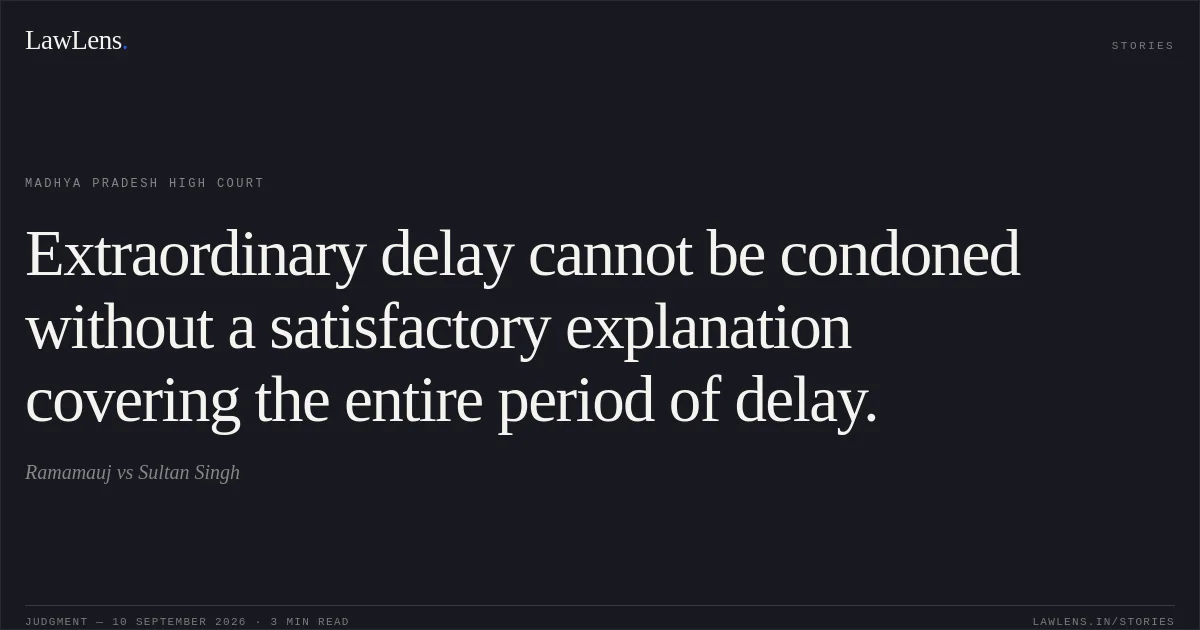
Whether the Additional Collector was justified in condoning the approximately 43-year delay in challenging the mutation order dated 24 April 1982 under Section 5 of the Limitation Act, 1963, without a satisfactory explanation covering the entire period of delay?
Source reference: pp.4–6Whether the Additional Collector had validly interfered with the SDO’s order dated 15 April 2025 dismissing the delayed appeal?
Source reference: p.6Law Applied
The Court applied Section 5 of the Limitation Act, 1963, under which delay may be condoned only upon a finding of “sufficient cause.”
Source reference: p.3Relying on P.K. Ramachandran v. State of Kerala, (1997) 7 SCC 556, the Court held that a reasonable and satisfactory explanation for the delay is an essential prerequisite and that limitation cannot be extended merely on equitable considerations.
Source reference: p.3Relying further on Basawaraj v. Special Land Acquisition Officer, (2013) 14 SCC 81, the Court reiterated that “sufficient cause” cannot be liberally construed where negligence, inaction, or lack of bona fides is attributable to the applicant, and that an inordinate delay cannot be condoned in the absence of sufficient cause merely by imposing conditions.
Source reference: pp.3, 6Revisional interference also required demonstration of perversity, illegality, or material irregularity in the SDO’s decision.
Source reference: p.6Reasoning
The Court treated the 43-year delay as extraordinary and held that the respondents’ plea of subsequent knowledge, by itself, did not explain the entire intervening period.
Source reference: pp.5–6The Additional Collector was required to record a clear and cogent finding showing how the explanation constituted sufficient cause, but the impugned order failed to do so.
Source reference: p.5The SDO had already considered the condonation application and found the delay inadequately explained.
Source reference: p.6Since the Additional Collector did not identify any perversity, illegality, or material irregularity in that finding, there was no lawful basis for revisional interference.
Source reference: p.6The Court expressly confined its determination to limitation and did not adjudicate the validity of the Will, the mutation, title, or the parties’ substantive rights.
Source reference: p.6Holding
The Court held that the Additional Collector was not justified in condoning the approximately 43-year delay in the absence of a satisfactory and legally sustainable explanation covering the entire period.
The order dated 18 November 2025 in Revision Case No. 17/25-26 was set aside.
Source reference: p.7The SDO’s order dated 15 April 2025, dismissing the application for condonation of delay and consequently the appeal, was restored.
Source reference: p.7The writ petition was allowed, with no order as to costs.
Source reference: p.7Acts & Sections Cited
1 provisions across 1 statute referred to in this judgment. Each provision opens on LawLens.
Limitation Act, 19631
Original Court PDF
RamamaujvsSultan Singh
Click to open original judgment
Original judgment, available to read, download and summarize on LawLens.in