Facts
The Appellant (MCGM) awarded a consultancy contract for a sewage project to the Respondent in 1995.
Source reference: para. 5Following disputes over outstanding dues, the Respondent invoked arbitration in 2005 under Clause 8.3(b) of the Agreement.
Source reference: para. 7Both parties appointed nominee arbitrators, but the appointment of the Presiding Arbitrator was delayed as the parties explored conciliation.
Source reference: para. 8-9After two previous presiding arbitrators resigned, the nominee arbitrators appointed Mr. Anwarul Haque on 24.10.2008.
Source reference: para. 14MCGM participated in the preliminary meeting on 09.01.2009 but subsequently challenged the Tribunal's jurisdiction under Section 16 of the Arbitration and Conciliation Act, 1996 ("1996 Act"), arguing that since the appointment happened beyond the 30-day window stipulated in the contract, only the Secretary General of ICSID had the power to appoint.
Source reference: para. 15-16The Tribunal rejected the plea, and the High Court of Bombay subsequently dismissed MCGM’s challenges under Sections 34 and 37.
Source reference: para. 17-20Issues
Whether the Arbitral Tribunal was improperly constituted and lacked jurisdiction because the Presiding Arbitrator was appointed by the Co-Arbitrators after the expiration of the contractual 30-day period.
Source reference: para. 21/27Whether the Appellant, by its conduct and participation in the proceedings, waived its right to object to the procedure of appointment.
Source reference: para. 38Law Applied
The Court applied Section 16 of the 1996 Act, which empowers a tribunal to rule on its own jurisdiction.
Source reference: para. 39It relied on Section 4 regarding the waiver of the right to object when a party proceeds without stating objections to non-compliance with the arbitration agreement.
Source reference: para. 40The Court further applied the principle of judicial non-interference in arbitral awards under Section 34, noting the arbitrator is the master of contractual interpretation as held in *Consolidated Construction Consortium Ltd. v. STPI*.
Source reference: para. 36Regarding waiver, it cited *Narayan Prasad Lohia v. Nikunj Kumar Lohia*, establishing that composition of a tribunal is a derogable matter.
Source reference: para. 60Regarding the relinquishment of known rights, it cited *Hindustan Construction Co. Ltd. v. Bihar Rajya Pul Nirman Nigam Ltd.*
Source reference: para. 59Reasoning
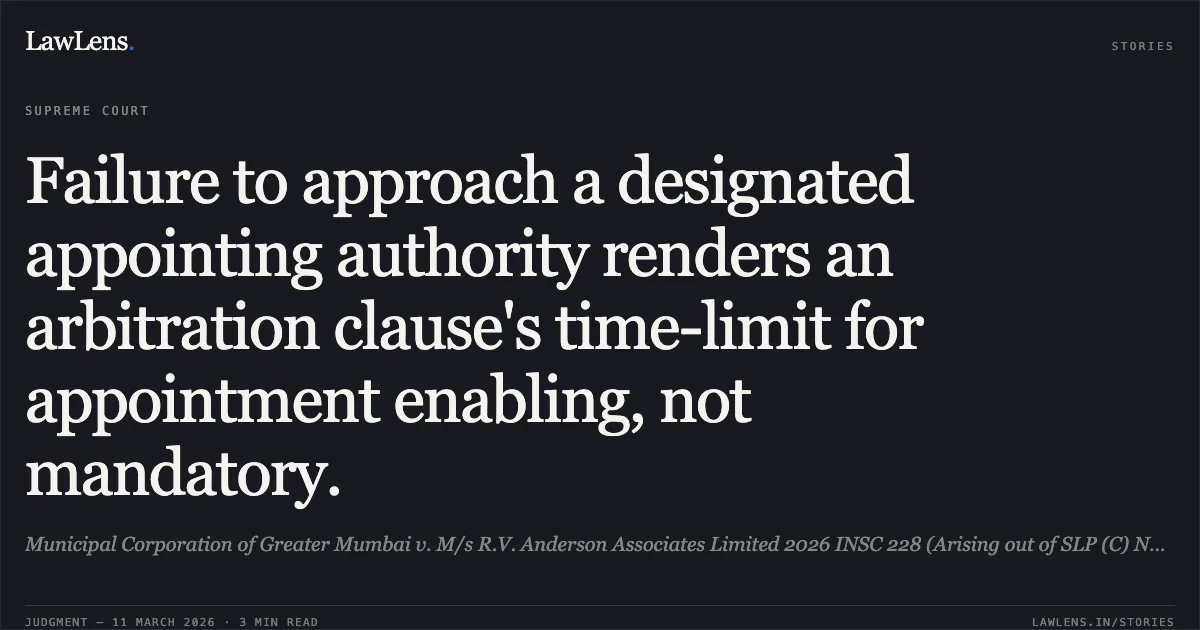
The Court found that Clause 8.3(b) was "enabling" rather than "restrictive."
Source reference: para. 32-34The provision for ICSID appointment was a "fail-safe" triggered only upon a specific request by a party, which neither party made.
Source reference: para. 32-34The Court reasoned that interpreting the clause to mean Co-Arbitrators lose power after 30 days would lead to "commercial absurdity," leaving the process in limbo indefinitely.
Source reference: para. 35While MCGM filed its Section 16 application within the statutory timeline (before the Statement of Defence), its prior actions—consenting to keep proceedings in abeyance and failing to object through three successive appointments of presiding arbitrators—constituted acquiescence.
Source reference: para. 63-66The Court held that a party cannot "keep a jurisdictional ace up their sleeve" while actively participating in the process.
Source reference: para. 67Holding
The Supreme Court dismissed the appeals and upheld the High Court’s judgment.
The Court held that the Tribunal’s interpretation of Clause 8.3(b) was a "plausible view" that did not warrant interference.
Source reference: para. 37It concluded that the appointment of the Presiding Arbitrator by the Co-Arbitrators was valid as no party had invoked the ICSID contingency.
Source reference: para. 33Furthermore, the Appellant’s conduct of participating in the process without demur for years precluded it from later challenging the foundational appointment process.
Source reference: para. 67The stay on the operation of the impugned order was vacated.
Source reference: para. 20/68Acts & Sections Cited
7 provisions across 1 statute referred to in this judgment. Each provision opens on LawLens.
Arbitration and Conciliation Act, 19967
Original Court PDF
Municipal Corporation of Greater Mumbai v. M/s R.V. Anderson Associates Limited 2026 INSC 228 (Arising out of SLP (C) Nos. 23846-47 of 2025)
Click to open original judgment
Original judgment, available to read, download and summarize on LawLens.in


![Subsequent exoneration does not retrospectively invalidate a finalized promotion select list.. UNNIKRISHNAN M vs M/o Environment And Forests. CAT - ['Ernakulam']. LawLens](/stories/thumbnails/subsequent-exoneration-does-not-retrospectively-invalidate-a-finalized-promotion-select-li-ce80a0e84f2f4887857271e8b4341c42.webp)