Facts
The respondents were appointed as Assistant Teachers in lower primary schools in Dhemaji District in 1989. They claimed selection through a regular process, continued service, transfers, confirmation, payment of salary, and discharge of duties including as Headmasters in some cases.
Source reference: paras. 5–7The State alleged that the appointments were irregular or illegal, having been made against non-existent or non-sanctioned posts, without following prescribed recruitment procedures and during a ban on appointments.
Source reference: para. 8Show-cause notices were issued in March 1992, replies were submitted in April 1992, and termination orders were passed in May 1992, including the order dated 18.05.1992.
Source reference: para. 9Subsequently, the State conducted a screening exercise concerning irregularly appointed teachers. The respondents participated in the process. They were treated as teachers who were not recommended but were continuing to work, and pursuant to the Cabinet decision dated 07.10.2020, most were accommodated prospectively as Tutors on fixed pay under orders dated 30.01.2021.
Source reference: paras. 13–18The learned Single Judge quashed the termination orders for want of proof of communication and directed that the respondents be treated as regular Assistant Teachers with all consequential benefits. The State challenged that direction in the present writ appeal.
Source reference: paras. 2–4, 28–29Issues
Whether the termination order dated 18.05.1992 was legally effective when the State failed to prove that it had been communicated to the individual respondents?
Source reference: paras. 30–34Whether the failure to establish communication of the termination order automatically entitled the respondents to be treated as regular Assistant Teachers from 1989 with all consequential service benefits?
Source reference: paras. 35–36, 44–48Whether the subsequent screening process, Cabinet decision dated 07.10.2020, and prospective accommodation of the respondents as Tutors could be disregarded or retrospectively nullified while granting relief in the writ proceedings?
Source reference: paras. 37–43, 52Law Applied
An order terminating service does not become operative merely upon being passed or retained on the official file; it must be communicated to the concerned employee. The Court relied on Union of India v. Dinanath Shantaram Karekar, (1998) 7 SCC 569, Municipal Corporation of Delhi v. Qimat Rai Gupta, (2007) 7 SCC 309, National Textile Corporation (M.P.) Ltd. v. M.R. Jadhav, (2008) 7 SCC 29, and Dulu Devi v. State of Assam, (2016) 1 SCC 622, particularly for the communication principle.
Source reference: paras. 20–21, 26–28, 33However, invalidity or ineffectiveness of a termination order does not establish that the underlying appointment was regular or lawful, nor does long continuation in service convert an illegal appointment into a valid one or create a right to regularisation contrary to recruitment rules, as recognised in State of Bihar v. Devendra Sharma, (2020) 15 SCC 466 and R. Vishwanatha Pillai v. State of Kerala, (2004) 2 SCC 105.
Source reference: paras. 24, 44A court exercising jurisdiction under Article 226 cannot grant relief that nullifies subsequent unchallenged administrative or policy decisions.
Source reference: paras. 42–43The Court also directed consideration of an appropriate pay scale for the respondents in their capacity as Tutors, in accordance with law and the principle considered in Mohor Ali Seikh v. State of Assam, (2024) 5 GLT 689.
Source reference: paras. 49–51Reasoning
The Court upheld the finding that the State had not proved effective communication of the termination orders to the individual respondents. Although the State produced the show-cause notices, replies, and the termination order, it failed to produce original acknowledgments or other satisfactory evidence establishing service of the termination orders.
Source reference: paras. 31–34Applying the communication principle in Dulu Devi and the other cited authorities, the Court held that the termination order could not be treated as having effectively ended the respondents’ services merely because it had been passed by the competent authority.
Source reference: paras. 33–34However, the Court distinguished between the ineffectiveness of termination and the legal character of the original appointments. The respondents’ participation in the later screening process, their categorisation, the Cabinet decision dated 07.10.2020, and their acceptance of prospective accommodation as Tutors demonstrated that the subsequent governmental framework had dealt with their status separately.
Source reference: paras. 37–40Since those proceedings were never challenged, the Single Judge could not grant a declaration of regular Assistant Teacher status from 1989 that would retrospectively nullify them.
Source reference: paras. 42–48Long service and payment of salary could not, by themselves, establish a substantive right to a regular post or all statutory benefits attached to a lawful appointment.
Source reference: paras. 44–47The Court nevertheless clarified that it was not declaring that the respondents had rendered no service, that salary already paid was recoverable, or that every appointment was void ab initio.
Source reference: para. 45Holding
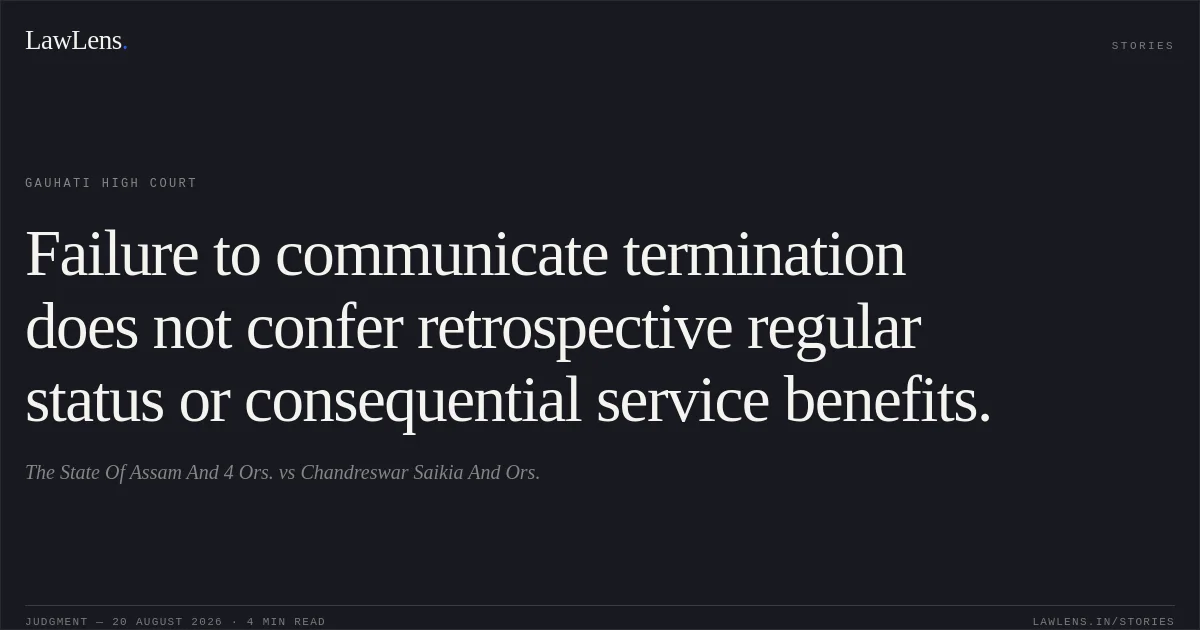
The appeal was partly allowed. The Court upheld the quashing of the termination order dated 18.05.1992 because the State failed to prove its communication to the respondents.
However, it set aside the direction granting all consequential benefits as Assistant Teachers and declaring the respondents to be regular Assistant Teachers for all purposes.
Source reference: paras. 52, 55The subsequent screening proceedings, Cabinet decision dated 07.10.2020, and orders dated 30.01.2021 accommodating the respondents as Tutors were permitted to operate according to their terms.
Source reference: paras. 52–55The competent authority was directed to consider whether an appropriate pay scale could be extended to the respondents in their capacity as Tutors, in accordance with applicable law, including the principle in Mohor Ali Seikh.
Source reference: para. 51The writ appeal was disposed of without costs.
Source reference: para. 56Original Court PDF
The State Of Assam And 4 Ors.vsChandreswar Saikia And Ors.
Click to open original judgment
Original judgment, available to read, download and summarize on LawLens.in