Facts
The deceased, Prakash, was traveling from Mumbai to Ahmedabad on 17.04.2017 when he accidentally fell from a passenger train and died on the spot
Source reference: p. 1-2The mother of the deceased filed a claim before the Railway Claims Tribunal, Ahmedabad, which awarded Rs. 8 lakhs with 9% interest
Source reference: p. 1The Appellant-Railways challenged the award, contending that the deceased was not a bona fide passenger as no ticket was found and that the death was a result of the deceased's own negligence or suicide under Section 124-A(b) of the Railways Act, 1989
Source reference: p. 2The Divisional Railway Manager (DRM) report, which suggested negligence, was completed nearly a year after the incident
Source reference: p. 4Issues
1. Whether the death of the deceased qualifies as an "untoward incident" under Section 124-A of the Railways Act, 1989, or falls under the exclusionary provisos such as suicide or self-inflicted injury
Source reference: p. 2 / para. 32. Whether the deceased can be considered a bona fide passenger in the absence of a physical recovery of the train ticket
Source reference: p. 5 / para. 12Law Applied
Section 124-A of the Railways Act, 1989, which imposes strict liability on the Railways for "untoward incidents"
Source reference: p. 2Rule 7.2 of the Railway Passengers (Manner of Investigation of Untoward Incidents) Rules, 2003, which mandates completion of investigations within 60 days
Source reference: p. 3-4Kalandi Charan Sahoo v. GM, South East Central Railway, establishing that failure to conduct a timely inquiry entitles claimants to compensation
Source reference: p. 4, para. 9Shrikumar Gupta v. Union of India (2025) and Rajni v. Union of India (2025), holding that a sane person is presumed not to jump from a running train and that the initial burden of proving bona fide passenger status is discharged by the claimant's affidavit, after which the burden shifts to the Railways
Source reference: p. 4-6Reasoning
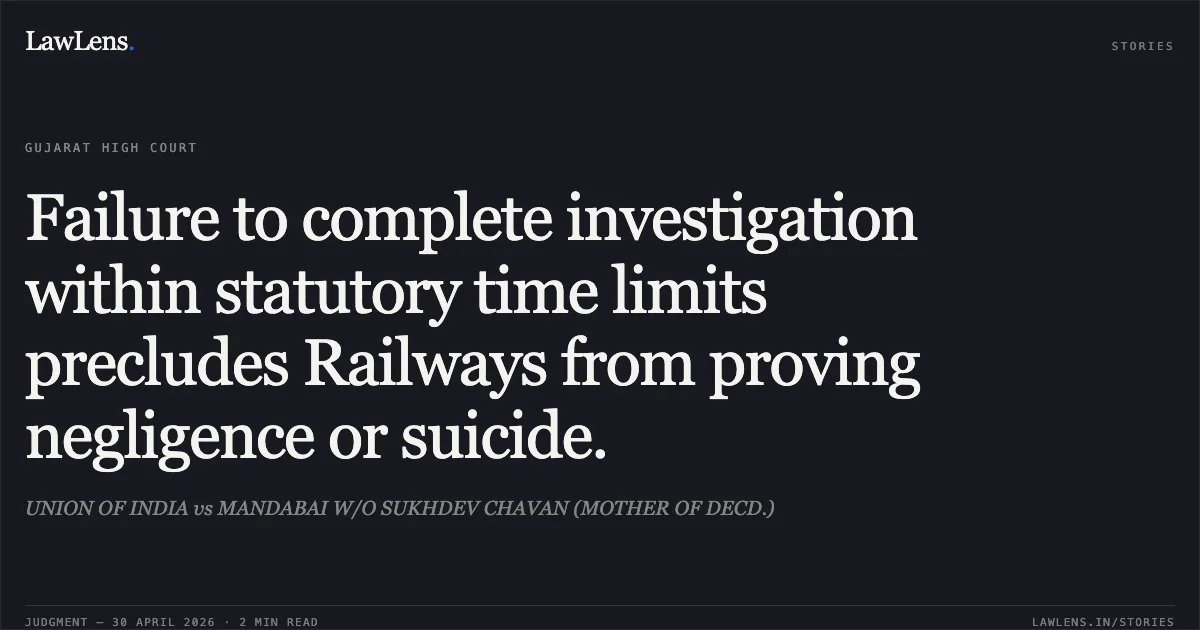
The court found that the Railways failed to complete the investigation within the statutory 60-day limit, rendering the delayed DRM report insufficient to rebut the claimant's case
Source reference: para. 8Regarding negligence, the court reasoned that no sane person would voluntarily jump from a running express train, and the Railways provided no proof of suicide or self-inflicted injury to invoke the Section 124-A exceptions
Source reference: para. 10-11On the issue of the ticket, the court noted the claimant’s affidavit stated the ticket was lost during the accident—a statement not successfully controverted in cross-examination
Source reference: para. 12Following recent Supreme Court precedents, the court held that a "hyper-technical approach" regarding the absence of a ticket should be eschewed in welfare legislation, and the statutory presumption of bona fide travel operates in favor of the claimant once the foundational facts are established
Source reference: para. 12-14Holding
The High Court dismissed the appeal and upheld the Tribunal’s award
The court held that the deceased was a bona fide passenger who died in an "untoward incident"
Source reference: para. 14The Railways was ordered to disburse the remaining compensation amount with interest to the mother of the deceased after due verification
Source reference: para. 16Acts & Sections Cited
2 provisions across 2 statutes referred to in this judgment. Each provision opens on LawLens.
Railways Act, 19891
Railway Claims Tribunal Act, 19871
Original Court PDF
UNION OF INDIAvsMANDABAI W/O SUKHDEV CHAVAN (MOTHER OF DECD.)
Click to open original judgment
Original judgment, available to read, download and summarize on LawLens.in


![Subsequent exoneration does not retrospectively invalidate a finalized promotion select list.. UNNIKRISHNAN M vs M/o Environment And Forests. CAT - ['Ernakulam']. LawLens](/stories/thumbnails/subsequent-exoneration-does-not-retrospectively-invalidate-a-finalized-promotion-select-li-ce80a0e84f2f4887857271e8b4341c42.webp)