Facts
The respondents operated a partnership firm engaged in manufacturing, selling and storing groundnut oil.
Source reference: p.2; para 2.1On 5 February 1992, a Food Inspector purchased 400 grams of “Maharani Brand” groundnut oil from the firm’s premises for analysis, divided the sample into three parts, sealed them and forwarded one part to the Public Analyst.
Source reference: pp.2, 8; paras 2.1–2.2, 7–8The Public Analyst reported that the sample was adulterated because it contained castor oil and did not conform to the prescribed standards.
Source reference: p.3; para 2.3After obtaining sanction under Section 20 of the Prevention of Food Adulteration Act, 1954 (“PFA Act”), the prosecution was instituted against the firm and its partners.
Source reference: p.3; paras 2.3, 9The Trial Court examined two prosecution witnesses and considered 20 documentary exhibits; one panch witness was declared hostile.
Source reference: p.9; paras 2.5, 10–11By judgment dated 4 June 2011, the Trial Court acquitted the accused, principally finding non-compliance with Section 13(2), Section 17 and Rules 13(2) and 14 of the Prevention of Food Adulteration Rules, 1955.
Source reference: pp.9–12; paras 12–19The State challenged the acquittal under Section 378(4) of the Code of Criminal Procedure, 1973.
Source reference: p.1; para 1Issues
Whether the Trial Court committed an error of fact or law in acquitting the respondents of offences under Sections 2(1-a)(a), (c) and (m), 7(1), 16 and 17 of the PFA Act?
Source reference: p.9; para 11; p.24; para 37Whether the prosecution proved compliance with the mandatory requirements of Section 13(2) of the PFA Act and Rule 13(2) of the PFA Rules, including effective service of the Public Analyst’s report and notice upon the concerned partners?
Source reference: pp.10, 20; paras 13, 29–30Whether the prosecution established compliance with Rule 14 concerning the use of clean and dry containers and proper sampling procedure, including obtaining a homogeneous sample?
Source reference: pp.11, 17–19; paras 17, 24–27Whether the prosecution validly sanctioned and instituted proceedings against the correct accused and established the liability of the partners under Section 17 of the PFA Act?
Source reference: pp.10–13, 20; paras 14–18, 29–30Whether the acquittal was so illegal or perverse as to warrant appellate interference?
Source reference: p.9; para 6; pp.21–23, 32–35Law Applied
The Court applied Sections 2(1-a), 7(1), 13(2), 16, 17 and 20 of the PFA Act, 1954, and Rules 13(2) and 14 of the PFA Rules, 1955.
Source reference: no citationSection 13(2) protects the accused’s statutory right to obtain analysis of the preserved sample by the Central Food Laboratory and therefore requires proper communication of the Public Analyst’s report and notice.
Source reference: p.12; para 20Section 17 requires specific proof of the firm’s and responsible partners’ liability; a merely formal or bald allegation against a partner is insufficient, as recognised in Pepsico India Holdings Pvt. Ltd. v. Food Inspector.
Source reference: pp.13, 16; paras 20, 23Rule 14 requires food samples to be collected in clean, dry and sufficiently sealed containers.
Source reference: p.14; para 21The Court also relied on authorities holding that edible-oil samples should be properly mixed or made homogeneous where necessary, and that failure to establish compliance with Rule 14 may vitiate the prosecution.
Source reference: pp.16–19; paras 24–27Finally, under Chandrappa v. State of Karnataka, an appellate court may reappreciate evidence in an appeal against acquittal, but the accused enjoy a reinforced or “double” presumption of innocence; where two reasonable views are possible, the acquittal should not be disturbed.
Source reference: pp.22–24; paras 32–35Reasoning
Although the Public Analyst’s report declared the groundnut-oil sample adulterated, the prosecution failed to prove that the Section 13(2) notice and report were effectively served upon each concerned partner or that the recipient was authorised to manage the partnership’s affairs.
Source reference: p.20; para 29Consequently, the accused’s statutory right to seek Central Food Laboratory analysis was not shown to have been meaningfully preserved.
Source reference: p.20; para 29The prosecution also failed to establish that the sample bottles were clean and dry at the time of collection, that the oil had been sufficiently mixed to obtain a reliable sample, or that the requirements of Rule 14 had been observed.
Source reference: pp.11, 17–20; paras 17, 24–30The sanction was further vitiated by discrepancies in the name of respondent No. 3—“Ravjibhai Kalabhai Mandanka” in the sanction and “Ravjibhai Kababhai Mandanka” in the partnership documents—and by the absence of evidence proving the sanctioning authority’s appointment as Local Health Authority.
Source reference: p.20; para 30These procedural and evidentiary deficiencies created reasonable doubt regarding the integrity of the sample, validity of the sanction and individual liability of the partners.
Source reference: no citationApplying the principles governing appellate review of acquittals, the High Court found that the Trial Court’s view was reasonable, supported by the record and neither perverse nor manifestly illegal.
Source reference: pp.20–24; paras 28, 31–37Holding
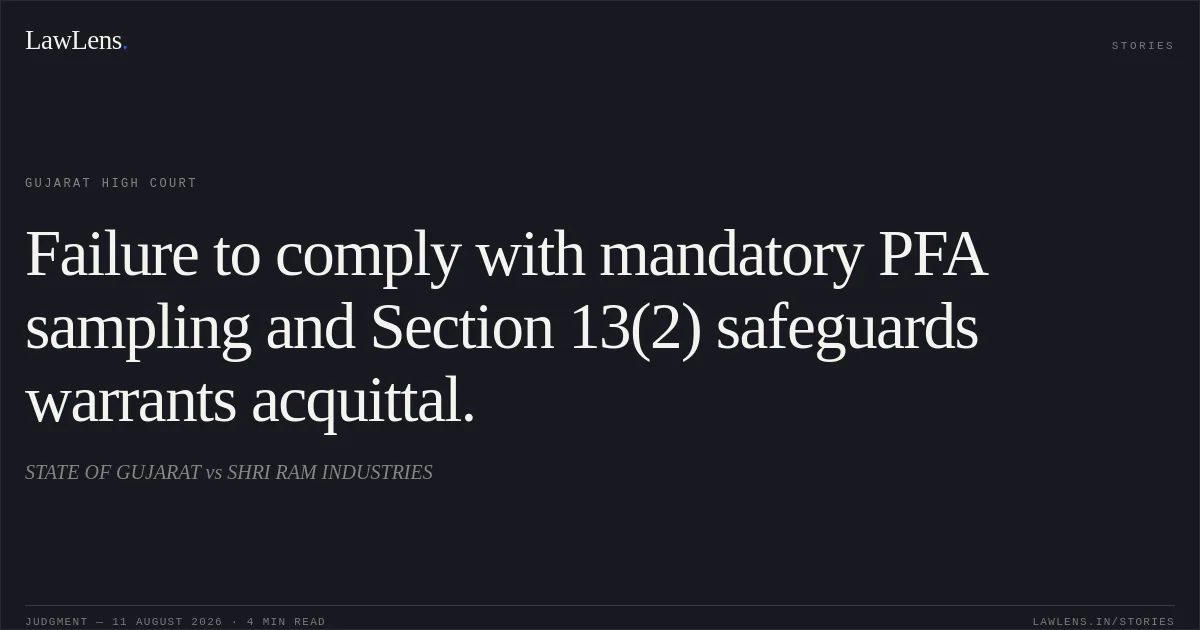
The High Court answered the issues against the State and held that the prosecution had failed to prove the respondents’ guilt beyond reasonable doubt.
The Trial Court had correctly found non-compliance with the mandatory requirements of Section 13(2), Section 17 and Rules 13(2) and 14 of the PFA Act and Rules.
Source reference: pp.20, 24; paras 28, 36–37The appeal was dismissed, the judgment of acquittal dated 4 June 2011 was confirmed, the bail bonds were cancelled, and the record and proceedings were directed to be returned to the Trial Court.
Source reference: p.25; para 38Acts & Sections Cited
2 provisions across 1 statute referred to in this judgment. Each provision opens on LawLens.
Code of Criminal Procedure, 19732
Original Court PDF
STATE OF GUJARATvsSHRI RAM INDUSTRIES
Click to open original judgment
Original judgment, available to read, download and summarize on LawLens.in