Facts
Residents of Chatha Farm alleged that a government-funded road/protection wall, constructed in 2015, was damaged and obstructed by the petitioners in January 2016.
Source reference: para. 2–8After departmental communications to the police did not result in an FIR, the complainants applied to the Chief Judicial Magistrate under Section 156(3) CrPC.
Source reference: para. 2–8The Magistrate forwarded the application to the SHO to verify the facts, but the police registered an FIR under Sections 431 and 341 IPC and, after investigation, filed a charge sheet.
Source reference: para. 2–8The petitioners sought to quash the charge sheet and ensuing proceedings, arguing, among other things, that the police had failed to conduct the directed verification and that the road had been built on their land, a matter also raised in a writ petition.
Source reference: para. 2–8The High Court considered the challenge after the investigation was complete and the charge sheet had been filed.
Source reference: para. 9–13Issues
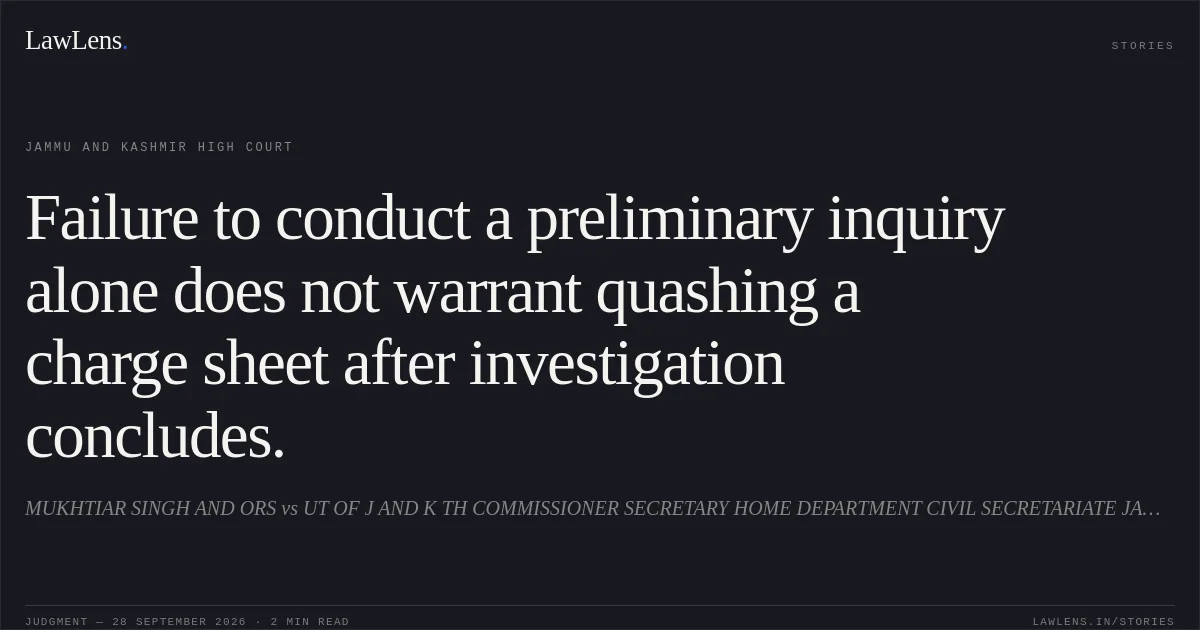
Whether the failure to conduct a preliminary verification before registering the FIR, despite the Magistrate’s direction and the delay in reporting, justified quashing the charge sheet and proceedings after completion of the investigation.
Source reference: para. 10–11Whether the material in the charge sheet disclosed a prima facie case of damage to public property notwithstanding the petitioners’ claim that the road was constructed on their land.
Source reference: para. 12–13Law Applied
Section 156(3) CrPC, now Section 175(3) BNSS, permits a Magistrate to direct police investigation; under Lalita Kumari v. Government of Uttar Pradesh, (2014) 2 SCC 1, preliminary verification may be desirable in cases involving delay, but delay does not bar registration of an FIR where the complaint otherwise discloses a cognizable offence.
Source reference: para. 10The High Court also relied on Anurag Bhatnagar v. State (NCT of Delhi), 2025 INSC 895, in declining to interfere with an FIR once investigation has concluded and a charge sheet has been filed, absent justification to exercise its discretionary jurisdiction.
Source reference: para. 11The Court considered its quashing jurisdiction under Section 482 CrPC, now Section 528 BNSS, and the allegations under Sections 431 and 341 IPC.
Source reference: para. 1, 14Reasoning
The Court accepted that preliminary verification would ordinarily have been advisable given the delay and the Magistrate’s direction, but held that the omission did not warrant quashing at the post-investigation stage.
Source reference: para. 10–11The charge sheet included witness statements and departmental records indicating that the road was government-funded, that it had been damaged, and that officials had repeatedly sought police action; this material was sufficient, at the prima facie stage, to support the allegation of damage to public property.
Source reference: para. 12The petitioners’ ownership claim did not justify damaging the road: any challenge to its construction on their land had to be pursued through lawful proceedings, rather than self-help.
Source reference: para. 13Holding
The Court held that the failure to conduct preliminary verification and the petitioners’ land dispute did not warrant quashing the charge sheet or proceedings.
Finding the petition without merit, it dismissed the petition under its quashing jurisdiction.
Source reference: para. 14Acts & Sections Cited
6 provisions across 3 statutes referred to in this judgment. Each provision opens on LawLens.
Indian Penal Code, 18602
Code of Criminal Procedure, 19732
Bharatiya Nagarik Suraksha Sanhita, 20232
Original Court PDF
MUKHTIAR SINGH AND ORSvsUT OF J AND K TH COMMISSIONER SECRETARY HOME DEPARTMENT CIVIL SECRETARIATE JAMMU AND ORS
Click to open original judgment
Original judgment, available to read, download and summarize on LawLens.in