Facts
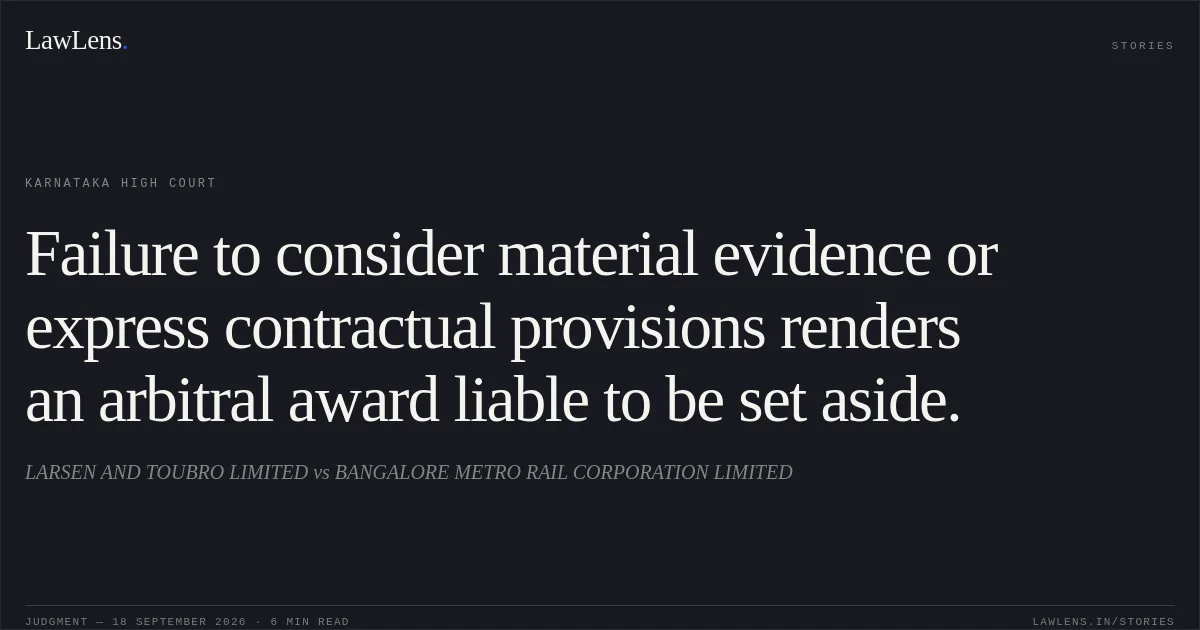
Bangalore Metro Rail Corporation Limited (BMRCL) awarded Larsen and Toubro Limited (L&T) a contract dated 5 March 2010 for construction of approximately 4.8 km of elevated viaduct and three stations on Reach R3A, for a contract period ending on 16 December 2011.
Source reference: para. 7–10The site was handed over progressively and, in several stretches, beyond the contractual schedule; hindrance-free land for 18 pier locations was handed over only on 4 January 2014.
Source reference: para. 11The works were ultimately completed in stages, and disputes arose concerning delay, variations, unpaid reinforcement quantities, revised rates, price variation, liquidated damages and prolongation costs.
Source reference: para. 12–13An arbitral tribunal awarded L&T various amounts, including ₹96,43,811 for reduced parapet quantities, ₹9,27,17,850 as revised rates for 18 pier locations, and ₹2,84,61,516 for unpaid reinforcement quantities.
Source reference: para. 17–21It held that the delays were attributable to BMRCL and that L&T was entitled in principle to time-related costs, but rejected L&T’s claim of ₹103.30 crore for prolongation costs for want of proof of quantification.
Source reference: para. 17–21BMRCL’s counterclaims were substantially rejected, except for a partial award of ₹31,21,461 on Counter-Claim No. 5.
Source reference: para. 20Both parties challenged the award under Section 34 of the Arbitration and Conciliation Act, 1996.
Source reference: para. 22–29The Commercial Court dismissed both petitions by orders dated 13 December 2024 without materially addressing the specific grounds of challenge.
Source reference: para. 22–29The parties thereafter filed the present cross-appeals under Section 13(1-A) of the Commercial Courts Act, 2015 read with Section 37 of the Arbitration and Conciliation Act, 1996.
Source reference: para. 1–5Issues
Whether the arbitral award granting compensation for the reduction in parapet-work quantities under Claim (ii) was sustainable under the contractual variation provisions and the evidence on record?
Source reference: para. 43–58Whether the award of revised rates for works at 18 pier locations under Claim (iv) was sustainable when the tribunal had not considered BMRCL’s reliance on Clauses 2.2, 8.3 and 19.3 of the Contract?
Source reference: para. 68–80Whether the award of ₹2,84,61,516 for unpaid reinforcement quantities under Claim (v) was sustainable, particularly when the award included amounts for piling guide rings/spacers that the Engineer had stated were included in the contract rates?
Source reference: para. 59–68Whether L&T’s claim for ₹103.30 crore towards time-related prolongation costs under Claim (iii) was wrongly rejected for want of proof of quantification, despite the tribunal’s finding that L&T was entitled to such costs in principle?
Source reference: para. 81–96Whether the arbitral tribunal’s findings attributing delay to BMRCL and rejecting BMRCL’s counterclaims warranted interference under Sections 34 and 37 of the Arbitration and Conciliation Act, 1996?
Source reference: para. 86–97Law Applied
The Court applied Sections 34 and 37 of the Arbitration and Conciliation Act, 1996, under which an arbitral award may be interfered with only on recognised grounds such as patent illegality, conflict with public policy, failure to consider vital evidence, or failure to adjudicate material contractual issues; an appellate court must not ordinarily re-appreciate evidence or substitute its own view for that of the arbitral tribunal.
Source reference: para. 27, 57, 94The Court relied on Associate Builders v. Delhi Development Authority, (2015) 3 SCC 49, and Ssangyong Engineering & Construction Co. Ltd. v. National Highways Authority of India, (2019) 15 SCC 131, on the limited scope of judicial review.
Source reference: para. 27, 57, 94It also applied the contractual provisions, particularly Clauses 2.2 and 8.3 of the GCC, which restricted monetary claims for delay in handing over the site and contemplated extension of time, as well as Clause 19.3 concerning price variation during an extended completion period.
Source reference: para. 73–79The Court further applied the principle that an arbitral tribunal must consider material contractual defences and cannot award relief beyond the contractual provision or the claim actually made.
Source reference: para. 51–57, 77–80Decisions including Maharashtra State Electricity Distribution Co. Ltd. v. Datar Switchgear Ltd., A.T. Brij Paul Singh v. State of Gujarat, State of Kerala v. K. Bhaskaran, McDermott International Inc. v. Burn Standard Co. Ltd., and National Highways Authority of India v. M. Hakeem were considered in relation to proof of damages, formula-based quantification and the limits on modifying arbitral awards.
Source reference: para. 34–36, 42Reasoning
The Court held that the tribunal’s award under Claim (ii) was not merely an appreciation of evidence but a departure from the contractual basis of the claim.
Source reference: para. 49–58Although the tribunal found that a reduction beyond 25% could justify rate revision, it did not determine the appropriate revised unit rate by analysing the actual cost of executing the reduced quantity.
Source reference: para. 49–58Instead, it awarded 20% of the value of the unexecuted quantity as assumed loss of profit, even though L&T had claimed a revised rate and not damages for loss of profit.
Source reference: para. 49–58The award was therefore unsupported by the claim and evidence and was set aside.
Source reference: para. 49–58As to Claim (v), the tribunal relied on the Engineer’s letter, which permitted payment for authorised chairs/spacer bars and specified reinforcement items but expressly stated that piling guide rings/spacers were included in the contract rates.
Source reference: para. 64–68Since the awarded amount included the latter items, the award could not stand to that extent.
Source reference: para. 64–68Regarding Claim (iv), the Court did not finally decide whether L&T was entitled to revised rates.
Source reference: para. 73–80It found that the tribunal had failed to consider BMRCL’s material defence based on Clauses 2.2 and 8.3, which allegedly barred monetary compensation for delay in handing over the site, and Clause 19.3 governing price variation during extensions.
Source reference: para. 73–80This failure to adjudicate a vital contractual issue constituted a patent defect in the decision-making process, warranting setting aside of the award on that claim.
Source reference: para. 73–80On Claim (iii), the Court accepted the tribunal’s factual finding that the delays were attributable to BMRCL and that L&T was entitled in principle to time-related costs.
Source reference: para. 88–93However, the tribunal incorrectly proceeded on the assumption that the claim was wholly based on the American Appraisal report, despite other supporting materials, including audited ledgers, expense summaries, vouchers, progress reports and documentary evidence referred to in Exhibits C-366 and C-385.
Source reference: para. 88–93Although the Court could not reappreciate the evidence, ignoring relevant material amounted to a legally reviewable error.
Source reference: para. 94–96At the same time, the tribunal had not considered BMRCL’s contention that the claim was contractually barred under Clauses 2.2 and 8.3.
Source reference: para. 94–96Accordingly, both the finding of entitlement and the rejection of the claim for want of quantification were set aside for fresh consideration.
Source reference: para. 94–96The Court found no basis to interfere with the tribunal’s attribution of delay to BMRCL or its rejection of BMRCL’s counterclaims, as those findings were factual and were supported by the tribunal’s assessment of the record.
Source reference: para. 97Holding
The cross-appeals were partly allowed.
The arbitral award was set aside: (i) insofar as it awarded amounts under Claims (ii), (iv) and (v); and (ii) insofar as it held L&T entitled to compensation for prolongation costs under Claim (iii) while rejecting the claim for want of proof of quantum.
Source reference: para. 98The Court clarified that the parties were not precluded from agitating Claims (iii), (iv) and (v) afresh, if so advised.
Source reference: para. 99The findings attributing delay to BMRCL and the rejection of BMRCL’s counterclaims were left undisturbed.
Source reference: para. 97–100No modification of the award was undertaken; the impugned award was only set aside to the stated extent.
Source reference: para. 97–100Acts & Sections Cited
5 provisions across 2 statutes referred to in this judgment. Each provision opens on LawLens.
Commercial Courts Act, 20151
Arbitration and Conciliation Act, 19964
Original Court PDF
LARSEN AND TOUBRO LIMITEDvsBANGALORE METRO RAIL CORPORATION LIMITED
Click to open original judgment
Original judgment, available to read, download and summarize on LawLens.in