Facts
The Appellants (PSLDC and PSPCL) challenged an APTEL judgment that reversed a penalty of ₹162.74 crores imposed on the Respondent (SGS/TSPL) for "misdeclaration of Declared Capacity" (DC) on four days in January 2017.
Source reference: p. 1-2Under the Power Purchase Agreement (PPA), the SGS receives fixed capacity charges based on its declared availability.
Source reference: p. 2-3The Punjab State Grid Code (SG Code) empowers the PSLDC to require the SGS to demonstrate its DC on a real-time basis.
Source reference: p. 3-4PSLDC found that TSPL failed to achieve its DC when tested on four occasions, leading to the penalty under Regulation 11.3.13.
Source reference: p. 2, 13The State Electricity Regulatory Commission (SERC) upheld the penalty, but APTEL set it aside, holding that "gaming" (intentional misdeclaration for profit) must be proven and that no specific time block was mandated for demonstration.
Source reference: p. 2, 13-14Issues
1. Whether the demonstration of declared capability under Regulation 11.3.13 of the SG Code requires proof of mens rea or "gaming" (intentional profit-making) to attract penalty.
Source reference: p. 20-212. Whether the SGS must demonstrate the declared capacity within a specific timeframe (the 4th time block) upon notice from the SLDC.
Source reference: p. 21-223. Whether deviation settlement mechanisms (DSM) or practical limits (1% margin) exempt a generator from penalties for failing to demonstrate DC.
Source reference: p. 23-24Law Applied
The Court applied the Punjab State Grid Code, 2013, specifically Regulation 11.3.13, which imposes a strict civil liability (reduction of capacity charges) for failure to demonstrate declared capability.
Source reference: p. 20-21The Court interpreted Regulation 11.5(xi) of the SG Code to establish that revised schedules or system operations must be effective from the 4th time block.
Source reference: p. 21-22The Court relied on Union of India v. Dharamendra Textile Processors and Chairman, SEBI v. Sri Ram Mutual Fund, establishing that for breaches of civil obligations, mens rea is not an essential ingredient unless the statute specifically requires it.
Source reference: p. 30The Court distinguished "Gaming," which involves "intentional misdeclaration" for "undue commercial gain" under Regulation 11.3.12, from a simple failure to demonstrate capability under Regulation 11.3.13.
Source reference: p. 19-20Reasoning
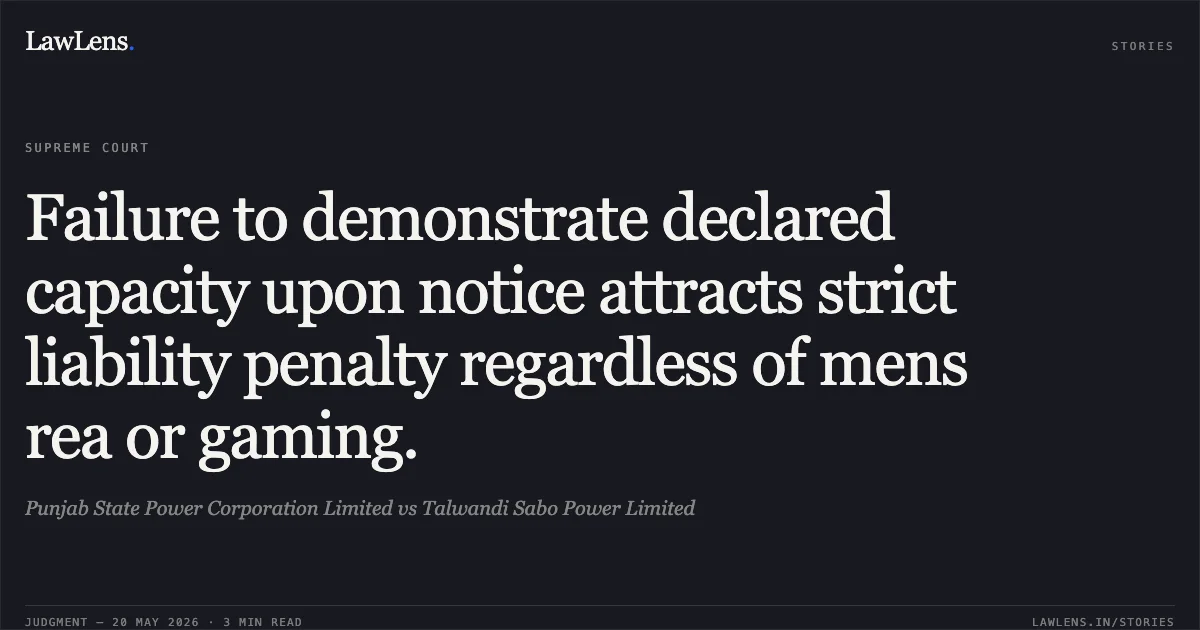
The Supreme Court held that the SERC and APTEL erred by conflating "Gaming" with "Demonstration of Declared Capability".
Source reference: p. 20Regulation 11.3.13 is a standalone provision creating strict civil liability; the penalty is triggered by the mere factual failure to demonstrate capacity upon request, regardless of whether the generator intended to cheat or lacks coal/machinery.
Source reference: p. 21, 28The Court rejected APTEL's view that no timeframe exists for demonstration, ruling that Regulation 11.5(xi)—which mandates a 4-time-block window for "better system operation"—governs the alacrity required for such demonstrations to ensure grid integrity.
Source reference: p. 22-23Factual analysis showed that TSPL failed to achieve its DC within the 4th time block (or at all) on the specified dates, even seeking downward revisions after receiving demonstration notices.
Source reference: p. 31-33The Court further clarified that DSM Regulations (regarding deviations) do not shield a generator from misdeclaration penalties under the SG Code.
Source reference: p. 24Holding
The Supreme Court allowed the appeals, set aside the APTEL order, and restored the SERC’s order affirming the penalty. It held that failure to demonstrate DC attracts a mandatory penalty as a civil liability where mens rea is irrelevant.
The SGS was ordered to refund the penalty amounts and pay any surcharges/interest to the PSPCL that accrued following the APTEL’s erroneous reversal.
Source reference: p. 33-34The Court clarified that while "Gaming" requires an inquiry into intent, "Failure to Demonstrate" is a matter of objective fact determined by the 4th-time-block rule.
Source reference: p. 25, 31Acts & Sections Cited
2 provisions across 2 statutes referred to in this judgment. Each provision opens on LawLens.
Electricity Act, 20031
Central Excise Act, 19441
Original Court PDF
Punjab State Power Corporation LimitedvsTalwandi Sabo Power Limited
Click to open original judgment
Original judgment, available to read, download and summarize on LawLens.in