Facts
The Respondent filed a complaint under Section 138 of the Negotiable Instruments (NI) Act, alleging that the Petitioner borrowed an interest-free loan of ₹15 lakhs in cash in February 2020 through the Petitioner's childhood friend (Respondent’s father)
Source reference: p. 2To discharge this liability, the Petitioner issued a cheque dated 30.03.2021, which was returned with the remark "funds insufficient"
Source reference: p. 2The Petitioner contended that the cheque was a blank security cheque given for a chit fund transaction and had been misused
Source reference: p. 3The Trial Court convicted the Petitioner on 15.12.2022, ordering a fine of ₹15 lakhs plus 9% interest, which was subsequently upheld by the Appellate Court on 08.11.2023
Source reference: p. 2The Petitioner approached the High Court in revision.
Source reference: no citationIssues
1. Whether the concurrent findings of conviction by the lower courts suffer from perversity or illegality warranting interference under revisional jurisdiction
Source reference: p. 5, para. 112. Whether the Petitioner successfully rebutted the statutory presumption under Section 139 of the NI Act regarding the existence of a legally enforceable debt
Source reference: p. 6, para. 13-153. Whether the non-disclosure of the loan in Income Tax Returns (ITR) or the Complainant’s alleged lack of financial capacity invalidates the proceedings under Section 138
Source reference: p. 7-8, para. 17-18Law Applied
Section 138 of the NI Act, outlining the six essential ingredients for the offence
Source reference: p. 5-6, para. 12Sections 118(a) and 139 of the NI Act, which mandate a presumption that a cheque is issued for consideration and in discharge of a debt once signatures are admitted
Source reference: p. 6, para. 13The court cited Rajesh Jain v. Ajay Singh (2023) to emphasize that once the presumption is activated, the evidential burden shifts to the accused to provide a "probable defense"
Source reference: p. 6, para. 14Regarding revisional limits, it applied Malkeet Singh Gill v. State of Chhattisgarh (2022), holding that the court cannot reappreciate evidence unless findings are wholly unreasonable
Source reference: p. 5, para. 11Reasoning
The Court observed that the Petitioner admitted his signatures on the cheque, thereby triggering the Section 139 presumption
Source reference: p. 6, para. 13The Petitioner’s defense regarding the "chit fund" and "misplaced cheque" was found to be a bare assertion unsupported by evidence, such as police complaints or "stop payment" instructions
Source reference: p. 8-9, para. 19-20Regarding financial capacity, the Complainant produced bank passbooks [Ex. CW-1/2] showing the withdrawal of funds sourced from a relative, which the Petitioner failed to effectively challenge during cross-examination
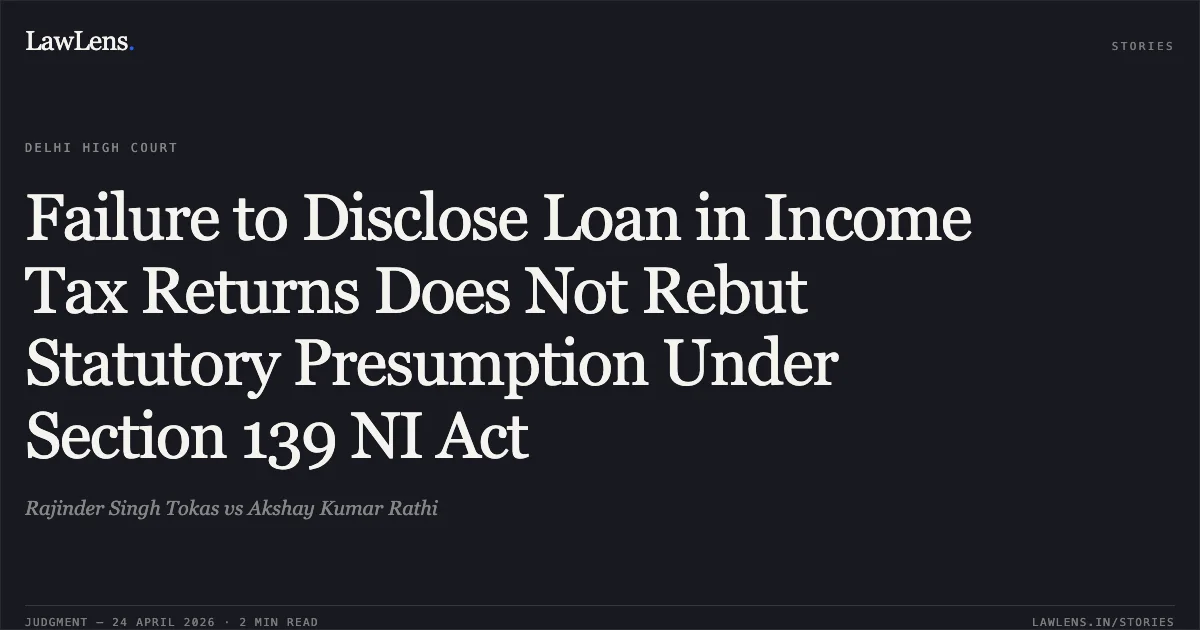
Source reference: p. 7, para. 17Finally, the Court ruled that while non-disclosure of a loan in ITR may attract penalties under Income Tax laws, it does not render a debt legally unenforceable for the purpose of Section 138
Source reference: p. 8, para. 18Holding
The High Court dismissed the revision petition, answering that there was no illegality or perversity in the lower courts' findings
The Court held that the Petitioner failed to discharge the burden of proof to rebut the statutory presumption
Source reference: p. 7, para. 15The conviction and the order passed by the learned Additional Sessions Judge dated 08.11.2023 were upheld
Source reference: p. 9, para. 21-22Acts & Sections Cited
5 provisions across 2 statutes referred to in this judgment. Each provision opens on LawLens.
Code of Criminal Procedure, 19732
Negotiable Instruments Act, 18813
Original Court PDF
Rajinder Singh TokasvsAkshay Kumar Rathi
Click to open original judgment
Original judgment, available to read, download and summarize on LawLens.in


